The United States and Iran signed an agreement on June 17 to end the nearly four-month-long war, a U.S. official told The Epoch Times.
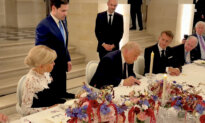
The memorandum of understanding—which involves reopening the Strait of Hormuz, Tehran halting its nuclear weapons program, and potential future economic relief if Iran adheres to the United States’ demands—is now in effect, after President Donald Trump signed it while in Versailles for the annual G7 leaders summit.
Details of the interim deal were revealed by a senior U.S. official in a call with reporters earlier Wednesday.
The agreement entails Iran immediately reopening the strait without tolls during a 60-day period of negotiations.
Iran also agreed to, at a minimum, reduce its stockpile of enriched uranium.
If Iran responds favorably, the deal will allow for future economic relief from regional partners in the form of a $300 billion reconstruction fund for damage incurred during the war.
A U.S. official had said that the United States will not be directly contributing money to the fund—only helping with its development—and would instead permit sanctions relief if Iran complies with the deal. This could be in the form of a neighboring nation, such as the United Arab Emirates, building a power plant in Iran.
Furthermore, the agreement would allow Iran to sell its oil without restrictions, and the 60-day window would be used for negotiations on the country’s nuclear program.
A senior official said that once all parties signed and ratified the memorandum of understanding, the United States would begin removing its naval blockade around Iran.
The final plan won’t be implemented until after the 60-day window, according to the deal, and the United States will grant any licenses, waivers, or permissions that are required for the relevant financial transactions.
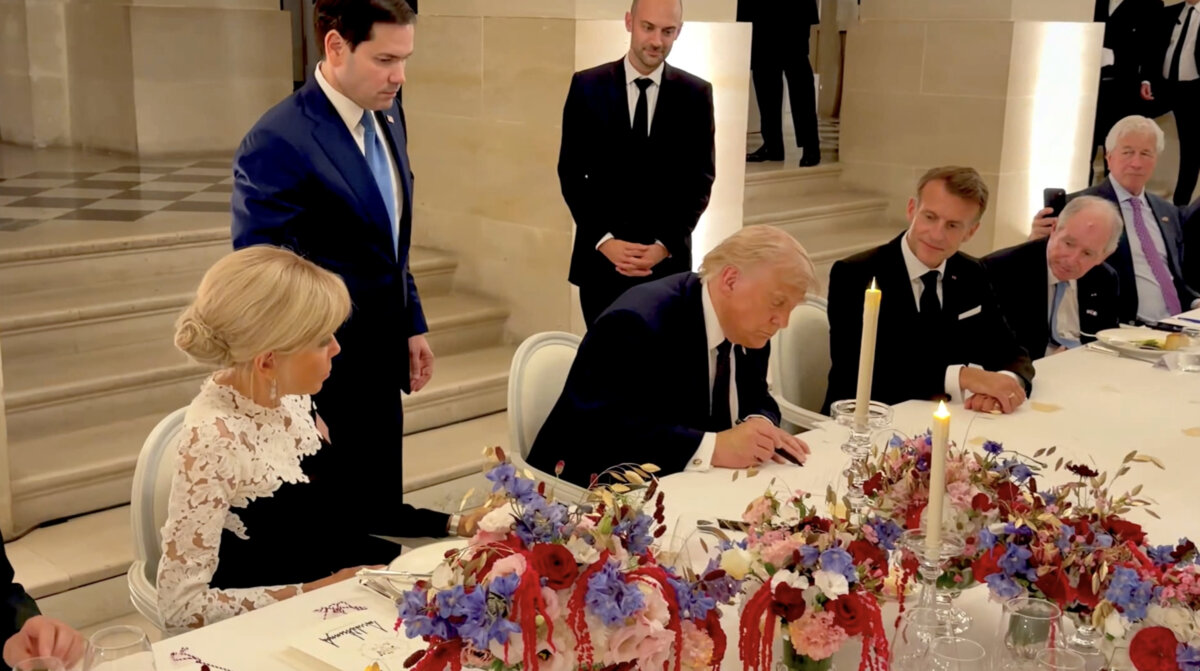
Deputy Chief of Staff Dan Scavino posted a video on X of Trump signing the deal in Versailles, with French President Emmanuel Macron sitting directly to his left, followed by applause.
“Good job, great job,” Macron could be heard saying.
Trump handed the agreement to Secretary of State Marco Rubio, then shook Macron’s hand. More applause followed.
“It’s signed,” Trump said as he left Versailles. “I signed it in Versailles. … Just signed it.”
Pakistani President Shehbaz Sharif, who has been a key moderator in the talks between Iran and the United States, also announced the signing in a post on X, saying it “demonstrates the commitment of both sides to a diplomatic resolution of the conflict.”
“I offer my heartfelt congratulations and sincere appreciation to the President of the United States, Donald J. Trump whose steadfast commitment to diplomacy and preference for peaceful resolution have once again helped end a conflict that could have led to devastating consequences for the region and beyond,” Sharif wrote.
The Pakistani president commended Vice President JD Vance, special envoy to the Middle East Steve Witkoff, and special envoy for peace Jared Kushner for their “invaluable contributions.”
Sharif also expressed his appreciation to Iranian Supreme Leader Seyyed Mojtaba Hosseini Khamenei and President Masoud Pezeshkian for their “wisdom, foresight and statesmanship in embracing the cause of peace,” and the rest of the Iranian negotiating team whose “patience, perseverance and commitment to constructive engagement were instrumental” to bringing the deal to fruition.
Qatar, Saudi Arabia, Turkey, and Egypt were also acknowledged by Sharif for their roles in the signing of the deal.
“May this Memorandum of Understanding serve as an enduring foundation for greater understanding, mutual respect and shared prosperity for the complete region,” Sharif said.
Co-mediator Qatar will host a formal ceremony on Friday in Switzerland to commemorate the signing and commence with “the technical level talks,” Sharif said.
Speaking at the annual G7 Summit earlier Wednesday, Trump said the memorandum was likely to be signed by Thursday or Friday and that Iran had “been acting very appropriately.”
The U.S. president warned that if negotiations collapse within the 60-day period or if Iran does not fulfill its end of the now-signed memorandum, then “we go back to bombing.”
Sen. Josh Hawley (R-Mo.) spoke about details of the memorandum of understanding earlier Friday and said he does not think it requires any congressional action.
“It never has in the past,” Hawley said. “Number one, I’m glad the Strait is reopening. I hope that that’s happening, that’s important in my state. Number two, I’m glad that their nuclear program is under rubble and presumably will stay that way.”
Although Hawley said he doesn’t know the details of the agreement yet, he said Wednesday’s signing was a promising step, especially if it’s in the best interest of the United States.
“I’m absolutely good with this. I’m good with the ceasefire extending,” Hawley said. “I’m good with the strait reopening. All of that is good news, and if that means—and I hope it will—gas prices, diesel prices, and in my state fertilizer prices come down, that’s good.”
Nathan Worcester and The Associated Press contributed to this report.
 Friends Read Free
Copy
Facebook
Tweet
Friends Read Free
Copy
Facebook
Tweet