
U.S. lawmakers are weighing visa restrictions, sanctions, and trade leverage against European officials accused of pressuring technology companies to censor online speech protected under the First Amendment.
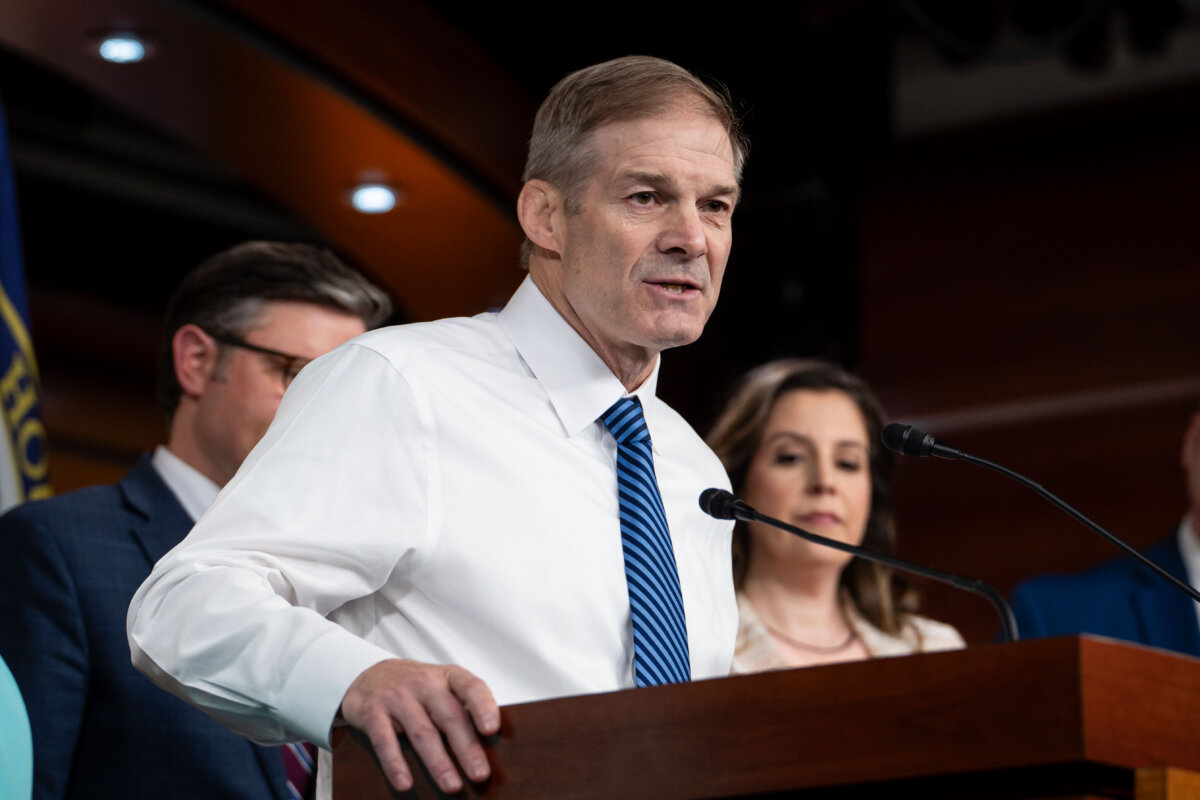
According to comments by Rep. Jim Jordan (R-Ohio), chairman of the House Judiciary Committee, U.S. authorities are examining “every possible route” to counter what Republicans describe as a sustained European campaign to influence global online speech.
Jordan said sanctions and trade negotiations were also under consideration, during an exchange with journalist Michael Shellenberger, posted to X on Feb. 5.
‘Every Possible Route’
In a follow-up question also aimed at UK officials, Jordan said that if a person who wants to visit the United States were determined by the State Department to have been involved in censoring American speech, he or she could be denied a visa.
“We’re looking at every possible route, negotiations, when it comes to trade talks, visas … we’re looking at all that,” he said.
The comments followed the release of a Feb. 3 report by the House Judiciary Committee alleging that the European Commission (EC) has driven global online censorship through closed-door regulatory forums and so-called voluntary codes that pressured major technology platforms to tighten content moderation rules.
The EU has rejected the allegations.
The committee accused the EC of conducting a decade-long campaign to shape global speech norms in ways that infringe on Americans’ constitutional protections, arguing that “voluntary” compliance mechanisms functioned as coercive tools backed by the threat of fines or market exclusion.
According to the report, pressure on platforms intensified after the EU’s Digital Services Act (DSA) was signed into law in October 2022.
The EC allegedly warned companies that they would need to change their globally applicable content moderation rules to comply with the DSA or face fines of up to 6 percent of global revenue and possible bans from the European market.
The House Judiciary Committee said in a statement that in more than 100 closed-door meetings since at least 2020, the EC, the executive arm of the EU, “repeatedly pressured platforms to change their globally applicable content moderation rules to more aggressively censor content and directly infringe on Americans’ online speech in the United States.”
One internal Google email referenced by the committee stated that Google staff discussed internally that they “don’t really have a choice” about whether to participate in a Disinformation Code subgroup meeting.
Censored subjects in the name of “combating hate speech and disinformation” included the COVID-19 pandemic, mass migration, and transgender issues, the committee said.
“The European Commission is specifically focused on censorship of U.S. content,” the committee stated in the report.
State-Level Countermeasures
Jordan also told Shellenberger that he would look into the GRANITE Act. The GRANITE Act is proposed legislation to protect U.S.-based individuals and platforms from foreign censorship and extraterritorial content regulation.
Lawyer Preston Byrne told The Epoch Times by email that his state-level legislative push could serve as a template for a broader American response.
“The Wyoming GRANITE Act, if enacted, would enter into force on July 1st,” he said.
“We expect that if it were enacted that large U.S. internet companies being targeted by foreign censorship agencies would begin relocating servers to Wyoming data centers immediately to prepare for its entry into force so that they could benefit from the shield.”
Byrne said that the GRANITE Act imposes a “penalty for even threatening an American citizen.
“If [foreign censorship agencies] send any communication attempting to enforce a censorship law on a U.S. persons, Americans can answer that communication with a lawsuit,” he said.
DSA-style systems “are designed as intimidation rackets,” Byrne said, and the GRANITE Act is one of a possible range of solutions “under consideration by the U.S. Congress.”
“GRANITE breaks those systems and forces censors to go back to the drawing board—if they want to carry out censorship in a post-GRANITE world without risking a titanic U.S. lawsuit, they’ll need to do it themselves by serving orders directly on their own ISPs,” he said.
“If they want the censorship, they’ll have to go all the way, and accept the political consequences of doing so, or abandon the project.”
The Epoch Times contacted the EC for comment but received no response.
An EC spokesperson previously told The Epoch Times by email that the censorship allegations “are pure nonsense” and “completely unfounded.”
“Look at public indexes online on freedom of expression,” she said. “All top countries on that list come from one part of the globe: Europe.”
 Friends Read Free
Copy
Facebook
Tweet
Friends Read Free
Copy
Facebook
Tweet