
Speculation has mounted in recent weeks about a proposed transit corridor that would link Azerbaijan to its Nakhchivan exclave through Armenia’s southern Syunik province.
There have also been signs that Washington seeks to play a role in the transit scheme, which Azerbaijan and its ally, Turkey, refer to as the “Zangezur corridor.”
Last month, Thomas Barrack, Washington’s envoy to Turkey, raised eyebrows when he suggested that the United States could lease the proposed corridor for a 100-year period.
Nothing has been announced officially, according to Matthew Bryza, a former U.S. ambassador to Azerbaijan.
“Based on my experience negotiating these sorts of things in these countries, nothing’s been agreed,” he told The Epoch Times.
Nevertheless, the leaders of Armenia and Azerbaijan have both responded to the U.S. proposal, which has also drawn the attention of Moscow and Tehran.
The Zangezur corridor was first proposed by the Turkish and Azerbaijani governments in 2020 after Azerbaijan, with Turkish support, retook the Nagorno-Karabakh region from Armenia after almost three decades.
Turkey shares a short but significant border with Azerbaijan’s Nakhchivan exclave.
Turkey views the proposed corridor as a means of projecting its influence eastward by creating a land bridge to Azerbaijan, via southern Armenia, and on to the Caspian Sea.
Armenia, whose borders with Turkey and Azerbaijan have been closed since 1993, is now in the process of normalizing ties with both countries after decades of war and mutual hostility.
In March, Armenia and Azerbaijan agreed on the draft of a final peace settlement, although several outstanding differences still must be ironed out.
Within the framework of the normalization process, Armenia has signaled its openness to the corridor scheme but insists on retaining control over the part of the route that would run through its territory.
An Unexpected Proposal
Speaking to reporters on July 11, Barrack, Washington’s envoy to Turkey, said Azerbaijan and Armenia are “arguing over 32 kilometers [about 20 miles] of road … It’s been going on for a decade.”
“So what happens is, America comes in and says, ‘Okay, we’ll take it over. Give us the 32 kilometers of road on a 100-year lease, and you can all share it,” Barrack said.
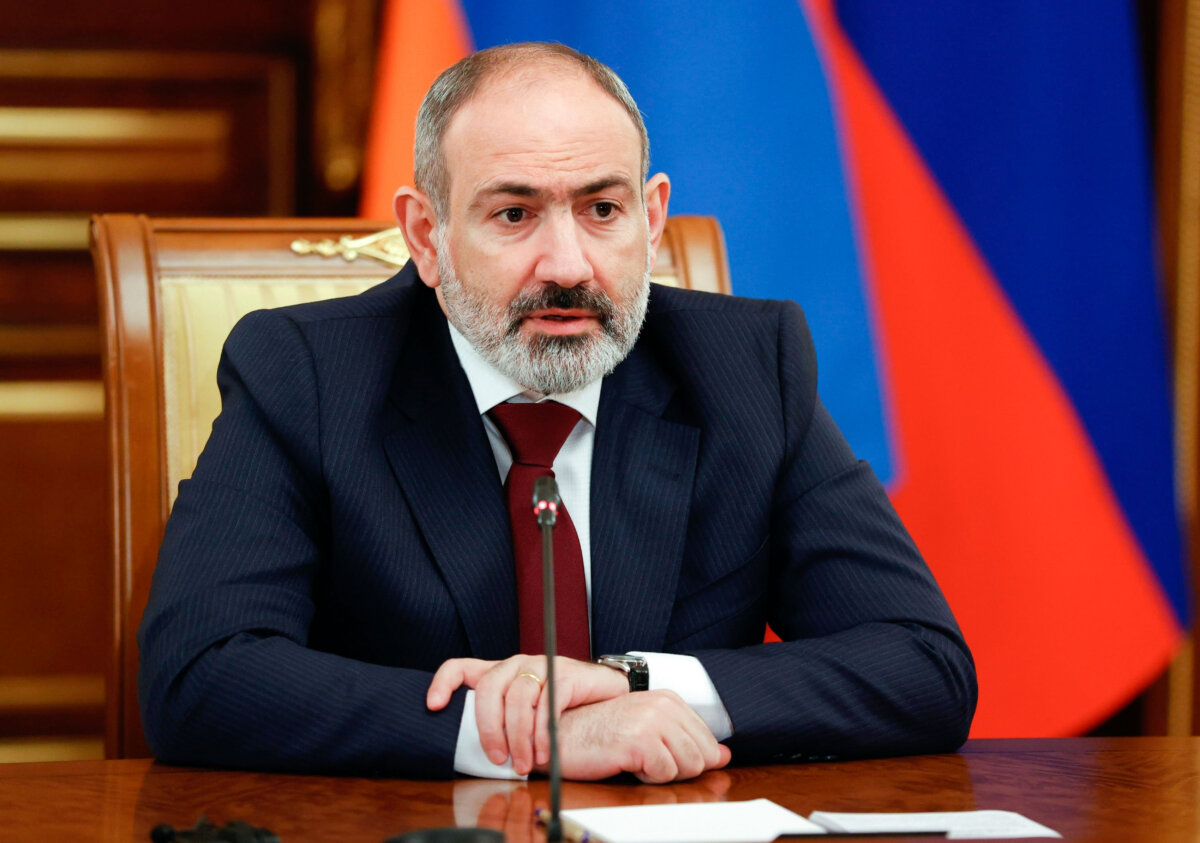
Five days later, Armenian Prime Minister Nikol Pashinyan confirmed that the proposed corridor could take the form of a “joint Armenian–American enterprise.”
“Whatever option is discussed, we consider it within the framework of the sovereignty and jurisdiction of the Republic of Armenia,” Pashinyan said in remarks carried by Armenian media outlets.
“We are discussing who will offer the best conditions and what the agreement will cover.
“At the moment, the proposal is from the United States, and we are discussing it.”
On July 21, a spokeswoman for Pashinyan reiterated the Armenian government’s willingness to “ensure transport connection through its territory between the western regions of Azerbaijan and the Nakhchivan Autonomous Republic.”
Quoted by Armenia’s Armenpress news agency, she also stressed that the transit scheme must conform to “the two countries’ territorial integrity, sovereignty, jurisdiction, and reciprocity.”
Azerbaijan has taken a harder line, ruling out any Armenian control over the corridor or its operations.
“Azerbaijani cargo and Azerbaijani citizens should not have to face Armenian border security—or anyone else, for that matter,” Azerbaijani President Ilham Aliyev told reporters on July 19.
Asked about the U.S. proposals to lease the corridor, Aliyev said: “On our territory, there will be no operator, no lease, no rent. We do everything ourselves.”
According to Bryza, the parties involved “are probably negotiating a concept other than a lease—maybe just operational rights of a U.S. logistics company to administer and operate the corridor.”
“The idea of leasing Armenian territory in Syunik province is also objectionable to Armenia,” he said, noting that the two countries “have fought two wars precisely over the sovereignty of their territories.”
Stanislav Pritchin, head of the Central Asia desk at Moscow’s Institute of World Economy and International Relations, said the U.S. proposal is still in the negotiating phase.
“Like everything between Armenia and Azerbaijan, the Zangezur corridor will remain the subject of lengthy disputes and differences of opinion,” he told The Epoch Times.
Pritchin said he believes that the U.S. proposal to lease the transit route was intended to “test the waters” and “gauge the reactions” of the parties involved.
Moscow, Tehran on Alert
The governments of Russia and Iran, meanwhile, are both wary of the proposed corridor, a section of which, if established, would run directly along Iran’s northern border.
This would threaten the two countries’ north–south trade link through Armenia, especially if the United States—their common adversary—was directly involved.

On July 27, Ali Akbar Velayati, a top adviser to Iran’s supreme leader, asserted that the nascent corridor scheme was a cover for “broader geopolitical projects.”
In remarks cited by Iran’s Tasnim news agency, he said the project sought to “sever Iran’s link with the Caucasus and impose a land blockade on Iran and Russia in the region’s south.”
Last month, a Kremlin spokesman said ongoing discussions about the corridor were “strictly a sovereign matter between Armenia and Azerbaijan.”
Days later, however, a Russian Foreign Ministry spokeswoman repeated claims that NATO was seeking to gain a “foothold” in the South Caucasus region with the aim of igniting a “geopolitical confrontation” with Russia.
Moscow’s relations with Armenia and Azerbaijan have deteriorated in recent months amid signs that both countries—despite their historical rivalry—are drifting further into the Western camp.
“It’s not a good idea to transfer responsibility for a strategic corridor to an external player and a geopolitical adversary of the corridor’s potential users,” Pritchin said.
“I doubt that Iranian [transport] companies, or Russian and Chinese ones, would use the corridor if it were operated by the United States.”
According to Bryza, the U.S. proposal is likely a “purely transport-related project without geopolitical objectives—other than the Trump administration’s belief, like in the case of the Ukraine minerals deal, that the presence of U.S. investors or U.S. companies … is itself an expression of U.S. influence.”
“I’ve never heard any credible reports of this having some sort of U.S. military angle,” said Bryza, who sits on the board of the Jamestown Foundation, a Washington-based think tank devoted to defense policy issues.
“I can’t believe Armenia or Azerbaijan would accept that. Certainly, Russia and Iran would oppose it.”
He said he believes that the lease proposal was “something that came up among the property developers that are running U.S. foreign policy now.”
“The State Department and others that are normally involved in U.S. foreign policymaking are not really involved,” Bryza said.
“This enables some strategic concepts, like the Zangezur corridor being leased, to make it to the top of the system without anybody saying, ‘Wait a second. … Leasing the sovereign territory of Armenia—and maybe Azerbaijan—really doesn’t make sense.’”
 Friends Read Free
Copy
Facebook
Tweet
Friends Read Free
Copy
Facebook
Tweet