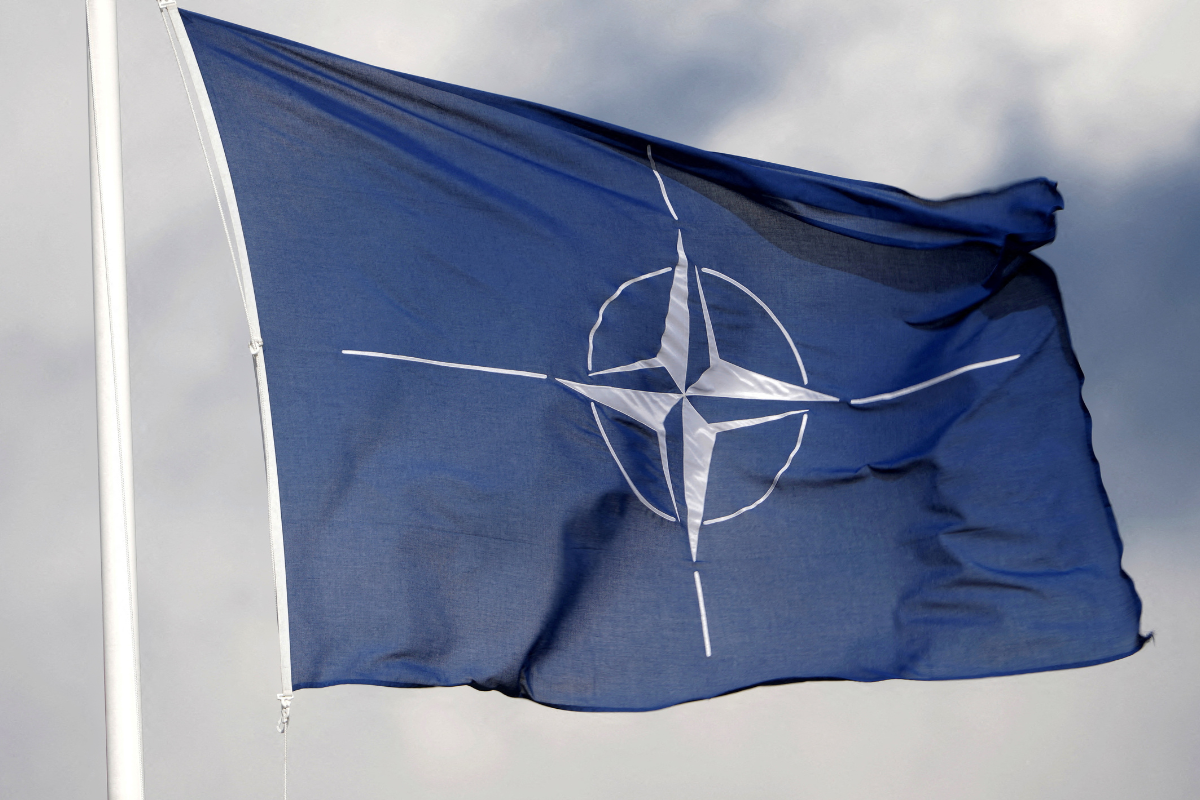

The United States has announced that it will be cutting its contributions to the NATO alliance, citing the “potential reality” of fighting multiple wars at once.
Officials from the U.S. Department of War notified allies on June 3 that Washington would “rightsize” its contributions to the NATO Force Model, “consistent with the burden sharing direction in the 2026 National Defense Strategy and the Department’s vision for a ‘NATO 3.0,'” according to a statement from the United States European Command (USEUCOM).
American officials first informed their fellow member states of the decision during a meeting of defense policy officials at NATO headquarters in Brussels on May 22.
USEUCOM Commander U.S. Air Force Gen. Alexus G. Grynkewich said in a statement that there had been an “unhealthy co-dependence” on American forces. He added that President Donald Trump and Secretary of War Pete Hegseth have “been clear that this needs to change, and it will change.”
“The potential reality of simultaneous conflict in multiple theaters demands it,” he added.
Grynkewich also said the change will strengthen the Alliance’s defense plans by making them more realistic. He said it would ensure that NATO is not overly reliant on U.S. forces, which are needed to maintain deterrence in other regions of the world and respond to changing global contingencies.
The move is also based on the premise that the European members of NATO and Canada are “increasingly capable of fielding the preponderance of forces required to defend the Alliance,” according to USEUCOM.
Grynkewich, who also serves as the Supreme Allied Commander Europe (SACEUR), noted the change was coordinated between his two commands—USEUCOM and Supreme Headquarters Allied Powers Europe (SHAPE)—over many months.
He said that a quick solution would be for other allies to boost their air and sea power.
“Two areas where Canada and European Allies can step up now and in the near term—as the United States reduces forces ‘sourced’ to the NATO Force Model in Europe and refocus them elsewhere—is with manned and unmanned aircraft, and with naval vessels,” Grynkewich said.
Allies again discussed the matter this week at SHAPE in Mons, Belgium, during a force sourcing conference over June 2–3.
“SHAPE continues to work with Allies to offset the reduced American capabilities,” said Grynkewich, who, as SACEUR, addressed representatives from the 32 militaries that make up the alliance at the conference.
“Allies have been stepping up. And nations have an opportunity to contribute and send a clear message of strength and commitment to our common defense ahead of July’s NATO Summit in Ankara.”
Shift in Priorities
The push for Europe to do more to secure its own defense came as the United States reoriented its defense and security priorities.
The Pentagon, on Jan. 23, released its National Defense Strategy, which outlines the U.S. plan to prioritize homeland defense, including by “defending America’s interests throughout the Western Hemisphere.”
It also stated that the United States would encourage partners in other parts of the world, including Europe, to take primary responsibility for their own defense “with critical but limited support from U.S. forces.”
In recent months, the Trump administration has vocalized its frustration with NATO due to members’ lack of support during the Iran war. This includes Spain, which closed its airspace to U.S. aircraft involved in the conflict.
On May 22, U.S. Secretary of State Marco Rubio said that the NATO alliance has to work for all members.
“Like any alliance, it has to be good for everyone who’s involved. There has to be a clear understanding of what the expectations are,” Rubio said.
“I don’t think anyone is shocked to know that the United States and the president, in particular, is very disappointed at NATO right now. … Why is NATO good for America? Because it gives us bases in the region that allow us to project power during a contingency in the Middle East or somewhere else,” he said.
“So, when that is the key rationale for why you’re in NATO, and then you have countries like Spain denying us the use of these bases, well then why are you in NATO?” Rubio added.
Victoria Friedman contributed to this report.
 Friends Read Free
Copy
Facebook
Tweet
Friends Read Free
Copy
Facebook
Tweet