
The United States will assign 200 troops from U.S. Central Command (CENTCOM) to be part of a joint task force to oversee Gaza stability, with no boots on the ground in the Palestinian enclave, the Trump administration said on Oct. 9.
Two senior administration officials confirmed the development to reporters one day after President Donald Trump announced that Israel and terrorist group Hamas had agreed to the U.S.-drafted plan to release the remaining hostages and implement a cease-fire between the two factions.
The troops will be tasked with monitoring the peace agreement in Israel while working with other international forces on the ground, White House press secretary Karoline Leavitt wrote on social media.
The soldiers are already stationed at CENTCOM, according to Leavitt. CENTCOM is one of the Department of Defense’s unified combatant commands and is responsible for military operations in the Middle East, North Africa, and portions of South and Central Asia.
The name comes from it covering the “central” area of the globe located between the European, African, and Indo-Pacific Commands. Its main headquarters is located at MacDill Air Force Base in Tampa, Florida.
The senior administration officials said the joint task force will include representatives from Egypt’s military, Qatar, Turkey, and likely also the United Arab Emirates.
A commander from CENTCOM will be there to “oversee, observe, [and] make sure there are no violations [or] incursions,” one of the officials said.
“No U.S. troops are intended to go into Gaza,” an official said. “It’s really just to help create the joint control center and then integrate all the other security forces that will be going in there to de-conflict with [Israel Defense Forces], and then to build the right force structure that’s able to handle the missions as they are defined.”
The exact location of the U.S. troops has yet to be decided, but the officials said they would have more information on that soon.
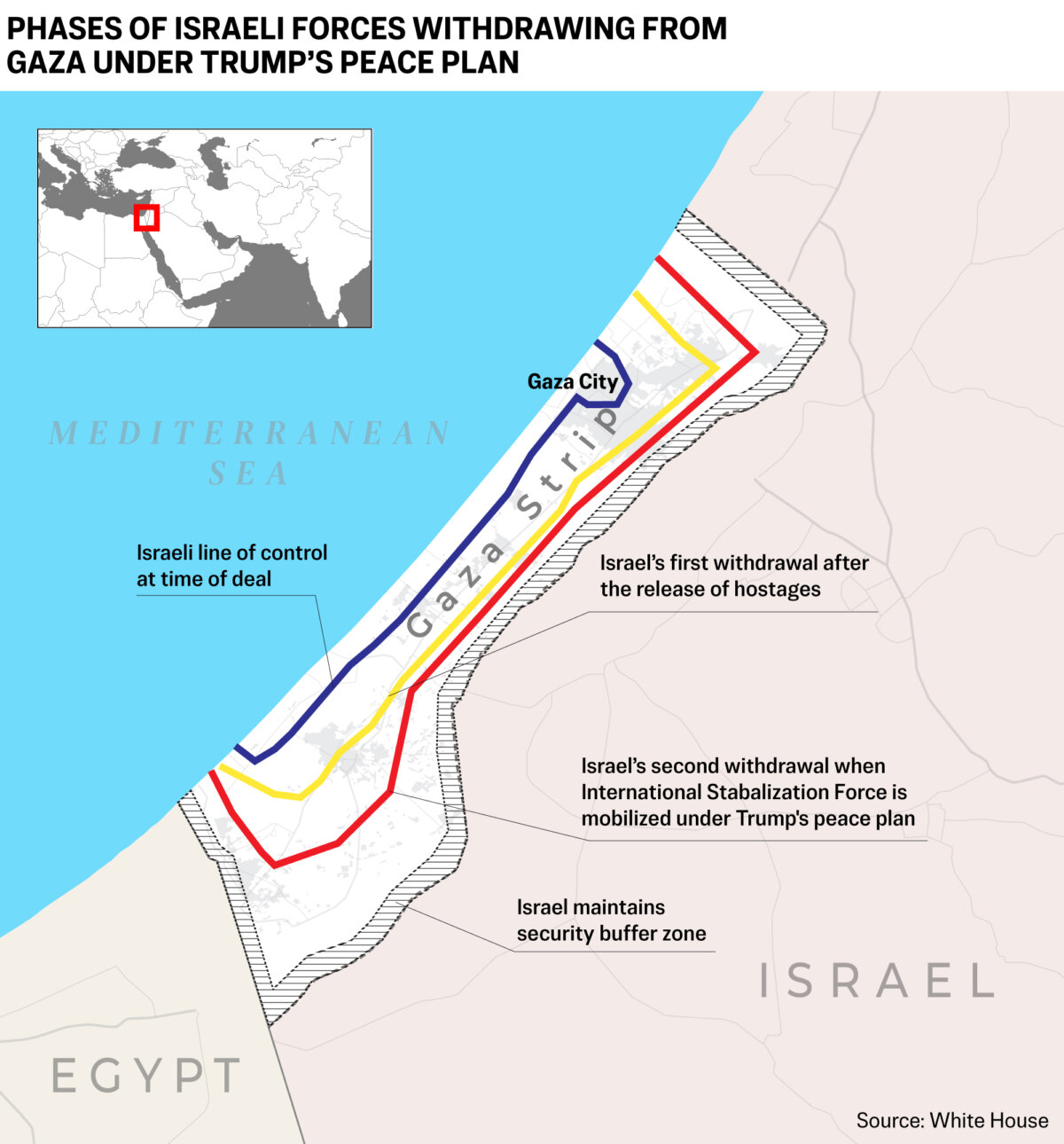
The officials said the major breakthrough in negotiations between Israel and Hamas came when they split the deal into two phases, with the hostage release coming first.
“Because we had to realize that [Hamas] didn’t need hostages necessarily to enforce a view of theirs, that it was better for them to concede their release was a positive thing, that better things would happen as a result of that decision on their part. And that took a lot of trust-building,” an official added.
“I think [the agreement] was so comprehensive—the engagement, so interactive—that we just got ourselves to that place, and then everybody could see the line, and they wanted to cross it.”
Not long after the officials spoke to reporters about the negotiations, Israeli Prime Minister Benjamin Netanyahu’s office announced that his nation’s cabinet had approved the “framework” of a deal between Israel and Hamas to release the hostages and implement a cease-fire.
 Friends Read Free
Copy
Facebook
Tweet
Friends Read Free
Copy
Facebook
Tweet