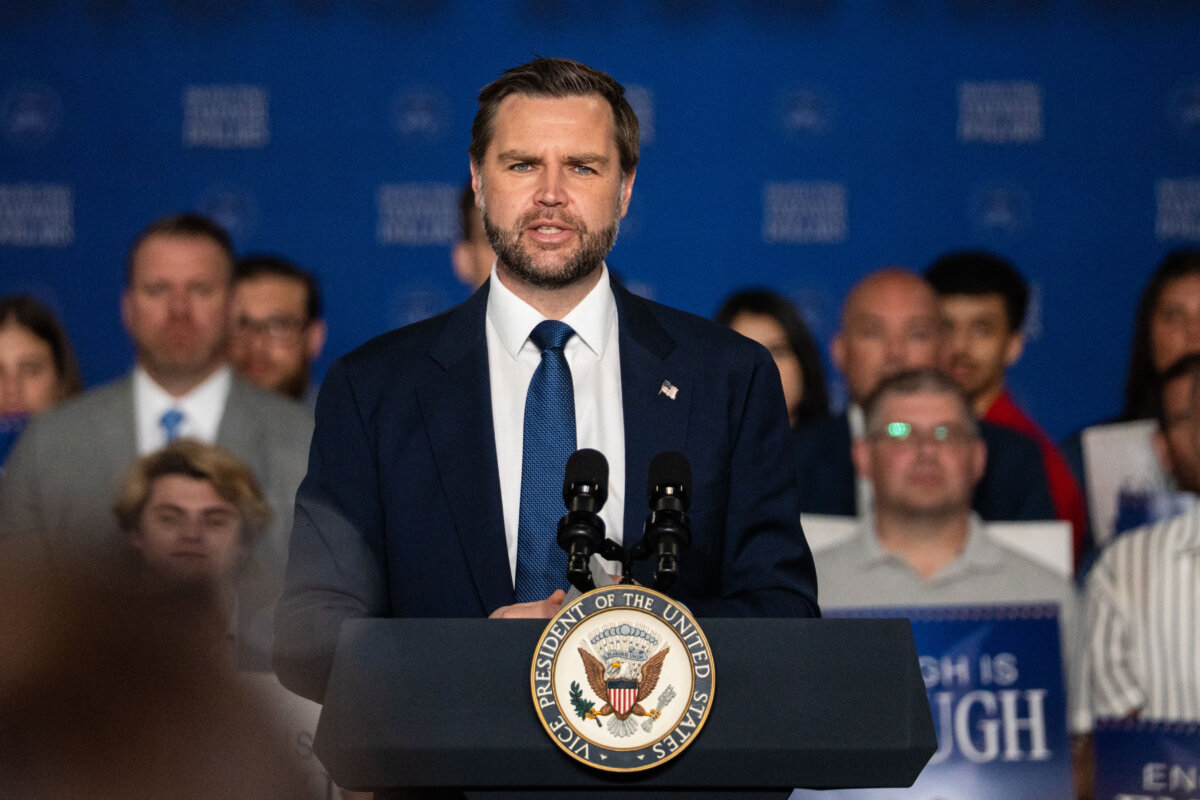

Vice President JD Vance has said that planned talks in Switzerland to negotiate the technical details of a long-term deal with Iran will still go ahead, but the exact date has not yet been determined.
Vance said on June 18 that negotiations are likely to begin this weekend, but plans could change depending on when the Iranians are able to attend.
The vice president had planned to travel to Switzerland on Friday for a ceremony marking the signing of a memorandum of understanding (MOU) between the United States and Iran. However, the agreement was already signed by U.S. President Donald Trump and Iranian President Masoud Pezeshkian. Trump added his signature during a dinner in Versailles on Wednesday night.
“Our plan is to go to Switzerland, I don’t know exactly when,” Vance said during a White House press briefing.
He said that the talks will tackle the “nitty gritty” technical questions, such as how to destroy Iran’s highly enriched uranium. “We’re going to have people on the ground actually driving the technical talks, the nuclear talks,” he said.
The MOU establishes a 60-day negotiation period during which both countries will work toward a final agreement to end the conflict and resolve issues related to Iran’s nuclear program.
“The deal started yesterday, we’re going to start the 60-day clock today,” Vance said.
Commercial ships will be allowed to freely travel through the Strait of Hormuz during the 60-day negotiation window, ensuring uninterrupted passage between the Persian Gulf and the Sea of Oman.
Vance said that international waterways “should be free of tolls” and that the final negotiation will set the terms of what comes after those 60 days. Vance said the U.S. military blockade of Iran has been lifted.
Under the interim deal, Iran also agreed to down-blend its stockpile of highly enriched uranium. If both sides uphold their commitments and the negotiations are successful, the United States will move forward with a final agreement that includes sanctions relief for Iran.
Vance said that if the Iranian regime changes its behavior, it would transform the Middle East for a generation. “If they don’t change their behavior, they don’t get the benefit of the bargain,” he said.
The memorandum allows Iran to resume sales of crude oil, petrochemical products, and related goods, providing significant economic relief. It also includes waivers covering essential sectors such as banking, transportation, and insurance to facilitate those sales.
Vance dismissed critics who said that Iran is getting rewarded in advance.
“This idea that the Iranians get all these benefits before the deal is actually consummated, the idea that they get benefits before they change their behavior, is fundamentally a talking point that is issued by people who want the conflict to continue indefinitely, despite the fact that that’s not good for the American people, and it’s not good for the region,” he said.
Vance said that the purpose of U.S. oil sanctions on Iran was “to drive down how much Iran is charging for a price for a barrel of oil. Those sanctions had stopped being effective. The blockade is what’s effective.”
Under the agreement, Iran reaffirms its commitment not to attempt to acquire or develop nuclear weapons. The dilution of its highly enriched uranium stockpile will be carried out under the oversight of the International Atomic Energy Agency (IAEA), the United Nations’ nuclear monitoring body.
Vance said Iran’s nuclear weapons program has been destroyed. “If the Iranians decided tomorrow to build a nuclear weapon, they simply don’t have the capacity.”
If a final agreement is reached, the United States will lift all primary and secondary sanctions on Iran. The final accord would also prevent the imposition of new U.S. sanctions and could lead to the release of frozen Iranian assets.
Vance said there were key differences between the MOU and the 2015 Iran nuclear deal.
One is that Gulf countries “hated” the 2015 accord, Vance said. “They felt like it empowered the Iranians to be bad actors across the region, and of course that’s exactly what happened.”
“What are they saying about the president’s peace deal? They’re saying this is an amazingly transformative thing for the region, because either way, we and the broader region win.”
Another is that the 2015 deal allowed some enrichment, whereas the MOU does not.
“The Obama deal allowed the accumulation of stockpiled weapons-grade material,” he said. “Ours is actually leading to the destruction of that stockpile.”
Iranian Supreme Leader Ayatollah Mojtaba Khamenei said on Thursday in a statement read by state media that he supports direct negotiations with the United States.
“It is obvious that the face-to-face negotiations that will be held in the future will not mean accepting the enemy’s opinion,” he said.
It was Khamenei’s first response to the MOU. Khamenei has not been seen in public since he was wounded in a strike at the beginning of the war.
 Friends Read Free
Copy
Facebook
Tweet
Friends Read Free
Copy
Facebook
Tweet