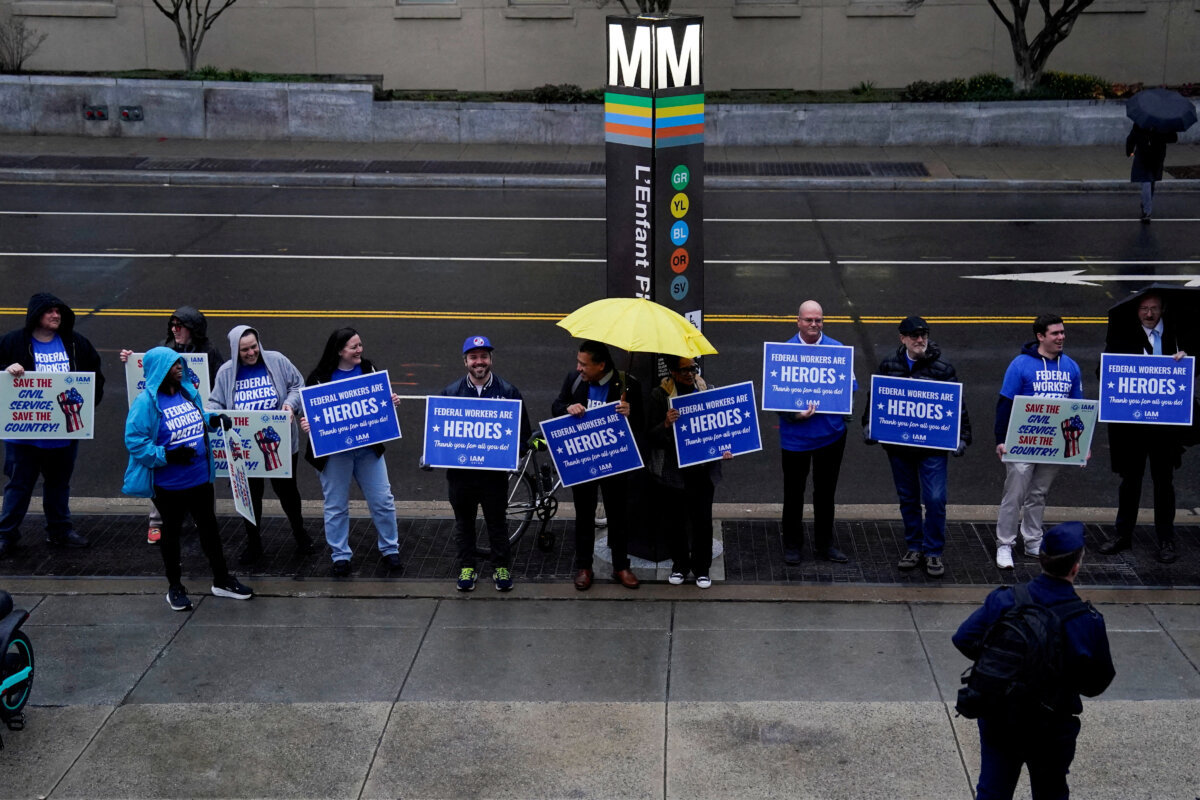

President Donald Trump can prevent some federal employees from unionizing, a federal appeals court ruled on June 17.
The president is authorized in federal law to, for national security considerations, exclude agencies from coverage under laws recognizing a right to engage in collective bargaining, a unanimous panel of the U.S. Court of Appeals for the Ninth Circuit said.
The law states that the president can exclude an agency or subdivision if it is primarily involved in intelligence, counterintelligence, investigative, or national security work and that the union protections “cannot be applied to that agency or subdivision in a manner consistent with national security requirements and considerations.”
Trump in March 2025 signed an executive order excluding multiple agencies including the Department of Justice, and certain subdivisions. He cited the law in the order.
The American Federation of Labor and Congress of Industrial Organizations sued, alleging that the order was promulgated to punish them for constitutionally protected speech, and a federal judge ruled that the unions were likely to succeed in part because evidence indicated the administration was hostile to unions and the order had a “chilling effect” on their right to free speech.
The Ninth Circuit later in 2025 paused the preliminary injunction, stating that the president would have taken the same action regardless of rhetoric from a White House fact sheet on the order.
Judge Daniel Bress said in the new decision, which vacated the injunction, that the unions have not shown they are likely to succeed because Trump’s order did not contain any retaliatory animus.
Even if the fact sheet did express animus, it also outlines that the reason for the order was a national security focus, the judge said.
“In short, because [the order] has ‘a legitimate grounding in national security concerns, quite apart from any’ retaliatory animus, the government on the existing record has shown that the President would have taken the same actions in the absence of the asserted retaliatory intent,” Bress said.
Taylor Rogers, a White House spokesperson, told The Epoch Times in an email, “This decision confirms what we’ve said from the start: Executive Order 14,251 is a lawful national security measure, not a retaliation against federal unions.”
The American Federation of Labor and Congress of Industrial Organizations did not respond to a request for comment.
The ruling is not the final decision in the case, Judge John Owens noted in a concurring opinion. He said that the court was limited to reviewing the law as applied by the district court and the record as it now stands.
A decision on the merits of the case may include considering a more developed factual record, Owens said.
 Friends Read Free
Copy
Facebook
Tweet
Friends Read Free
Copy
Facebook
Tweet