
A senior minister in Vanuatu’s government has told Australia it must respect the Pacific nation’s plan to sign a new policing agreement with the Chinese Communist Party (CCP).
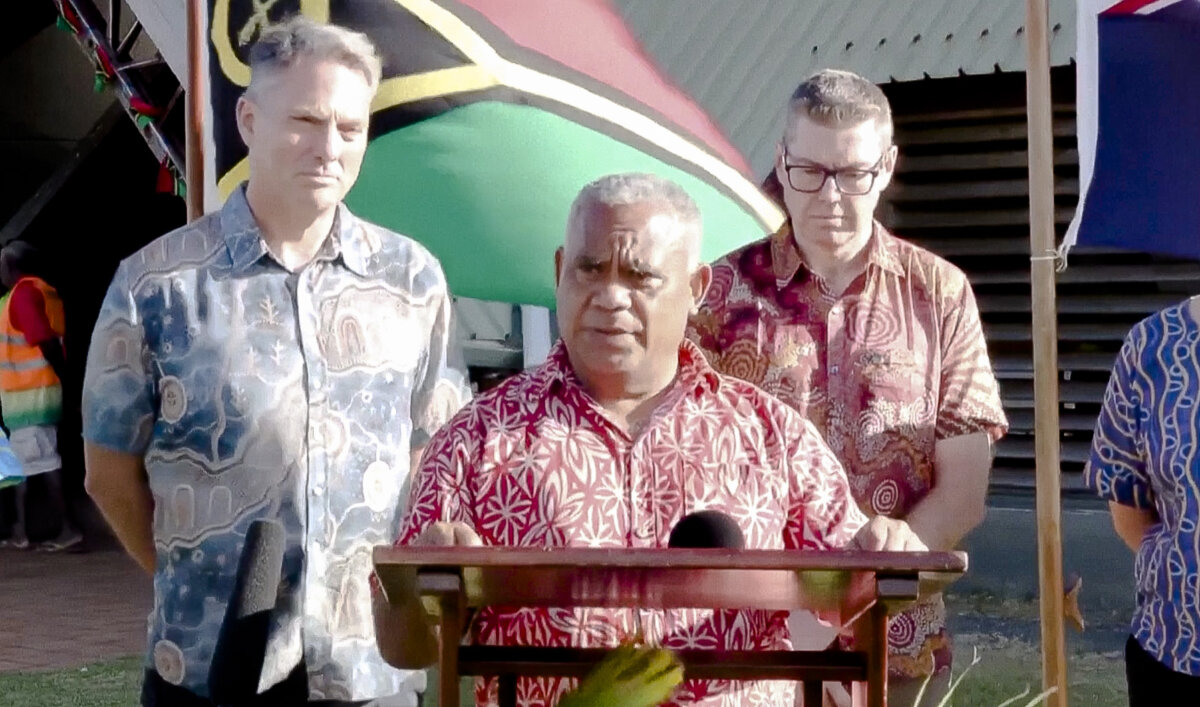
Internal Affairs Minister Andrew Napuat also singled out Australia’s Pacific Minister Pat Conroy over remarks he made about the deal.
Napuat met with CCP Councillor and Minister of Public Security Wang Xiaohong in Beijing on Sept. 19 and returned, stating that the two countries would sign a new Memorandum of Understanding (MoU) to strengthen Beijing’s police assistance programmes, including a new tranche of equipment such as INTERPOL systems, motorcycles, drones, and other gear worth $635,000 (US$416,000).
The agreement still needs sign-off from Vanuatu’s Cabinet.
Conroy attempted to portray it, in an interview with Sky News Australia, as being more of an aspiration for Napuat than a pending deal.
“The comments by that particular minister about wishing to explore a possible MoU with that country didn’t come as a surprise,” Conroy said. “We’ve been very open with the Australian people that we’re in a permanent state of contest in the Pacific to be the partner of choice in terms of security.
“We respect the sovereignty of the Vanuatu government and the Vanuatu people, and we’ll see what happens there.”
‘Arrogance and Ignorance’: Vanuatu Minister
However, Napuat appeared not to see it that way, telling the ABC those were “the kind of comments that are made from our friends that shows arrogance and ignorance of what we’re stating as a government.”
“I respectfully understand his freedom and his right to make those kind comments, but he also needs to respect the internal processes happening here, and then he needs to get his facts correct,” he said.
“We are deciding on this as a government; it is not a decision that comes from a single minister. It’s a decision we’re making collectively as a government. This is my piece of advice to my friend in Australia.”
He also denied the new agreement would embed a permanent Chinese police presence in Vanuatu.
“I wouldn’t say this is about formalising some kind of permanent presence whatsoever. This is a simple MoU that guides what we need to work on together,” he said. “Whenever we need them, we’re going to talk to them.”
Assuming the Vanuatu Cabinet agrees, the decision is another blow to Australia’s hopes of getting Vanuatu to sign the $500 million Nakamal Agreement, which was postponed in early September over concerns it would prevent other countries from providing Port Vila with assistance.
But Napuat said the two deals were not linked, and that Australian officials had been kept fully informed about the China policing MoU.
“Australia knew very well, and we were up front with them when we told them we are just wanting to sort out the way we manage our relations with our partners,” he said.
US Needs to Re-Engage in the Region
According to the Centre for Strategic and International Studies (CSIS), Beijing’s signing of such agreements—including one in February with the Cooks Islands that took Wellington completely by surprise—needs to be seen partly as a response to a shift by Australia to a more transactional, security-focused approach to the Pacific, and partly as taking advantage of what it sees as a period of uncertainty in terms of U.S. reliability in the region.
“As the United States rescinds or pauses virtually all its development assistance abroad, and while the Trump administration ponders downsizing diplomatic presence worldwide, it plays directly into the narrative of a disinterested and unreliable global power,” the Centre said in a report.
“This withdrawal from the Pacific has the potential to do far more than create a vacuum—it presents an open playing field, with many of the best defenders walking off the pitch.”
This will not only cause doubt in the region’s smaller capitals. Together with more militaristic actions, such as sailing warships down the Australian coast and engaging in two live-fire exercises, they are “a not-so-subtle way to exacerbate Australia and New Zealand’s greatest fears of being isolated, alone, and cut off in a time of conflict.”
In response, Washington must understand the importance of its engagements across the region for its own national security and that of its allies.
In a region where presence and relationships are the currency of influence, the pausing of U.S. foreign assistance is creating a “perception challenge.”
“U.S. efforts to engage with the Pacific should resume,” the Centre says.
Meanwhile, Australia needs to assert itself as a regional middle power by demonstrating to its neighbours that it is “a formidable military power that can more explicitly identify, shadow, and target Chinese forces that enter this vital region,” the report recommends.
 Friends Read Free
Copy
Facebook
Tweet
Friends Read Free
Copy
Facebook
Tweet