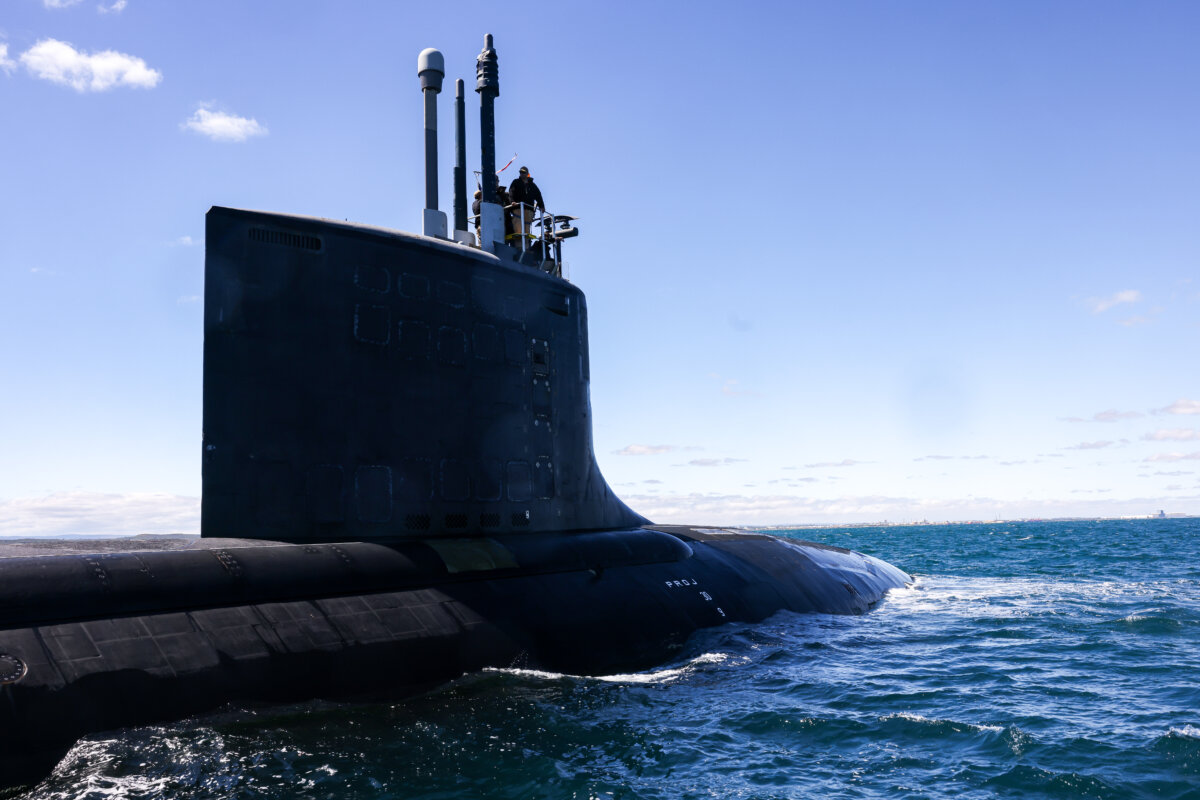

The three used submarines Australia will now receive as part of the first delivery under Pillar 1 of AUKUS will be around six years old, and will have a remaining life span of 20 years, says an Australian navy chief.
Vice-Admiral Jonathan Mead, head of the Australian Submarine Agency, was testifying at Senate Estimates about the change, which represents a major shift to how Australia would be armed under the 2023 trilateral AUKUS deal.
The original agreement was for one new and two in-service vessels, but Defence Minister Richard Marles announced last week that Australia will now receive three “in-service” submarines instead, which will be transferred around six years after they are first built, after undergoing extensive maintenance procedures in the United States.
Virginia-class submarines have an expected life span of 30 to 33 years.
Marles characterised AUKUS as a “very complicated endeavour” and said the acquisition of three in-service vessels represented “a much simpler pathway,” as it would mean all the submarines would be of the same type.
He also said it would result in cost savings, but Department of Defence officials were unable to tell senators how much would be trimmed when questioned earlier this week.
Meanwhile, Vice-Admiral Mead told the Senate Foreign Affairs, Defence and Trade Legislation Committee on June 3 that the change had come about as the result of “intense discussions” with the United States and, when asked when they began, said they had been going on since the start of last year.
Pressed by opposition defence spokesperson James Paterson as to whether the change came about under the Trump administration, Mikaela James, the agency’s acting head of policy, argued that the details should remain secret “as part of long-standing practice to keep confidential discussions between parties.”
Paterson objected to that, saying that was not a valid reason under the rules for estimates.
“The grounds are very clear,” he said. “If the information can’t be provided, [you] should make a public interest immunity claim and set out the specific harm that would arise. We’ve just heard there’s been a significant change.
“There’s been discussions with the Americans that commenced 18 months ago; they were very intense, we’re told. This is an enormous amount of taxpayers’ money and a critically important program for our national security. I think surely the public has a right to know.”
Eventually, it was decided the agency would take the question “on notice” and decide what, if anything, it could divulge at a later date.
Mead said constraints in America in 2023 meant it couldn’t agree to sell three in-service submarines, but that had changed over time.
“What was available to us then was the optimal pathway,” he said. “The very fact that we were able to get from the U.S., for the very first time … three Virginia-class submarines transferred to Australia is an astonishing achievement.”
He said that although submarine production rates were improving, America was still not producing enough vessels for its own needs.
U.S. Secretary of Defense Pete Hegseth announced last week that AUKUS will extend to the development of unmanned and underwater drones by 2027.
 Friends Read Free
Copy
Facebook
Tweet
Friends Read Free
Copy
Facebook
Tweet