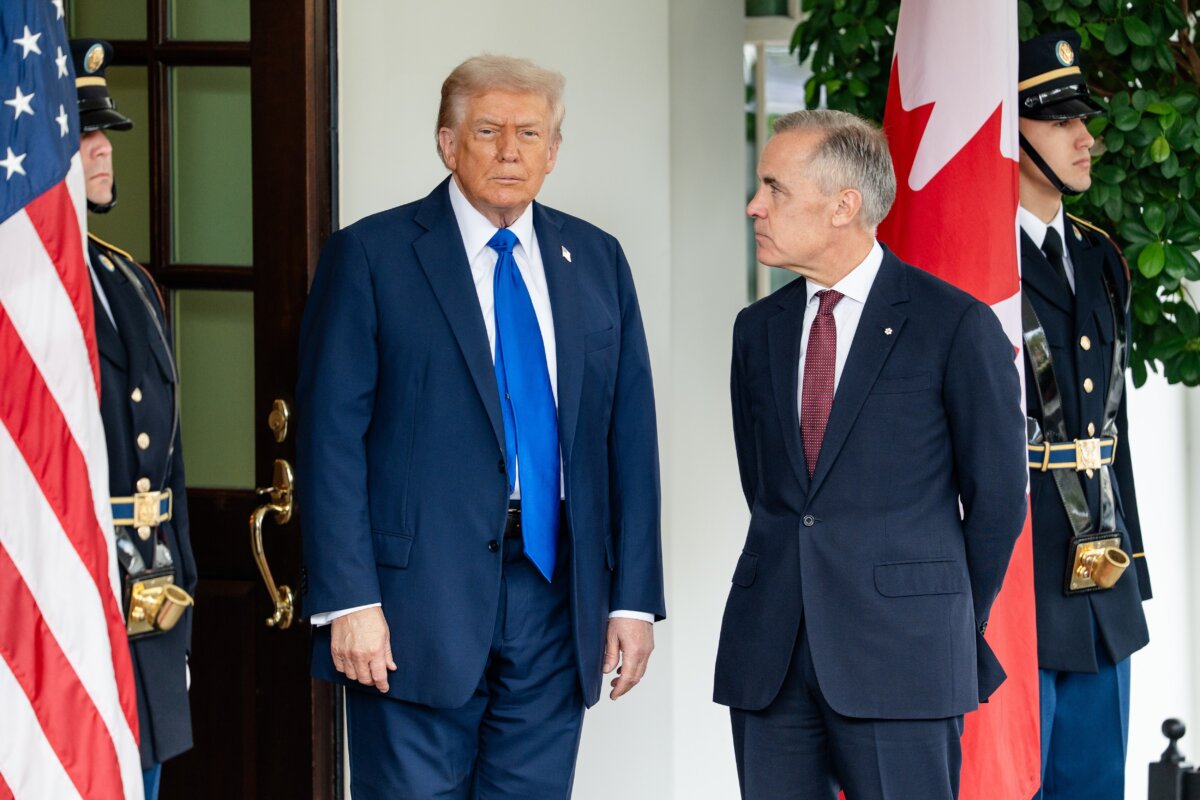

The White House is disputing Canadian Prime Minister Mark Carney’s remarks about French language rights derailing trade talks, saying the issue was related to taxes on streaming services like Netflix.
Carney and Quebec Premier Christine Fréchette, who along with other premiers were briefed on the trade talks by Carney, told reporters on Aug. 22 that trade talks with the United States collapsed last week partly because Washington was demanding changes to Canadian French-language protections, bilingual labelling, and content rules.
Carney said one of the main sticking points was American efforts to “restrict our protections of our language, our culture, and in effect, our sovereignty.”
“The subsidies, the support for our culture and the French language. And even the information that is on Canadian products,” Carney said in French. “There are many examples that are never acceptable. Americans try, try and try and we say no. And it’s simple. Never on the table for Canada, my government.”
President Donald Trump took to his Truth Social platform on Aug. 25 to dispute Carney’s comments.
“I would never interfere with Canadians speaking French! In fact, I have never even thought of doing such a stupid thing,” Trump wrote. “This lie was made up by a weak and ineffective Prime Minister in an attempt to gain political support, which he has totally lost, from the people of Quebec. I love French Canadians!”
U.S. Trade Representative Jamieson Greer is also denying that his country is targeting the French language, saying in an interview with CNBC on Aug. 24 that Carney’s framing of the issue is “not true” and a “funny, fake story.”
He said the problem does not lie with the language itself or the necessity for product labels to be presented in both English and French. Instead, it is the rules requiring American tech and streaming companies such as Netflix to contribute a portion of their Canadian earnings to local broadcasting funds that were highlighted as a concern during trade discussions.
The Canadian Radio-television and Telecommunications Commission as of 2024 has required foreign streaming platforms to contribute 5 percent of revenue to support Canadian and indigenous content, including French-language programming, under the Online Streaming Act.
Greer said the U.S. government takes issue with the rule, calling it a “discriminatory tax on American companies.”
“I like the Quebecois, and I like that they speak French. What we don’t like is a situation where Canada, the federal government, forces American tech companies to take their earnings and give a percentage to their competitors in Canada,” Greer told CNBC. “But I understand why the Quebecois want to have French language content … and we think that’s a really valuable thing, and we encourage countries to really put their own country first and put their national identity first.”
Carney was asked about Greer’s “funny, fake story” comments during an Aug. 24 press conference, and whether the issue is about French labelling laws or concerns with putting requirements on platforms such as Netflix.
Carney told reporters in French that he does not consider the matter to be “funny” whatsoever, and emphasized what he framed as an “enormous” gap between Canada and the United States regarding French language rights.
He said the White House exerted pressure on Ottawa to modify its stance on discoverability rules, which, if enacted, would influence the options available to Canadians when using streaming services.
The tax on American streaming services was identified by the United States earlier this year as a trade irritant, particularly after the CRTC said this spring that it planned to triple the tax. The Carney government directed the CRTC to review this decision, with the agency ultimately withdrawing the change. Carney said this was done to reduce costs for Canadians, denying suggestions that it was done as a concession to the United States.
 Friends Read Free
Copy
Facebook
Tweet
Friends Read Free
Copy
Facebook
Tweet