
U.S. President Donald Trump is considering sending Ukraine the Tomahawk cruise missile platform for use in its war with Russia.
The weapon system, a key part of the U.S. arsenal for decades, has several capabilities that could make it pivotal to Ukraine’s defense efforts.
Here’s what you need to know.
Used in Every Major Conflict Since 1991
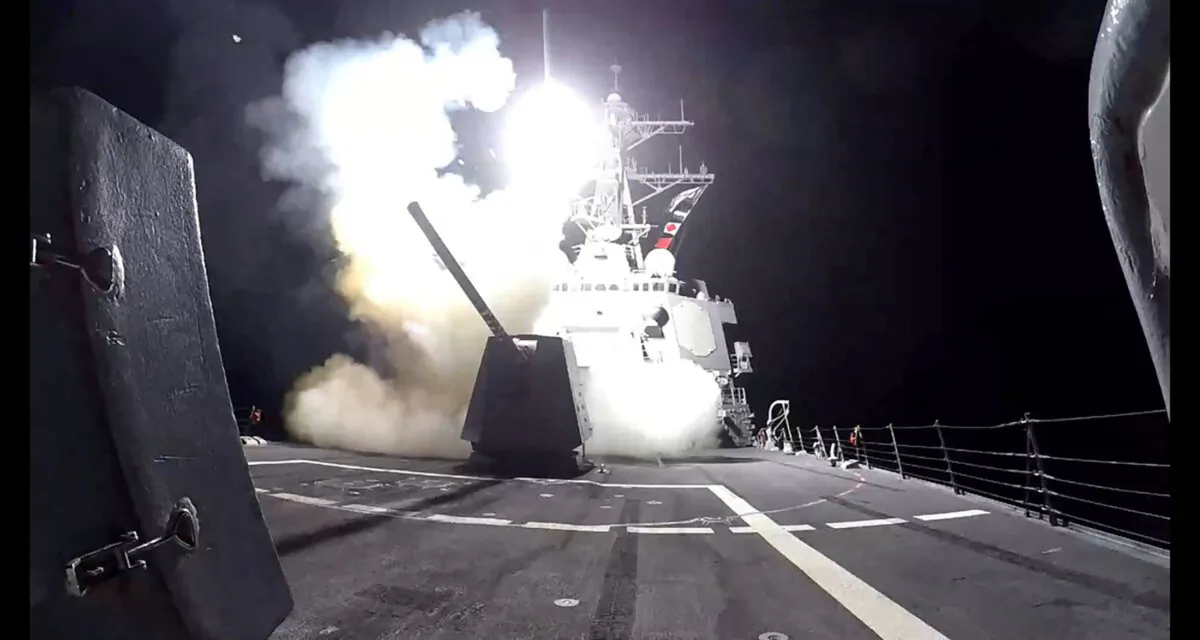
The Tomahawk is an intermediate-range, subsonic cruise missile used to strike key enemy positions from a great distance. It is most often used to strike at hardened defense points such as air defense systems in order to pave the way for larger military actions.
According to Britannica, the platform first entered service in 1983 and was used in combat for the first time in 1991, during Operation Desert Storm in Kuwait and Iraq.
According to Raytheon, the company that manufactures Tomahawks, the missiles have been used in nearly every U.S. engagement since then, including U.S. strikes on Iran in 2025. In all, the platform has seen more than 2,300 combat uses.
The missiles are designed to fly at very low altitudes and high subsonic speeds. Newer variants include improved GPS systems that allow the system to reprogram its targeting configuration mid-flight, thereby striking at any of several pre-programmed potential targets or diverting course to a specified GPS location.
According to the U.S. Navy, newer variants also have the capability to loiter over a target area while using an onboard camera to assess battle damage or respond to emerging targets in rapidly developing situations.
Nuclear Capability
The Tomahawk was originally designed to be equipped with either conventional or nuclear payloads, but its use as a nuclear platform was phased out when the United States entered into the Intermediate-Range Nuclear Forces Treaty with Russia in 1988, in which both sides agreed to ban the use of such weapons.
The United States removed the last nuclear Tomahawks from service in 1992, and ground-based variants of the weapons were wholly retired as part of a 2010 nuclear posture review, with sea-based nuclear variants retired by 2013.
Trump withdrew from that treaty in 2018, citing Russia’s noncompliance, but allowed the United States the ability to pursue such platforms again should it so choose.
The history of the Tomahawk’s nuclear capability is important for Ukraine, as the ground-based variant of the weapon system was phased out alongside its nuclear mission. As such, nearly all Tomahawks have been sea-launched platforms since the early 2010s, making them useless to the Ukrainian military because of Kyiv’s lack of naval vessels suitable for the mission.
A new version of the ground-based Tomahawk system was prototyped by the U.S. Army in 2023 and deployed to the Philippines in 2025.
That launch system, known as “Typhon,” is likely the only Tomahawk launch platform that Ukraine would be able to use effectively, but its recency casts doubt on whether the United States has a large enough inventory of the system to sell.
Range Would Threaten the Heart of Western Russia
Vitally for Ukraine, the Tomahawk system would grant Kyiv the ability to strike directly at targets deep within the heart of Russia.
The Tomahawk has an effective range of roughly 775 miles to 1,500 miles, depending on the variant and payload used. For comparison, the ATACMS short-range ballistic missiles given to Ukraine by the Biden administration in 2024 have a maximum effective range of 190 miles.
Therefore, should the Trump administration sell Tomahawks to Ukraine and also remove restrictions on how Ukraine uses U.S. weapons, Kyiv would be able to hold every target in the western part of Russia under threat, including Moscow and Saint Petersburg.
Ukraine has pledged to only use such systems against viable military targets, but it is unclear if the United States would actually be willing to lift restrictions on deep strikes against Russian territory. Such a state of affairs would grant Kyiv a stronger position for negotiating a cease-fire than it has ever had but would be viewed by Russian authorities as an escalation of the war by Washington.
Trump and Ukrainian President Volodymyr Zelenskyy are scheduled to meet on Oct. 17 in Washington, where they are expected to discuss the Tomahawk system. A Ukrainian government delegation met earlier in the week with major U.S. weapons manufacturers, including Raytheon.
 Friends Read Free
Copy
Facebook
Tweet
Friends Read Free
Copy
Facebook
Tweet