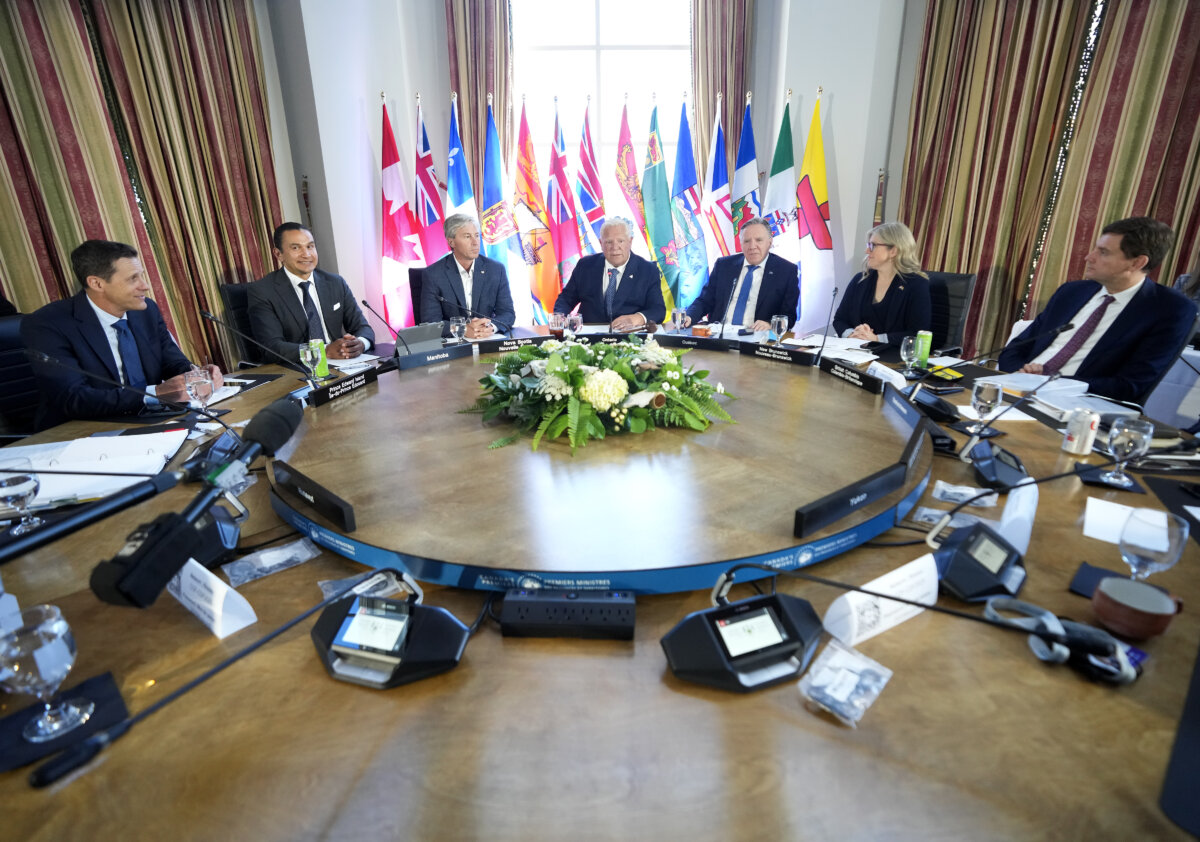

During the premiers’ three-day meeting in Muskoka this week, several leaders commented on what the potential trade deal with the United States could look like.
While the premiers did not provide specific details of what the deal might entail, the premiers echoed that getting the “best deal” for Canada is more important than meeting the Aug. 1 deadline.
U.S. President Donald Trump has threatened to raise U.S. tariff related to border security concerns from 25 to 35 percent on that date.
Speaking to reporters on July 22, Ontario Premier Doug Ford said he wouldn’t divulge the prime minister’s trade deal plans to avoid jeopardizing Carney’s negotiations with Trump, but noted that “we have a strong plan in making sure that we get our economy going.”
Ford, who says the U.S. president is “unpredictable,” has on multiple occasions expressed his support for Canada responding to the U.S. tariffs with counter-tariffs.
“We need to make sure we match tariff by tariff, dollar for dollar, and hit him [Trump] back as hard as we possibly can,” Ford said.
Addressing the larger issue of the renegotiation of the USMCA free trade deal, Alberta Premier Danielle Smith said it appears the United States will be “putting off a full renegotiation of the Canada–U.S. free trade agreement until next year.” The agreement has a clause allowing for renegotiations starting in 2026.
“I find that disappointing,” Smith said at the closing press conference. “I would have liked to have seen it accelerated.” She said that coming to an agreement by Aug. 1 for the industries affected by sectoral tariffs, such as steel and aluminum, would be “a win,” and she would support taking “a bit longer” to negotiate the Canada-U.S. free trade agreement to “make sure that we get it right.”
Smith said Canada should not retaliate with counter-tariffs over concern of how Canada may be negatively impacted.
‘A Good Deal’
Saskatchewan Premier Scott Moe told reporters that while he would like a deal to be reached as soon as possible, he recognizes that Canada needs “a good trade deal first and foremost.”
“I think it’s less about the date and more about the content of the conversation that is happening,” Moe said. He added that an agreement with no tariffs is the goal, but that Canada should at least have lower tariffs than other countries considering the relationship Canada has with the United States. Several premiers noted that Canada is America’s “biggest customer.”
Moe has also expressed concern about Canada responding to the United States with counter-tariffs, agreeing with Smith that retaliation may not work out in Canada’s favour.
Manitoba Premier Wab Kinew echoed the idea of getting “a good deal.” He said he thinks it’s important for Canada to get such a deal instead of rushing to take any deal, such as one that could cause “harm” to Canada in the long term.
“I think our kids and grandkids are going to look back at this time as an inflection point where we had the opportunity to stand up for our nation’s independence and for our economic self sufficiency,” Kinew said.
Nova Scotia Premier Tim Houston told reporters he has not been focused on the Aug. 1 deadline as he feels that getting “the best deal” is more important than giving up leverage to get a deal by a certain date.
Houston said he didn’t want to “presuppose the outcome” of the deal but expressed his confidence in the prime minister’s ability to come up with the “best deal” for Canadians. He said ideally the deal would not include any tariffs, “but we’re not in that world right now.”
“I think it’s just really important that we keep moving for what is the best possible deal for Canadians, and all the while knowing that the U.S. administration changes their thoughts on things quite frequently,” Houston said.
During his opening remarks at the meeting on July 22, Carney said that he is looking for “the best deal for Canada,” adding that what Canadians can control the most is building a strong economy.
Unity Among Premiers
Several premiers also agreed that coming together to figure out how to deal with the threat of U.S. tariffs has brought the premiers closer.
“One thing we can thank President Trump for is getting us moving, getting us united like I’ve never seen before across the country, and focusing on large infrastructure projects,” Ontario’s Ford told reporters.
Nova Scotia’s Houston said that Canada’s uncertain trade relationship with the United States has brought the federal and provincial governments “closer together” in making a “stronger country.”
“Everyone is really united on the same page of really seizing the opportunities that are before us that in the past we may have looked away from, that right now we’re all looking squarely at,” Houston said.
Manitoba’s Kinew echoed that “the premiers are united around building this country up, and the prime minister is right there on the same page.”
Similarly, Saskatchewan’s Moe and B.C. Premier David Eby both confirmed the message of unity between the premiers as well as the prime minister.
“If there’s any positive from any of this, and I’m not saying there’s a lot, but if there is any positive from any of this, it is a fact that we in Canada, very much, are looking internally to control what we can control,” Moe said.
“We have to be able to do multiple things at once in this country,” Eby said. “We have to ensure that we’re fixing the plane while it’s flying, and not only are we going to do it, but when we’re done, it’s going to be a project that all Canadians can be proud of. And the nice thing about this table is we’re united on that.”
 Friends Read Free
Copy
Facebook
Tweet
Friends Read Free
Copy
Facebook
Tweet