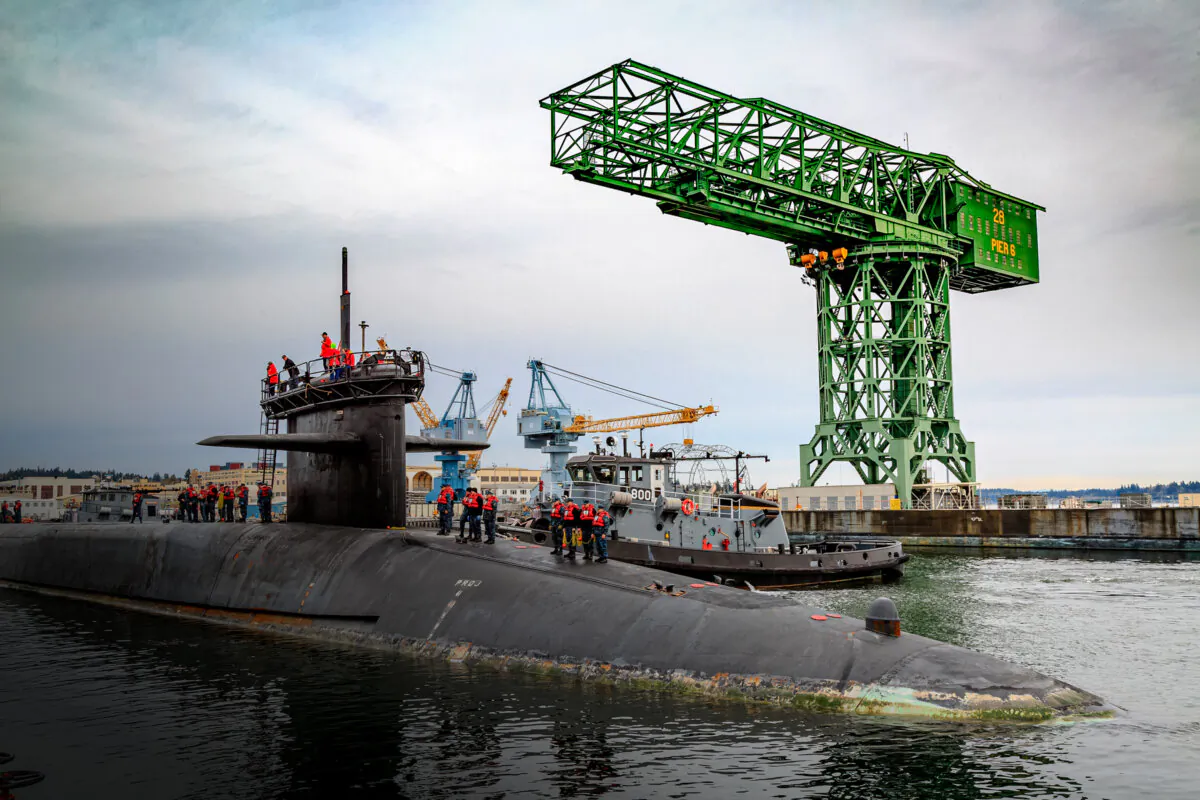

On Aug. 1, shortly after U.S. President Donald Trump cut down his deadline for Russia to accept a cease-fire deal with Ukraine, he announced that he had also ordered a pair of U.S. nuclear submarines to be repositioned to respond to a perceived threat by former Russian President Dmitry Medvedev.
Detailing the decision in an Aug. 1 Truth Social post, Trump said that Medvedev made “highly provocative statements.” Trump said he ordered the submarine movement “just in case these foolish and inflammatory statements are more than just that.”
Submarine movements are typically shrouded in secrecy, and Trump’s Aug. 1 decision to announce such a deployment is a rare flex of U.S. nuclear firepower.
“Words are very important, and can often lead to unintended consequences,” Trump’s Aug. 1 social media post reads. “I hope this will not be one of those instances.”
Just days earlier, Trump announced that he had reduced a deadline for Russia to reach a cease-fire with Ukraine to avoid new U.S. sanctions and tariff actions.
Responding to Trump’s escalating cease-fire deadline, Medvedev had taken to X on July 28 to write that each new ultimatum by Trump is “a threat and a step towards war.”
Trump did not specify in his Aug. 1 post exactly what Medvedev had said that prompted the repositioning of U.S. nuclear forces.
Medvedev may have also triggered Trump’s nuclear submarine announcement with a July 31 social media post referencing the “dead hand” system, which enables Russian nuclear forces to launch automatically if a nuclear strike on Russia is detected.
Facing questions about the submarine deployment on Aug. 4, the president told reporters that the submarines had already arrived “where they have to be.”
Exactly where these two U.S. nuclear submarines are is unclear. It is also unclear how far they actually moved, if at all, following Trump’s Aug. 1 announcement.
The Undersea Competition
The U.S. Navy currently operates 67 nuclear-powered submarines, including 49 general-purpose attack submarines, 14 Ohio-class ballistic missile submarines, and four Ohio-class guided-missile submarines.
U.S. general-purpose attack submarines are equipped to launch Tomahawk cruise missiles, conduct surveillance missions, launch special operations forces, engage in mine warfare, and otherwise support broader fleet operations.
In addition to the 49 general-purpose attack submarines in service, another 14 are in various states of construction or preparation to enter the fleet.
The four Ohio-class guided-missile submarines can deploy with up to 154 Tomahawk missiles and 66 special operations troops at a time.
The 14 Ohio-class ballistic missile submarines can deploy with up to 24 submarine-launched ballistic missiles, including nuclear-armed missiles.
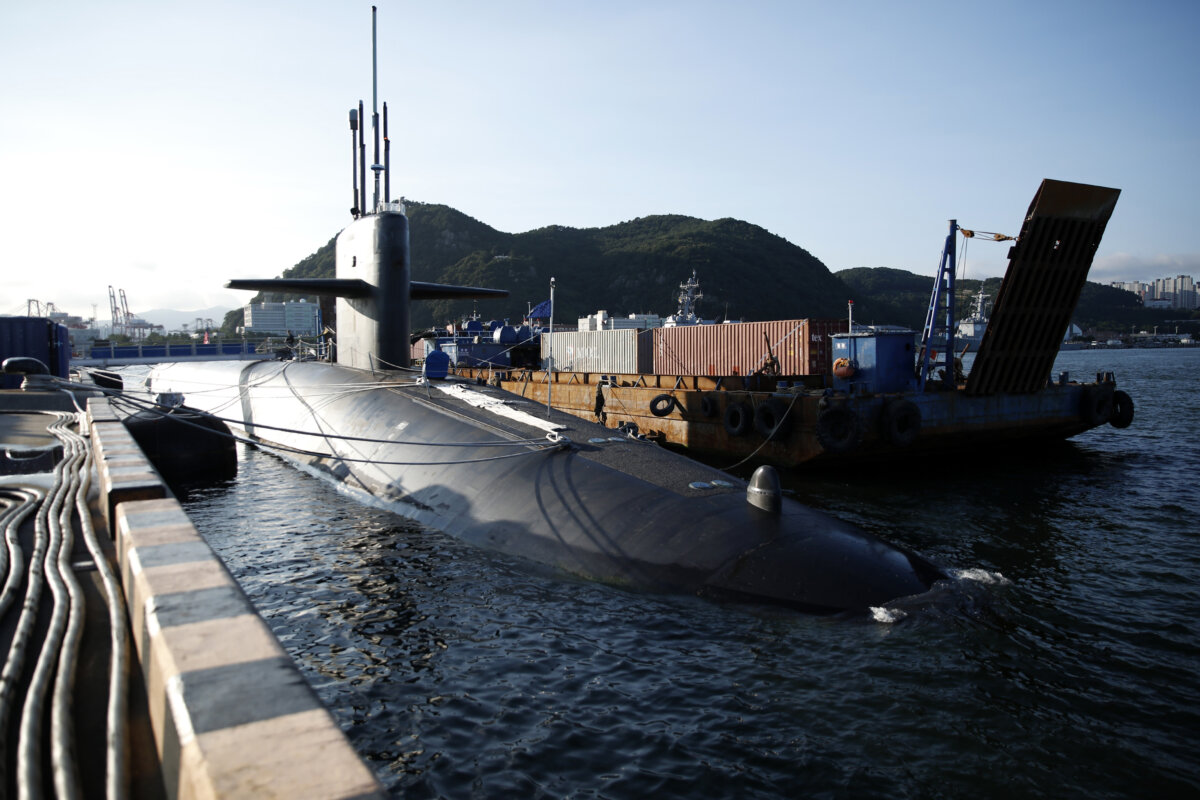
The Nuclear Threat Initiative assesses that Russia operates 64 different submarines, including 16 nuclear-powered ballistic missile submarines, 11 nuclear-powered cruise missile submarines, and 14 nuclear-powered attack submarines. Russia also operates 23 diesel-electric attack submarines, which are generally louder and have less endurance than their nuclear-powered counterparts.
As of August 2024, the Nuclear Threat Initiative assessed that China possessed 60 submarines, including 48 diesel-electric attack submarines, six nuclear-powered attack submarines, and six ballistic missile submarines. China has rapidly expanded its fleet in recent years, and the Nuclear Threat Initiative assessed that China could have 65 submarines in service in 2025.
A Message of Deterrence
With stealth being a key component of a submarine’s survivability, submarine locations are rarely shared in real time. On the other hand, presidents have hinted at submarine movements during periods of rising global tensions.
In December 2020, amid growing U.S.–Iran tensions approaching the one-year anniversary of the U.S. strike that killed Iranian Gen. Qasem Soleimani, U.S. Central Command shared statements describing the movements of the guided-missile submarine USS Georgia throughout the waterways of the Middle East.
In November 2023, as Israeli forces ramped up combat operations against the Hamas terrorist group in the Gaza Strip and prepared to defend against attacks from the Hezbollah terrorist group to the north and Yemen’s Houthi terrorist group to the south, the Biden administration began directing additional U.S. military assets to the region. Central Command shared a post on X showing an Ohio-class submarine that it stated was operating in the region.
A U.S. submarine also participated in the June 22 U.S. strike on Iranian nuclear facilities, launching a salvo of Tomahawk cruise missiles at Iran’s Isfahan facility.
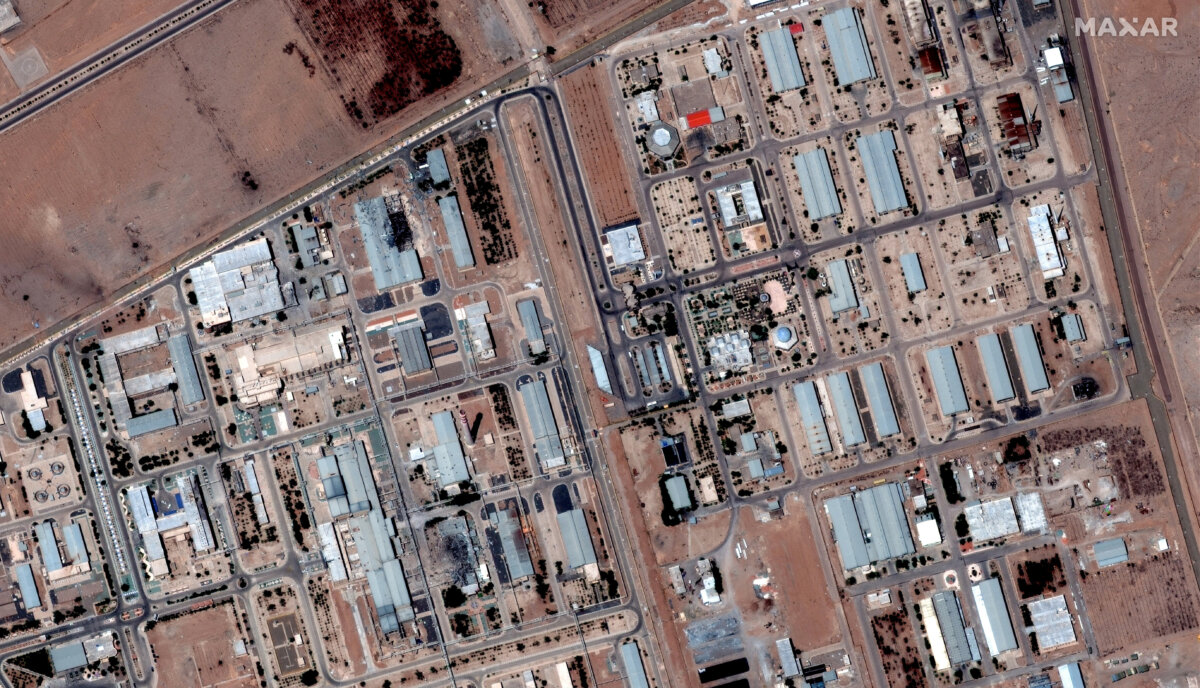 Satellite image shows an overview of Isfahan Nuclear Technology Center, before it was hit by U.S. airstrikes, in Isfahan, Iran, on June 16, 2025. (Maxar Technologies/Handout via Reuters)
James Robbins, dean of academics with the Institute of World Politics and a national security strategist, said Trump’s announcement of the submarine movement was a clear message of deterrence.
In a telephone interview with The Epoch Times, Robbins said the U.S. submarine fleet “contains most of [the United States’] nuclear firepower, [and] has been the chief deterrent force, the most survivable part of the nuclear triad.”
Following Medvedev’s comments and Trump’s response, Kremlin spokesman Dmitry Peskov urged caution.
“We believe that everyone should be very, very careful with nuclear rhetoric,” Peskov told reporters on Aug. 4, according to state-run media outlet RT.
At the same time, Peskov appeared to suggest that the U.S. submarine deployments were not a new concern.
“In this case, it is obvious that American submarines are already on combat duty,” Peskov said. “This is a constant process.”
Hans Kristensen, director of the Nuclear Information Project at the Federation of American Scientists, was less convinced that Trump’s message would dissuade Russia.
“I do not think Trump’s statement has any deterrence value or will subdue Moscow’s actions,” Kristensen wrote in an emailed statement to The Epoch Times. “U.S. nuclear submarines are always deployed, including in the Atlantic, and Russia knows that.”
Nuclear Brinkmanship and Diplomacy
This is not the first time Trump has flexed U.S. nuclear power amid tension with an adversarial country.
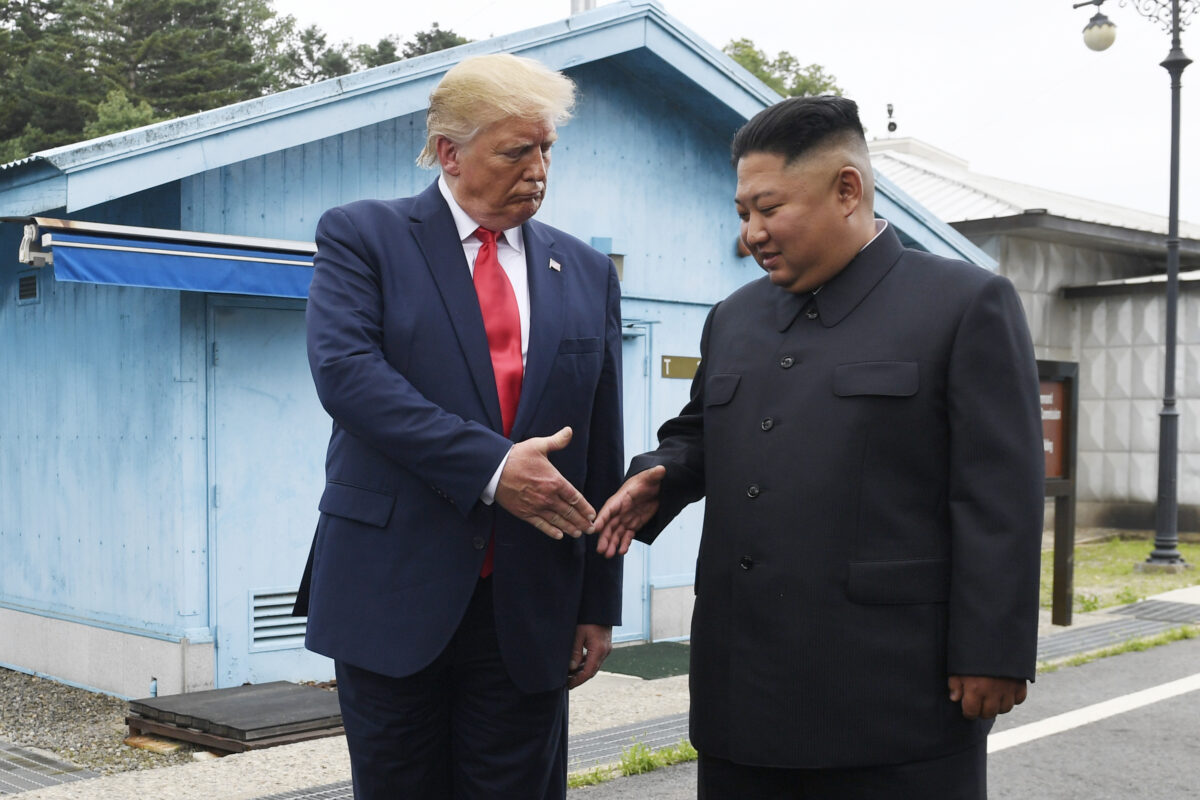
After North Korean leader Kim Jong Un delivered a 2018 New Year’s Day address in which he claimed that he has a “nuclear button” on his desk, Trump wrote on X, “I too have a Nuclear Button, but it is a much bigger & more powerful one than his, and my Button works!”
In the months that followed Trump’s response, Kim agreed to meet with Trump to discuss denuclearization. The pair would continue to engage in talks on denuclearization throughout the remainder of Trump’s first term but did not reach a deal by the time Trump left the White House in 2021.
In his comments to reporters on Aug. 4, Peskov said the Kremlin does not believe that Trump’s comments about the redeployment of U.S. submarines were an escalation.
“We do not believe that we are talking about any escalation now,” the Kremlin spokesman said. “It is clear that very complex, very sensitive issues are being discussed, which, of course, are perceived very emotionally by many people.”
Russian leaders themselves have alluded to their nuclear arsenal throughout the ongoing conflict in Ukraine. In 2024, Russian President Vladimir Putin warned that Russia could allow nuclear strikes on nations that supply weapons to Ukraine.
Kristensen warned that frequent use of nuclear threats can diminish their potency as a tool of deterrence or diplomacy.
“Russia has discovered this the hard way by making so many nuclear threats that the West began to consider them to be just words,” Kristensen said.
U.S. special envoy Steve Witkoff visited Moscow on Aug. 6 ahead of Trump’s Aug. 8 deadline for Russia to agree to a cease-fire with Ukraine. Trump reported that the meeting was “highly productive” but provided no clear sign that Putin is ready to pause the conflict.
Trump announced on Aug. 8 that he would meet with Putin in Alaska on Aug. 15 in an effort to end the war.
Jack Phillips contributed to this report.
 Friends Read Free
Copy
Facebook
Tweet
Friends Read Free
Copy
Facebook
Tweet