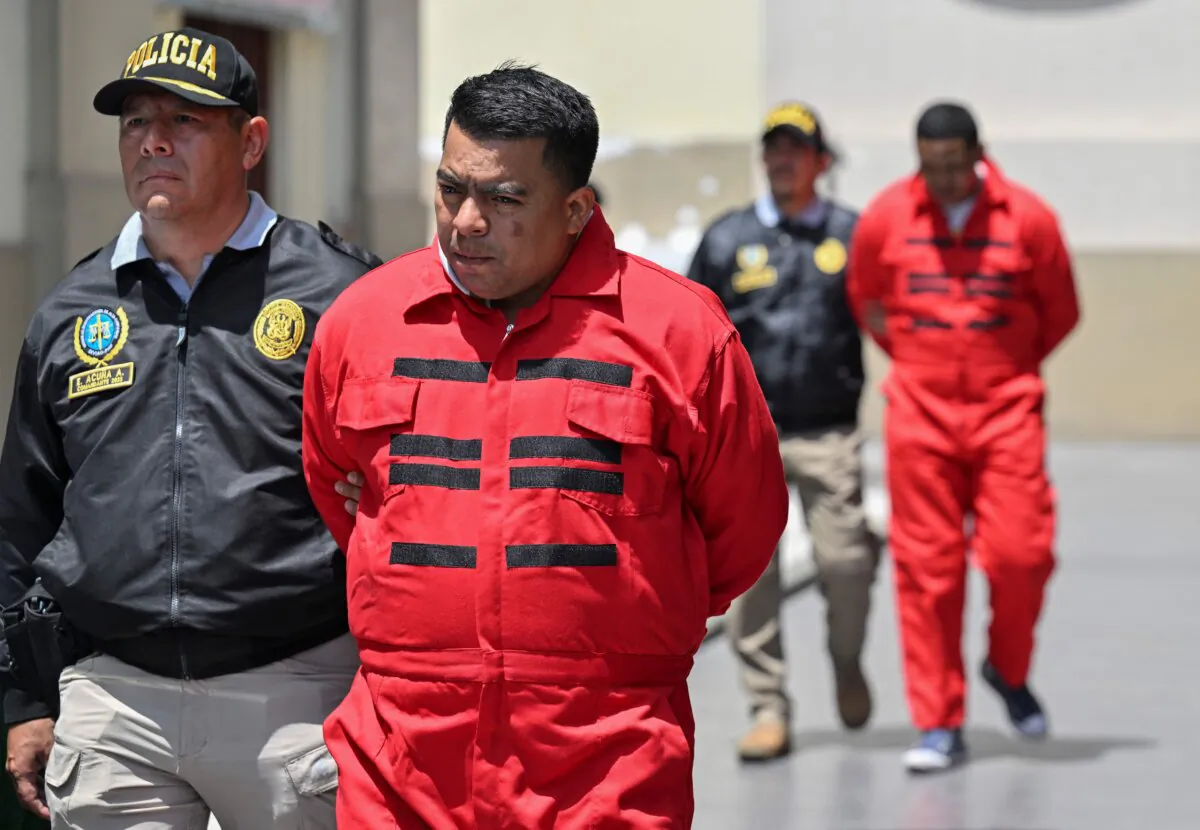
U.S. forces in the Caribbean killed 11 suspected members of the Tren de Aragua (TdA) narcotics cartel on Sept. 2, when they fired on a boat in the southern Caribbean Sea off the coast of Venezuela.
Earlier in 2025, U.S. President Donald Trump added the Venezuela-based group to a list of cartels and organized criminal networks that his administration has designated as “foreign terrorist organizations.”
Here is what we know about TdA and its ties to the Venezuelan government.
What Has Trump Said?
In a post on Truth Social on Sept. 2, the president said, “Earlier this morning, on my Orders, U.S. Military Forces conducted a kinetic strike against positively identified Tren de Aragua Narcoterrorists in the SOUTHCOM area of responsibility.”
He accused Venezuelan leader Nicolás Maduro of backing the gang and its criminal activities.
“[TdA] is a designated Foreign Terrorist Organization, operating under the control of [Nicolás] Maduro, responsible for mass murder, drug trafficking, sex trafficking, and acts of violence and terror across the United States and Western Hemisphere,” Trump wrote.
He said the boat was in international waters and was transporting illegal narcotics to the United States.
“Please let this serve as notice to anybody even thinking about bringing drugs into the United States of America,” he wrote. “BEWARE!”
Maduro said on Sept. 1 in a rare press conference that with the recent naval deployments in the Caribbean, the United States was seeking regime change in his country.
Venezuela Drug Connection
The World Drug Report, published by the U.N. Office on Drugs and Crime in June, estimated that more than 3,708 tons of cocaine were produced globally in 2023. This was a record amount and 34 percent more than the previous year.
“This is primarily a reflection of an increase in the size of the area under illicit coca bush cultivation in Colombia,” the report reads.
While Venezuela is not named in the report, the country “has historically been a critical point in drug trafficking, especially due to its strategic location between Colombia, the world’s largest producer of cocaine, and the Caribbean,” according to a December 2024 report by Venepandi, an insurance company based in Caracas, Venezuela.
“Over the years, the country has seen an increase in narcotrafficking activities, with criminal groups operating in various regions, exploiting political and economic instability,” Venepandi’s report reads.
What Is TdA?
TdA is an organized crime group that has its roots in Venezuela and is heavily involved in human smuggling, drug trafficking, and money laundering, with operatives suspected of being involved in crime all over the United States.
François Cavard, a human rights activist who has spent years investigating the drug trade in Central and South America, told The Epoch Times that the gang’s name translates to “train of Aragua” and refers to a failed railway project, on which the original gang members worked and began an extortion racket.
Cavard said the original TdA leaders were detained in Tocorón Prison.
“That place became their office, their headquarters, and from there they started organizing themselves as a transnational criminal organization,” he said.
TdA, which has no political ideology, has spread its tentacles among the Venezuelan diaspora in North, Central, and South America.
The police in Colombia, Peru, and Chile—all of which have large communities of Venezuelan migrants—have accused TdA of being behind an explosion of violent crime.
On Jan. 26, the U.S. Drug Enforcement Administration announced that it had carried out a raid in Denver that led to the arrest of 49 TdA suspects and the seizure of cocaine, crack cocaine, and pink cocaine, known on the street as “tusi.”
On April 21, 27 members of TdA or a splinter faction known as Anti-Tren were indicted in New York City on charges of sex trafficking, narcotics trafficking, robbery, and armed robbery.
In July 2024, the U.S. State Department offered a $12 million reward for information leading to the capture of three of TdA’s leaders: Héctor Rusthenford Guerrero, also known as Niño Guerrero; co-founder Yohan Jose Romero, also known as Johan Petrica; and Giovanny San Vicente, also known as El Viejo.
Links With Maduro Government
Cavard said TdA started growing under the auspices of Tareck Zaidan El Aissami Maddah. El Assaimi, whose parents were of Lebanese and Syrian origin, was a senior figure in the ruling United Socialist Party of Venezuela who rose to become the country’s vice president. He was part of Maduro’s inner circle before falling from grace in 2023.
El Assaimi, who was charged in absentia by the United States in 2019 for violations of the Foreign Narcotics Kingpin Designation Act, became governor of Aragua Province in 2012.
U.S. Defense Secretary Pete Hegseth said on “Fox & Friends” on Sept. 3 that Maduro was running his country “as a kingpin of a drug narco-state.”
In March 2020, the U.S. Justice Department charged Maduro and several of his top lieutenants in Venezuela with conspiring with the violent Marxist Revolutionary Armed Forces of Colombia to export large quantities of cocaine to the United States.
At the time, Maduro dismissed the charges as false and racist.
Regional Support for the US
The United States has two strong allies in the region in the form of Venezuela’s neighbors: Trinidad and Tobago, as well as Guyana.
On Sept. 3, Trinidadian Prime Minister Kamla Persad-Bissessar said: “I, along with most of the country, am happy that the U.S. naval deployment is having success in their mission.
“The pain and suffering the cartels have inflicted on our nation is immense. I have no sympathy for traffickers. The U.S. military should kill them all violently.”
Maduro has threatened to annex Guyana’s oil-rich Essequibo region.
Guyanese President Irfaan Ali was reelected on Sept. 1. Joined by Ali, U.S. Secretary of State Marco Rubio said during his visit to the country’s capital, Georgetown, in March: “It will be a very bad day for the Venezuelan regime if they were to attack Guyana or attack [American oil and gas company] ExxonMobil.
“It would be a very bad day, a very bad week for them.”
 Friends Read Free
Copy
Facebook
Tweet
Friends Read Free
Copy
Facebook
Tweet