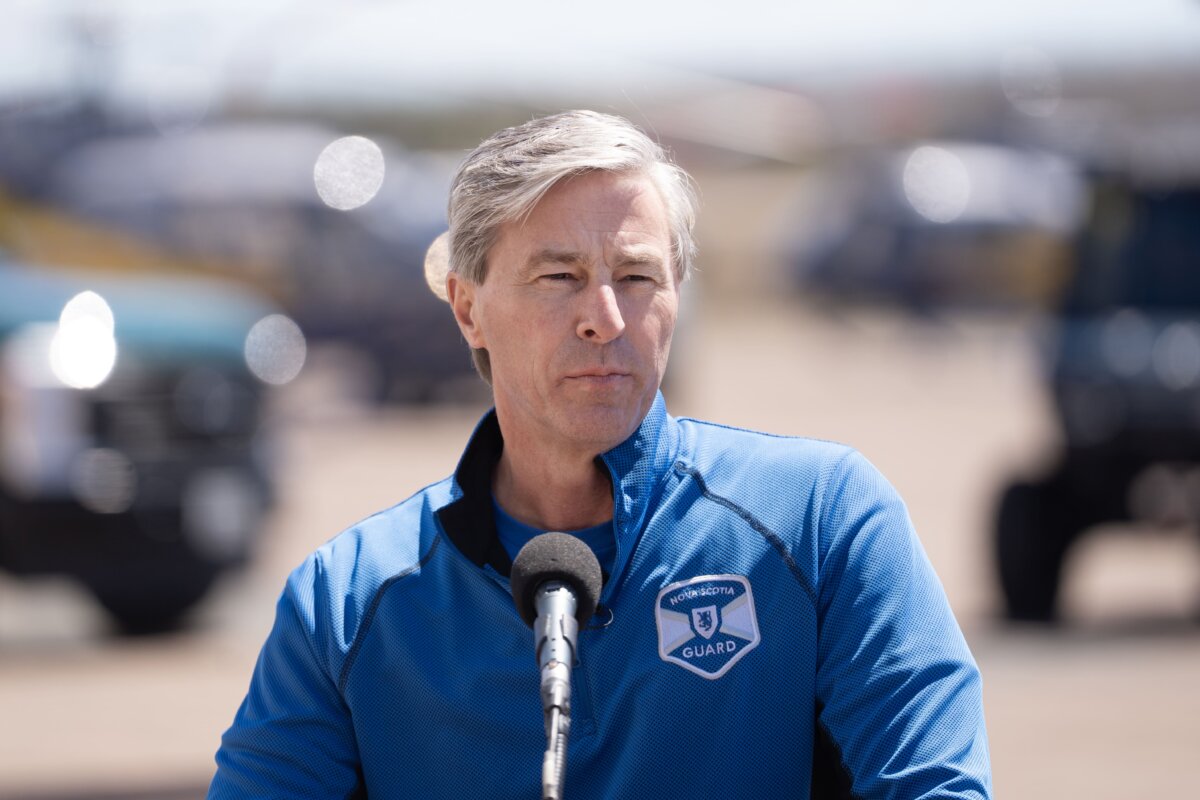
A recent protest against Nova Scotia Premier Tim Houston turned violent after a group surrounded the premier’s vehicle and one man jumped on it and smashed the windshield.
Police say they are still investigating the incident, which occurred July 15 at Acadia University in Wolfville, N.S., and was condemned by Prime Minister Mark Carney and those across the political spectrum in the province.
Here’s what we know so far about what happened in Wolfville and the groups who were helping organize demonstrations against Houston that day.
What Happened in Wolfville?
Houston is currently on a “summer tour” where he delivers remarks and meets with chambers of commerce across Nova Scotia and visits local businesses to talk about the province’s economy and opportunities.
The July 15 luncheon with the Annapolis Valley Chamber of Commerce at Acadia University was the first planned stop on the tour.
While only a few dozen protesters had initially gathered when Houston arrived, the protest steadily grew amid calls from various groups to demonstrate against the government that day.
Police say they responded to “concerns for safety” after a group of protesters blocked Houston and his staff’s vehicles from exiting campus, and one individual climbed onto the vehicle with Houston inside and smashed the windshield.
“Additional RCMP officers arrived to provide support and the premier was led back inside a nearby building and escorted away from the venue,” police noted in a July 16 release, adding that no injuries were reported.
Police said they arrested one man due to an incident that occurred during the protest at Acadia but later released him without charges. They added that they do not believe the man was responsible for trying to block Houston’s exit from campus or smashing the windshield of Houston’s vehicle.
RCMP noted they are still working to identify several individuals they believe may have blocked the vehicle or been involved in causing damage to it. The premier’s office said that an “extreme faction” of the protesters were involved in the violence.
“Individuals have a protected right to lawfully, peacefully, and safely assemble,” police said. “Acts of violence will not be tolerated and will be investigated fully.”
Who Was Protesting Houston?
The July 15 incident comes amid a constellation of wider protests against some of the policies of Houston’s Progressive Conservative government, including for issues related to indigenous treaty rights, resource development, old-growth logging, and funding cuts.
Numerous groups had encouraged people to attend protests against Houston July 15. However, authorities have not linked any specific protest cause to the violence and blocking in of Houston and his staff’s vehicles.
Social media posts indicate a wide array of groups who promoted the demonstrations at Acadia in the lead-up to the event, including unions, environmental activists, indigenous activists, anti-fracking activists, and advocates of arts funding.
The protests were promoted under different slogans including “Houston, We Have a Problem: You’re Not Listening,” promoted by the Ecology Action Centre and “Shoulder to Shoulder: We Are All Treaty People” promoted by the environmental activist group Extinction Rebellion Mi’kma’ki.
The Nova Scotia Arts Coalition said members would attend and urged supporters to bring “Culture is Critical” signs, while Save Our Old Forests had also urged its supporters to protest Houston July 15 and “make some noise.”
The Council of Canadians’ Atlantic office shared a notice saying, “Tomorrow at Acadia University!” The Nova Scotia Fracking Resource and Action Coalition asked supporters to join “our friends with Shoulder to Shoulder” and “add some colour.”
There was also union promotion of July 15 demonstrations, with the Nova Scotia Federation of Labour writing ahead of time that its community organizers would be in Wolfville making sure “all voices will be ready to greet” the premier.
Source of Opposition
The groups had various focuses in terms of what was being protested.
Extinction Rebellion Mi’kma’ki has been focused on a longstanding dispute between indigenous Mi’kmaq communities in Nova Scotia and the provincial government over regulation of cannabis and tobacco sales, including several raids in First Nations communities over the issue.
A number of Mik’maq leaders have said that treaty rights entitle them to regulate cannabis sales in their own communities, but Houston rejected this reasoning, saying this April that “there is no recognized treaty right to sell cannabis.”
Under the province’s framework, recreational cannabis is sold through the Crown-owned Nova Scotia Liquor Corporation.
Environmental groups have been focused on protesting the government’s policies on resource development, including legislation passed last year that ended blanket bans on hydraulic fracturing (“fracking”) and uranium exploration and mining.
The government says the legislation will create jobs, increase provincial revenue, and make the province more independent, while opponents say there are unaddressed dangers of pollution, water contamination, and radioactive waste.
Forestry has been another point of contention, with groups like Save Our Old Forests arguing that continued timber harvesting in old growth forest areas could harm conservation and ecological health.
Several community and arts groups are also upset about the 2026–2027 provincial budget, which included a 30 percent cut to operational funding for arts, culture, and heritage organizations, as well as a $14 million cut to discretionary funding for the province’s Department of Communities, Culture, Tourism and Heritage.
Although Houston later apologized for some of the reductions and reversed them citing public pushback, the initial cuts led to an upswell of opposition. The cuts to the arts and culture sector were not reversed.
Police have not named a suspect in the July 15 incident or identified any group with which the violence may be associated.
‘Threats of Violence’
Bridgewater Mayor David Mitchell, whose town is roughly one hour south of Wolfville, expressed concerns about politically motivated “threats of violence” in the province in the wake of the attack.
He noted that he was disabling comments on a Facebook post about the incident at Acadia because a number of users had been calling for further violence.
“People are allowed to be frustrated and protest but I will not allow my page to be used to further calls for violence regardless of who it is against,” Mitchell wrote, adding that a colleague of his has been subject to frequent threats.
Houston’s office thanked the police for their response, and said violence harms “constructive dialogue.” Nova Scotia NDP Leader Claudia Chender also condemned the violence, saying that while dissatisfaction with government policies is valid, there should be no disruption to public safety.
In a social media post, Carney said he condemns the violence against Houston’s speaking event, adding that there “is no excuse to resort to violence and intimidation.”
 Friends Read Free
Copy
Facebook
Tweet
Friends Read Free
Copy
Facebook
Tweet