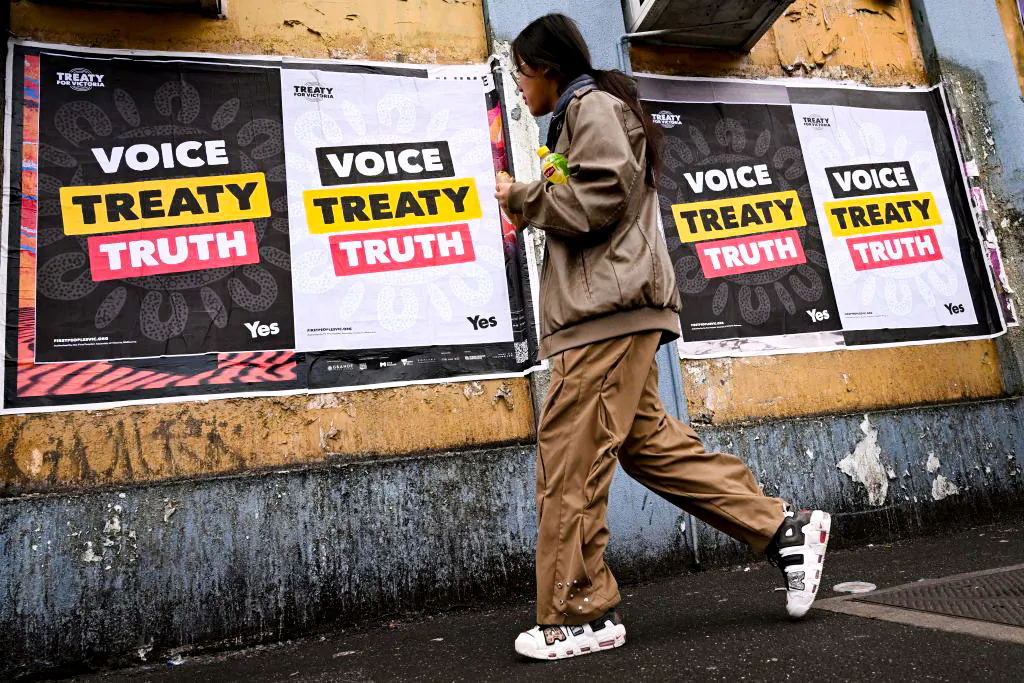

While the federal push to alter Australia’s Constitution failed, states are going it alone with their own version of an Indigenous “Voice,” bypassing the need for a national referendum.
The Victorian Labor government will push to make the “First Peoples’ Assembly of Victoria” into an official legislated body within the state’s parliament.
The body will oversee decision-making from an Indigenous perspective and advance the development of an official “treaty.”
While the assembly was established in 2019, the Allan Labor government only announced on June 30, 2025 that it plans to legislate the body.
What Changes Are Proposed?
The Allan government will introduce the Statewide Treaty Bill to Parliament later this year.
While the finer details remain unclear, the government has made a number of its intentions known.
Firstly, the bill will solidify the assembly’s presence as an ongoing representative body, effectively forming a “Voice” advisory body.
The bill will give Indigenous representatives the power to advise the government and question ministers on policy, and would require ministers and departments to consult on matters deemed relevant to Indigenous Australians—effectively another layer of bureaucracy impacting government decision-making.
Quotas will likely be more common, with a pledge to guarantee Indigenous Australians seats on government boards and entities—like current appointments to the Heritage Council of Victoria.
The government also proposes to “celebrate over 60,000 years of First Peoples’ culture, including by bringing it into the ceremonial life of Victoria” but remains unclear on what that would entail.
The state Voice would sit within the parliamentary system, but would not be able to able to veto policy or legislation, the government says, because those powers don’t currently exist under state law.
Premier Says it Will Create a ‘Better and Fairer’ Situation
Labor Premier Jacinta Allan has vowed to listen to the body if it is implemented.
“The significant change is, it will be a body where we will be listening, taking on their advice,” she told media.
Allan says the new system will make for a “better and fairer” situation, with giving Indigenous Australians “decision-making powers” at the core of the government’s reasoning.
“The Productivity Commission found governments haven’t fully understood the scale of change needed to meet their Closing the Gap commitments,” she said in a joint statement.
“It urged shared decision-making with First Peoples—and praised Victoria’s treaty process as a leading example.”
Criticism of the Proposal
Victorian Liberal Opposition Leader Brad Battin vowed to scrap the plan if his party wins election.
“The Liberals’ and Nationals’ position is clear—we do not support a state-based treaty or a Victorian Voice to parliament,” he said.
“Jacinta Allan is now trying to push ahead with her own version, without transparency and without a mandate.”
One Nation Victoria weighed in calling it discriminatory.
“All Australians want better outcomes for disadvantaged Indigenous people but that does not extend to exclusive race-based privileges that are denied to the rest of us,” said party leader Senator Pauline Hanson on X.
States Going it Alone
While Australians may not see another $450 million Voice any time soon, any successful state bodies could wield significant weight.
South Australia already has its own version, changing its constitution to implement a Voice, meanwhile, New South Wales Labor Premier Chris Minns has also vowed to push for a state treaty agreement.
Exact details around Victoria’s plans will become clearer as legislation is made public during the year.
 Friends Read Free
Copy
Facebook
Tweet
Friends Read Free
Copy
Facebook
Tweet