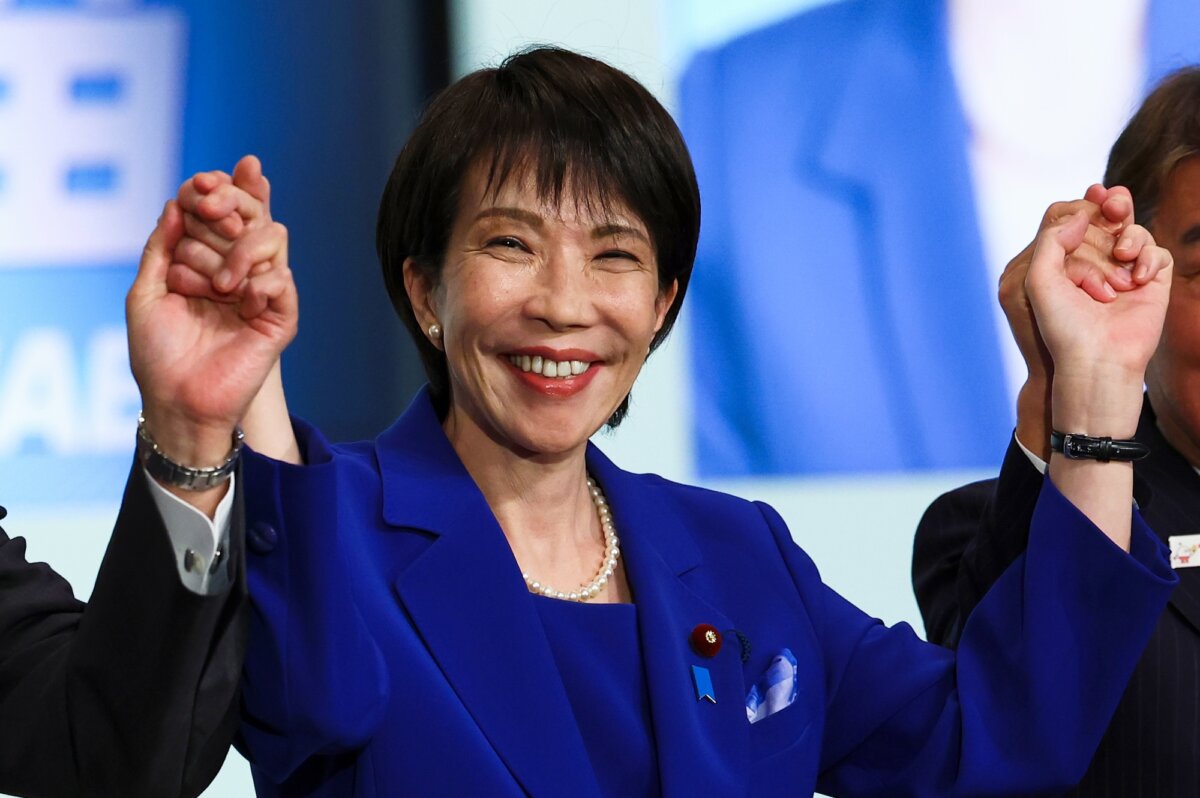

Sanae Takaichi was chosen over the weekend as the new leader of Japan’s center-right Liberal Democratic Party (LDP) and is set to become the country’s first female prime minister.
“Rather than being happy, I feel like the tough work starts here,” Takaichi, 64, said in her victory speech.
A former economic security and interior minister, Takaichi has often said her inspiration is Margaret Thatcher, who was the UK’s prime minister from 1979 to 1990 and gave her name to a political and economic ideology, Thatcherism.
Takaichi said she met Thatcher, who was dubbed “the Iron Lady” by the British press, at a symposium shortly before her death in 2013.
So what is her backstory?
Takaichi was born in Nara, a city near Osaka in the economically important Kansai region of Japan’s main island Honshu, in 1961, just as Japan’s economy began to boom after recovering from the devastation of World War II.
Her father worked in the automotive industry, and her mother was a police officer in Nara.
She graduated from Kobe University with a degree in business management and then, in 1984, entered the Matsushita Institute of Government and Management, which was created by the founder of the Panasonic Corp. to “develop future leaders.”
In December 1987, she was a congressional fellow in the U.S. Congress for two years before teaching at Nihon Junior College of Economics.
She broke into Japanese politics in 1993, winning a seat in the lower house as an independent, and briefly represented the now-defunct New Frontier Party before switching to the LDP in 1996.
Takaichi got her first junior ministerial post in 1998 but did not make a particularly rapid rise.
In 2006, when Shinzo Abe became prime minister, he promoted her to minister of state for science and technology policy, and eight years later, he reshuffled her, making her minister for internal affairs and communications.
She also fulfilled key roles at the LDP, including chairing its policy research council.
After Abe resigned in 2020, Takaichi’s star continued to shine, and in 2022, she was promoted to economic security minister under the new prime minister, Fumio Kishida.
Previous Leadership Bids
Her ambition has been no secret, and she stood for the leadership of the LDP in 2021 and again in 2024.
Last year, she was leading in the first round of the contest, but after Shinjiro Koizumi was knocked out, the majority of his supporters switched to backing Shigeru Ishiba, who was duly elected.
This time around, she maintained her first-round lead and defeated Koizumi to become the leader.
Takaichi remains a devotee of Abenomics, the economic stimulus policies favored by her political mentor, Abe, who was assassinated in 2022.
She has called for tax cuts to help voters with the rising cost of living and has criticized the Bank of Japan for raising interest rates.
In that respect, she may have a lot in common with U.S. President Donald Trump, who is due to visit Japan at the end of the month.
Takaichi is on the right of the LDP and has often adopted nationalist positions, which have been criticized by China, South Korea, and others.
She is a regular visitor to the Yasukuni Shrine in Tokyo, which—according to the Shinto religion—houses the kami, or souls, of 2.5 million people who died in service of Japan in war—including several war criminals who were executed.
Such visits are often viewed by other Asian countries as glorifying Japan’s militarist past.
Takaichi also favors revising Japan’s constitution, which was drawn up after the war, and expanding Tokyo’s military to deal with the threats from China and North Korea.
Alliance With Taiwan
She has suggested that Japan could form a “quasi-security alliance” with Taiwan.
In a speech last month, Takaichi also complained about foreigners kicking sacred deer in Nara Park, touching on the issue of poorly behaved tourists, which has become a political issue, along with voter concerns about rising immigration.
Takaichi married Taku Yamamoto, another LDP lawmaker, in 2004, and formally adopted his three children.
The couple divorced in 2017 but remarried four years later. He suffered a stroke earlier this year.
The Associated Press and Reuters contributed to this report.
 Friends Read Free
Copy
Facebook
Tweet
Friends Read Free
Copy
Facebook
Tweet