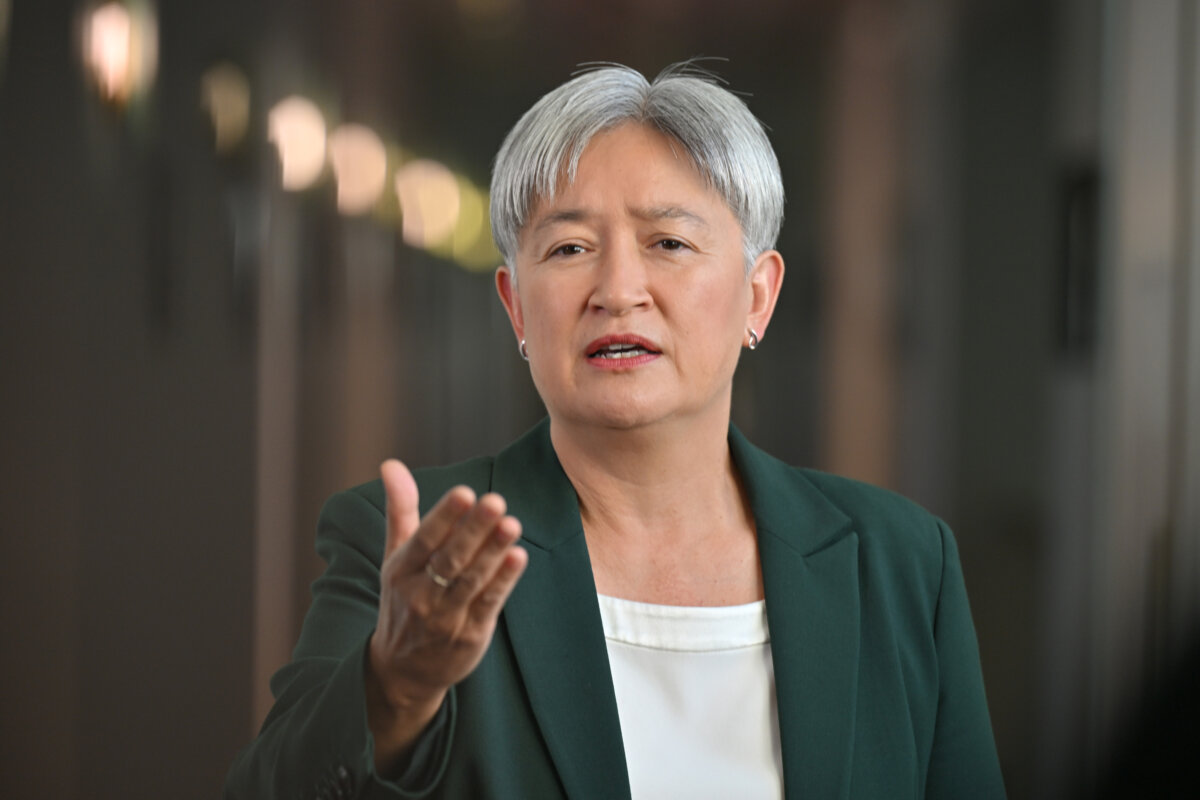

Labor Foreign Minister Penny Wong says she has struck an agreement for Chinese Communist Party (CCP)-owned oil companies to negotiate the sale of aviation fuel to Australian businesses.
The announcement comes as Beijing hints at lifting export restrictions applied to China’s domestic supply amid the Iran War fuel crisis.
China is Australia’s top source of jet fuel, responsible for 28 percent of supply.
Wong’s announcement comes during a whirlwind tour of Beijing, Japan and South Korea where she is attempting to shore up fuel shipments to Australia amid the current shortage due to years of offshoring.
As part of her trip, Wong held the eighth Australia-China Foreign and Strategic Dialogue meeting with Beijing counterpart Wang Yi on April 29.
“Following Prime Minister (Anthony) Albanese’s discussions with [CCP] Premier Li, where they agreed to increase communication and coordination on energy security, I can confirm that the Chinese government is facilitating engagement with Australian businesses on jet fuel,” Wong said in a press conference in Beijing.
Wong did not go into specific details on the agreements, instead describing the meeting’s outcome as an important “first step.”
“What we want to see is those engagements continue and commercial contracts to flow,” she told reporters.
On the issue of Australia being too dependent on Beijing, Wong said the Middle East conflict revealed how vulnerable “so many economies” were.
Around 20 percent of global oil supply passes through the Strait of Hormuz, and while Australia imports most of its fuel via Asian refineries, it remains heavily reliant on crude originating in the Middle East.
Australia’s Foreign Market Reliance
At its peak in the year 2000, the Australian oil industry had eight oil refineries that could provide for national requirements.
Australia now possesses just two refineries—Viva in Victoria and Ampol’s Lytton facility in Brisbane—and must import around 90 percent of oil needs from countries like Singapore, South Korea, India, Malaysia, China, who mostly import their crude from the Middle East.
“Australia’s current fuel crisis and the outsourcing of manufacturing was 100 percent caused by globalisation,” said retired University of Queensland academic Eric Louw, in an interview with The Epoch Times.
Globalisation—which promotes free international trade so companies can achieve the lowest possible costs—often relies upon moving manufacturing to countries with lower labour and material costs.
But the perceived benefits of globalisation are met by its vulnerabilities—supply chains that can be controlled or impacted by conflicts, over-reliance on particular countries or routes and the decline of domestic markets.
Louw, a researcher in Marxism, says regimes like the CCP have aggressively leveraged the globalisation movement to build its own influence.
“During the Cold War, the [Soviet and CCP] communists opposed globalisation and free trade. What has changed is that Beijing decided to accept [and use] the rules-based order,” he said.
“Effectively Beijing built its own global supply chains—via initiatives like the Belt and Road—by piggybacking off the free trade system the Americans built.”
 Friends Read Free
Copy
Facebook
Tweet
Friends Read Free
Copy
Facebook
Tweet