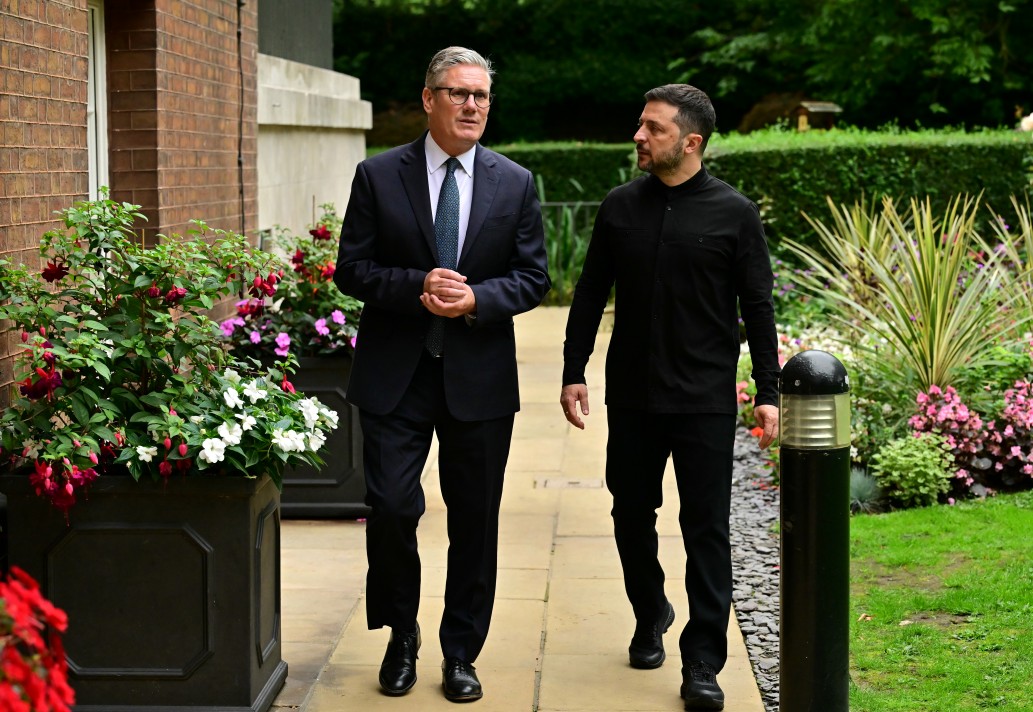
Ukrainian President Volodymyr Zelenskyy met with UK Prime Minister Keir Starmer in London on Aug. 14, on the eve of the summit between U.S. President Donald Trump and Russian President Vladimir Putin in Alaska.
After the meeting, a Downing Street spokesman said Starmer and Zelenskyy had a private breakfast, where they discussed meetings from the previous day, and said there was “a strong resolve to achieve a just and lasting peace in Ukraine.”
Zelenskyy said it had been a productive meeting, writing on X, “We also discussed in considerable detail the security guarantees that can make peace truly durable if the United States succeeds in pressing Russia to stop the killings and engage in genuine, substantive diplomacy.”
On Aug. 13, Starmer described the Alaska summit as “hugely important” and said there was now a prospect of a viable solution because of the work that Trump has put in.
The Kremlin said on Aug. 14 that the Alaska summit would start at 11:30 a.m. local time on Aug. 15, when Trump and Putin would sit down for a face-to-face meeting at the Elmendorf-Richardson joint military base, before more detailed discussions between the two delegations.
Putin held a meeting on Aug. 14 with his advisers about the summit, and in a short video released by the Kremlin, he said the Trump administration was making “quite energetic and sincere efforts to stop the hostilities.”
Zelenskyy was in Berlin on Aug. 13 as the guest of German Chancellor Friedrich Merz and held a virtual meeting with Trump and U.S. Vice President JD Vance.
At a press conference after the meeting, Zelenskyy said: “I told the American president … Putin is bluffing. … Russia is pretending they can occupy the entire Ukraine, but this is not true. Also, he’s saying that sanctions are not important and they are not working, but I am sure that sanctions are effective; they are harmful for the Russian economy.”
Starmer has been a key member of the “coalition of the willing,” a group of European countries that have offered to take part in a peacekeeping force in Ukraine if a cease-fire is agreed upon.
On Aug. 13, Trump warned of “severe consequences” if Putin does not agree on Aug. 15 to a cease-fire in Ukraine.
Asked by reporters whether he was referring to tariffs or more sanctions, Trump said: “I don’t have to say. There will be very severe consequences.”
‘Setting the Table’
But he described the Alaska summit as “setting the table” for a follow-up meeting, to which Zelenskyy would be invited.
“If the first one goes OK, we’ll have a quick second one,” Trump said. “I would like to do it almost immediately, and we’ll have a quick second meeting between President Putin and President Zelenskiy and myself, if they’d like to have me there.”
The Russian and Ukrainian positions are far apart at the moment; Zelenskyy is refusing to hand over any territory, and Moscow is insisting that Kyiv hand over Crimea and four regions—Donetsk, Luhansk, Kherson, and Zaporizhzhia—where it occupies the majority of the territory after three years of war.
Trump has insisted there would be some “land-swapping” as part of a peace agreement.
On Aug. 13, Starmer, Merz, and French President Emmanuel Macron published a joint statement following the virtual meeting with Trump and Zelenskyy.
They said they welcomed Trump’s efforts to end “Russia’s war of aggression,” and described the Aug. 13 meeting as an open discussion.
In the statement, Starmer, Macron, and Merz reiterated their position that “meaningful negotiations can only take place in the context of a ceasefire or a lasting and significant cessation of hostilities.”
“Second, sanctions and wider economic measures to put pressure on Russia’s war economy should be strengthened if Russia does not agree to a ceasefire in Alaska,” they said.
“Third, international borders must not be changed by force.”
The three European leaders also stated, “Ukraine must have robust and credible security guarantees to effectively defend its sovereignty and territorial integrity.”
“No limitations should be placed on Ukraine’s armed forces or on its cooperation with third countries. Russia could not have a veto against Ukraine‘s pathway to EU and NATO,” they said.
Putin has insisted that in order to reach a lasting peace in the conflict, there must be a guarantee that Ukraine will never become a member of NATO.
Under Article 5 of the NATO treaty, any attack on a member of the alliance “is considered as an attack against all allies,” so allowing Ukraine to join would mean Russia could face a war with NATO countries.
Russian forces in recent days have made significant advances in the Donetsk region, putting pressure on Kyiv days before the Aug. 15 summit.
According to Ukrainian sources, Russian forces are now closing in on the town of Dobropillia, which is roughly 14 miles north of the town of Pokrovsk, a key Ukrainian transit hub, the capture of which remains a long-standing Russian objective.
Reuters contributed to this report.
 Friends Read Free
Copy
Facebook
Tweet
Friends Read Free
Copy
Facebook
Tweet