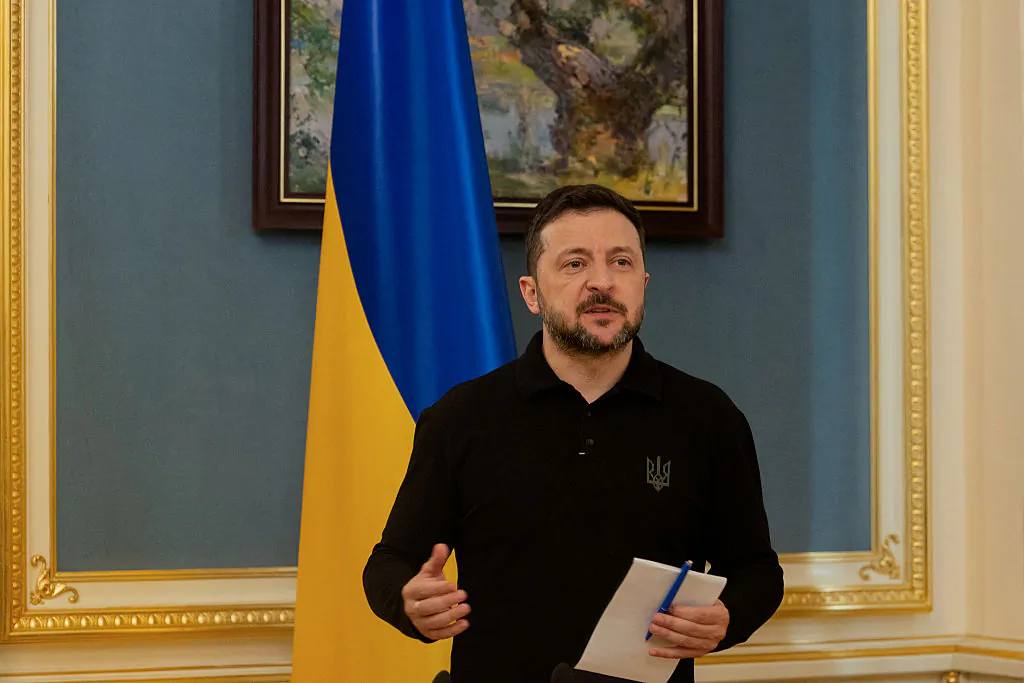

Ukrainian President Volodymyr Zelenskyy has signed a contentious law granting the country’s prosecutor general control of anti-corruption agencies, triggering backlash from officials, protests, and warnings from European Union officials about Kyiv’s commitment to rule-of-law reforms.
The new bill, signed on July 22, allows the prosecutor general to reassign prosecutors and transfer cases from the National Anti-Corruption Bureau of Ukraine (NABU) and the Specialized Anti-Corruption Prosecutor’s Office (SAPO), two agencies formed after Ukraine’s 2014 revolution to combat high-level corruption.
Zelenskyy defended the move, saying it would strengthen Ukraine’s institutions and remove Russian influence from anti-corruption infrastructure.
Ukraine must uphold the independence of its anti-corruption institutions and continue reforms to combat graft, according to the European Commission’s seven conditions for EU accession.
Critics have said the reform undermines the autonomy of watchdog bodies that have recently accused senior officials of accepting bribes.
Probe of Anti-Corruption Agencies
The legislation follows a high-profile security operation earlier this week, during which Ukrainian law enforcement agencies conducted dozens of searches involving anti-corruption officials.
The Security Service of Ukraine (SBU) said it had arrested one NABU official suspected of spying for Russia and another over alleged business ties to the country.
Others were accused of links to the banned party of fugitive former Ukrainian President Viktor Yanukovych.
In total, the SBU, the Prosecutor General’s Office, and the State Investigation Bureau carried out about 70 searches, targeting at least 15 NABU employees.
Most of the cases, according to NABU, involved administrative offenses such as traffic violations, but several officials are under investigation for more serious allegations, including links to foreign intelligence services.
According to NABU, some of the investigative actions went too far.
Zelenskyy Defends the Reform
Zelenskyy said the legislation was necessary to eliminate Russian influence within law enforcement agencies.
On July 22, he said he had met with NABU Director Semen Kryvonos, SAPO Prosecutor Oleksandr Klymenko, Prosecutor General Ruslan Kravchenko, and the head of the SBU, Vasyl Maliuk.
He emphasized that Ukraine’s anti-corruption infrastructure would continue to operate and said that delaying criminal proceedings must be investigated.
“For years, officials who have fled Ukraine have been casually living abroad for some reason—in very nice countries and without legal consequences—and this is not normal,” he said on X
“There is no rational explanation for why criminal proceedings worth billions have been ‘hanging’ for years.”
On July 23, Zelenskyy said he had held further meetings with security and anti-corruption officials, pledging to deliver a joint anti-corruption action plan within two weeks.
“We all share a common enemy: the Russian occupiers. And defending the Ukrainian state requires a strong enough law enforcement and anti-corruption system—one that ensures a real sense of justice,” he said on X.
“Criminal proceedings must not drag on for years without lawful verdicts. And those who work against Ukraine must not feel comfortable or immune to the inevitability of punishment.”
Protests and EU Alarm
The law’s passage on July 22 sparked rare public demonstrations in Kyiv and several other cities, the first major protests against Zelenskyy’s government since the beginning of the war in February 2022.
The Delegation of the European Union to Ukraine voiced concerns over the new bill.
“Undermining key guarantees of NABU’s independence is a significant step backward,” it said on X. “Independent institutions like NABU and SAP are crucial on Ukraine’s path to the EU. The rule of law remains at the heart of EU accession negotiations.”
EU Enlargement Commissioner Marta Kos said on X that she discussed the EU’s concerns with Ukrainian Prime Minister Yulia Svyrydenko and her deputy for European integration, Taras Kachka.
Kachka said on X on July 23 that he told EU Director General for Enlargement Gert Jan Koopman that Ukraine is interested in resolving the developments around the new bill in a transparent way.
 Friends Read Free
Copy
Facebook
Tweet
Friends Read Free
Copy
Facebook
Tweet