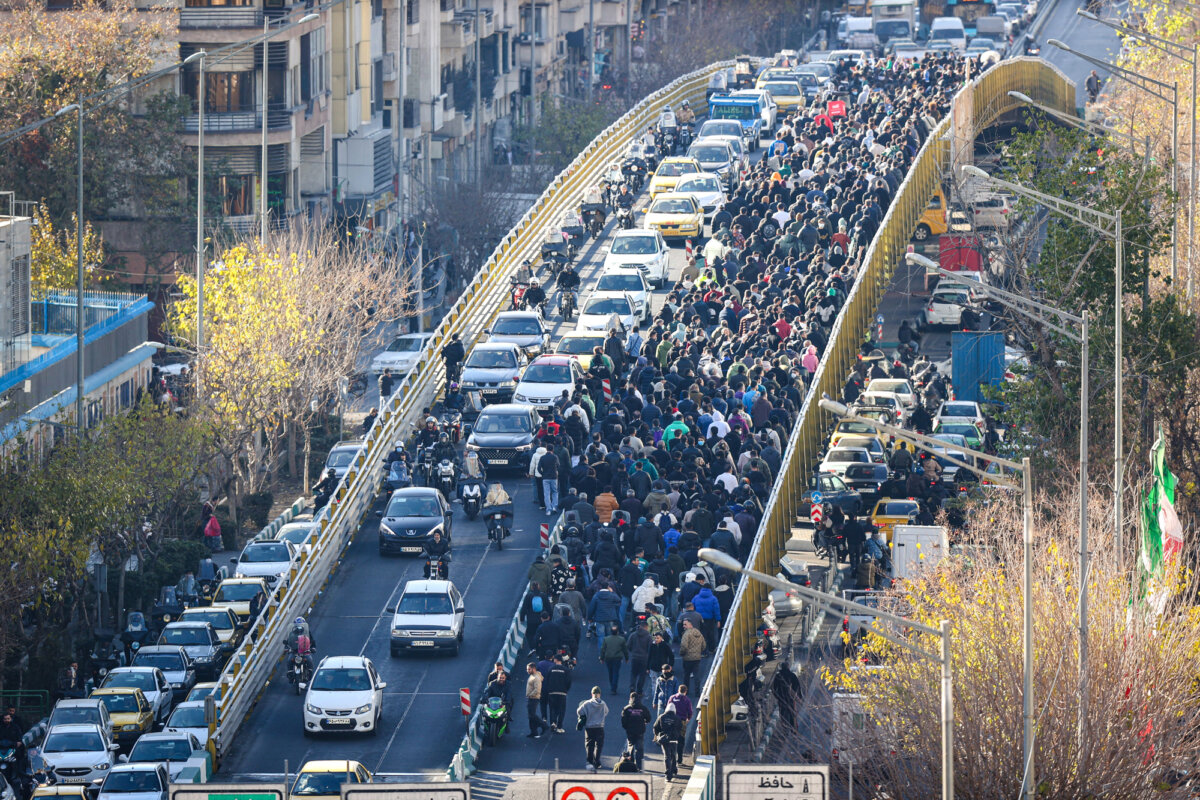
What initially started as a reaction to economic distress amid sanctions and the tanking of the Iranian rial has turned into mass demonstrations against the ruling regime, with calls for the overthrow of the government of the Islamic Republic.
In the span of about a week, the protests evolved into one of the longest and most persistent episodes of unrest Iran has seen in recent months, according to rights monitors.
At least 119 people have been arrested, while at least eight individuals have been killed and 33 others injured since demonstrations began, according to the Human Rights Activists News Agency, which stated that protests have spread to at least 32 cities across multiple provinces.
1. Currency Drop
The immediate trigger for the unrest was a sharp decline in the value of Iran’s foreign exchange market. In late December 2025, the U.S. dollar climbed on the open market from below 1 million rials to about 1.45 million rials, fueling inflation, unsettling markets, and deepening cost-of-living pressures for Iranians.
Rising rents, lack of basic goods, and fluctuating wages have increased frustration amid the daily difficulties of living under the Islamic regime’s authoritarian rule.
Merchants in Tehran’s historic bazaar, which is often seen as a sign of economic confidence, said they struggled to set prices from one morning to the next, as currency swings made sales risky.
In several cities, shops closed and strikes spread along with street protests, attracting students, workers, and small business owners.
Security forces reacted with crowd suppression tactics, including the use of tear gas and, in some cases, shooting directly at protesters, based on eyewitness reports and video footage shared online. As the protests grew, economic complaints slowly turned into political slogans.
2. Government Response
Even though the mood on the streets has changed, the government has so far framed the situation as an economic issue. Authorities have replaced some top financial officials and promised policy changes.
As part of these steps, President Masoud Pezeshkian named Abdolnaser Hemmati as head of the Central Bank. Hemmati is linked to earlier reform efforts but was previously removed from his post after lawmakers accused him of causing problems with the exchange rate. His return has raised new political tensions and criticism from hardline members of parliament.
Several analysts say that only making some leadership changes cannot resolve Iran’s crisis. Political commentator Saeed Bashirtash said expectations surrounding the replacement of economic officials are misplaced.
“The idea that changing the central bank governor can solve Iran’s economic problems is an illusion,” Bashirtash said in an interview with the Persian edition of The Epoch Times, arguing that the crisis runs deeper than any single policy shift.
“The Islamic Republic is fundamentally at odds with the modern world. Its bankruptcy is rooted in its ideology and constitutional framework.”
According to Bashirtash, public sentiment in Iran has shifted toward the belief that reform from within the existing system is no longer possible.
“Even if President Pezeshkian wanted to pursue real reforms, the system itself would not permit them,” he said.
Bashirtash said addressing Iran’s economic and political challenges would require a comprehensive transformation, including reengagement with the international community, combating systemic corruption, establishing an independent judiciary, separating religion from the state, and ensuring respect for citizens’ rights.
3. Turning Point
Some analysts link the economic crisis fueling the protests to recent regional and international developments. Arya Kangarloo, a political commentator, said Iran’s 12-day conflict with Israel in June marked a turning point in the Islamic Republic’s projection of power.
Kangarloo said the conflict exposed what he described as the collapse of the regime’s core strategic tools.
“For years, the Islamic Republic relied on two main pillars: its nuclear program and its network of proxy forces,” he told The Epoch Times.
According to Kangarloo, these proxy forces—including the Hezbollah and Hamas terrorist groups, the Assad regime in Syria, Houthi terrorists in Yemen, and Iraqi militias—were created to put pressure on Israel through coordinated attacks on several fronts. He said that by weakening these groups, Israel removed one of the Islamic regime’s main strategic tools.
He noted that Israel’s strikes inside Iran, together with direct U.S. strikes on three Iranian nuclear sites, marked a major change. He said these actions broke the regime’s image as a regional power and left it in a weak strategic position.
Kangarloo also mentioned recent moves by European countries to activate the so-called snapback mechanism, which would bring back international limits on economic ties with Iran. He said all these pressures together have played a direct role in the sharp fall of Iran’s currency.
“When the rial loses almost 8 percent of its value in just one day, normal business cannot continue,” he said. “The bazaar is the biggest center of trade in Iran. When merchants are no longer able to do business, they reach their limit.”
As the demonstrations continued throughout the week, the slogans clearly moved beyond economic demands. Video footage shared online shows protesters shouting chants such as “death to the dictator” and “Seyyed Ali will be toppled this year,” directly challenging the foundations of the Islamic regime. Seyyed Ali refers to Iran’s Supreme Leader, Seyyed Ali Khamenei.
At the same time, many protesters have turned to Iran’s pre-revolutionary past. In cities across the country, crowds were heard chanting phrases such as “This is the final battle, Pahlavi will return” and “Reza Shah, may God bless your soul.”
The return of these slogans has once again focused attention on Iranian Crown Prince Reza Pahlavi, who has spent most of his life in exile but still carries strong symbolic meaning for many in the country.
4. The Exiled Crown Prince
Pahlavi was born in Tehran on Oct. 31, 1960. He is the eldest son of Mohammad Reza Shah Pahlavi, Iran’s last monarch, and the grandson of Reza Shah Pahlavi, founder of the Pahlavi dynasty. He was named crown prince at his father’s coronation in 1967 and spent his early childhood within the royal court.
In 1978, amid mounting unrest, he left Iran to train as a fighter pilot in the United States. Months later, the 1979 revolution erupted, overthrew the monarchy, and forced the royal family into exile.
Pahlavi later completed his U.S. Air Force training and earned a degree in political science, ultimately settling near Washington, where he lives with his wife and three daughters.
Over the decades, Pahlavi has sought to redefine himself as an advocate of democracy and secular governance, rather than a claimant to the throne. He has repeatedly called for a national referendum that would allow Iranians to freely decide their country’s future political system.
Pahlavi has said that he does not see himself as a ruler with permanent power but as a figurehead for a possible transition period. He has explained that his role would be to help Iran move past the Islamic Republic and toward a true democratic system.
He has stressed that this leadership would be temporary and would be followed by a national referendum and the handover of power to institutions chosen by the Iranian people.
In recent years, the Iran Prosperity Project has become a key element of Pahlavi’s political platform. The initiative—developed in cooperation with the National Union for Democracy in Iran and a network of economic and legal advisers—is provided as a transitional roadmap for a post-Islamic Republic Iran.
Focusing on economic stabilization rather than prescribing a permanent political system, the project emphasizes market-based reforms, government transparency, protection of private property, combating corruption, and reintegration into the global economy.
Pahlavi has said that the plan is meant to prevent the collapse of the economy during a political transition and to give confidence to both Iranians and the international community that political change will not cause long-term instability.
5. The Pahlavi Legacy
Reza Shah Pahlavi, the grandfather of Reza Pahlavi, rose through the military ranks in the 1920s and was elected shah after the last Qajar monarch was deposed. During his rule, he started major modernization programs, including building infrastructure, reforming education, and reducing foreign influence.
His son, Mohammad Reza Shah, ruled Iran from 1941 to 1979. During this time, Iran saw rapid economic growth and industrial development, wider access to education and health care, and social changes, including granting women the right to vote and participate in public life.
At the same time, his government was often criticized by opponents at home and by observers abroad for limiting political parties and suppressing dissent. Human rights groups accused the security services of making arbitrary arrests, censoring the media, and torturing political prisoners. These claims later became an important part of the revolutionary narrative, questioning the legitimacy of the monarchy.
In foreign policy, Iran under Mohammad Reza Shah became a close ally of the United States and an important part of Western security plans in the Middle East.
With support from the United States, Mohammad Reza Shah used Iran’s economic and military power to protect the Persian Gulf, oil facilities, and shipping routes and limit the spread of communism during the Cold War rivalry with the Soviet bloc.
Although he was strongly aligned with the West, the shah also tried to keep balance in the region. In the 1960s, he moved toward better relations with the Soviet Union and expanded economic and technical cooperation while still keeping close ties with conservative Arab countries.
At the same time, Iran became Israel’s most important strategic partner in the region. Iran was often called the “gendarme of the Persian Gulf,” with a role meant to stop communist influence and support stability, not only in the Middle East but also in parts of Africa.
Inside the country, however, Marxist ideas became more popular. Leftist groups, especially the Tudeh Party of Iran and later radical student movements, grew in universities, in cultural circles, and among intellectuals.
They spread ideological propaganda, recruiting students and, in some cases, using violence. These groups carried out bank robberies, bomb attacks, and strikes on state and private targets in their struggle against the monarchy.
By the late 1960s and into the 1970s, Marxist ideas began to mix more with radical political Islam. Ideas such as anti-imperialism, social justice, and opposition to capitalism were explained in religious language that many people could understand and support.
Ruhollah Khomeini, founder of the Islamic Republic, openly rejected Marxism but drew on its themes and expressed them within a Shiite Islamic framework that could unite opposition groups.
This mix of ideas led to the 1979 Iranian Revolution. Soon after the revolution, leftist student groups took over the U.S. Embassy in Tehran, holding U.S. diplomats hostage and demanding that the shah be returned from the United States, where he was receiving medical treatment. The groups were first united against the shah but then quickly split, as the new Islamic government began to suppress its former leftist allies.
In the recent protests, a growing number of people have been chanting the name of Reza Pahlavi—many protesters inside and outside of Iran now see him as a unifying figure and a symbol of a new political era.
President Donald Trump recently warned on social media that any use of live fire against protesters would trigger U.S. support for the Iranian people.
Taken together, the revival of monarchist symbolism on the streets, the articulation of a post-regime transition plan, and increasingly explicit foreign warnings have fueled perceptions that Iran may be entering a decisive phase, one that could mark the beginning of the end for the Islamic Republic of Iran.
 Friends Read Free
Copy
Facebook
Tweet
Friends Read Free
Copy
Facebook
Tweet