
After trading fire for about 12 days, Iran and Israel have agreed to wind down a conflict that set the Middle East on edge.
The conflict began amid an impasse over Iran’s nuclear program. U.S. President Donald Trump had pressed Iran to agree to abandon its nuclear programs. While Iran has insisted it’s not pursuing nuclear weapons, Iranian negotiators had signaled reluctance to give up Iran’s uranium enrichment capabilities.
In the early morning hours on June 13, Israeli warplanes launched a surprise attack aimed at crippling Iran’s nuclear program and offensive military capabilities. Following the attack, Iranian representatives pulled out of talks set for June 14 with U.S. counterparts in Oman.
Iran also retaliated for the Israeli strike with barrages of explosive drones and ballistic missiles, several of which managed to slip through Israel’s air defense networks, causing death, injuries, and damage throughout Israel.
As the conflict grew, the U.S. military diverted the Nimitz Carrier Strike Group to the Middle East and set its troops on heightened alert.
Before the fighting came to a close, Trump ordered an around-the-world stealth bomber strike targeting three Iranian nuclear sites. The primary target of this U.S. bombing mission was the Fordow uranium enrichment facility, situated hundreds of feet underground, mostly out of reach of the weapons Israel’s Air Force possesses. The Trump administration has touted the strikes on the three Iranian nuclear facilities as a huge success, though the full extent of the damage to Iran’s nuclear program is not entirely clear.
Following what he cast as a “weak” and largely theatrical Iranian retaliatory missile barrage targeting a U.S. base in Qatar, Trump announced that both Iran and Israel had agreed to a cease-fire to end the conflict.
“I would like to congratulate both Countries, Israel and Iran, on having the Stamina, Courage, and Intelligence to end, what should be called, ‘THE 12 DAY WAR,’” Trump wrote in a June 23 Truth Social post laying out the cease-fire plan.
Reflecting on the course of the conflict in an interview with Fox News host Bret Baier later that evening, U.S. Vice President JD Vance said the short-lived conflict marked an opportunity to change the course of diplomacy in the Middle East.
“I actually think, when we look back, we will say the 12-Day War was an important reset moment for the entire region,” Vance said.
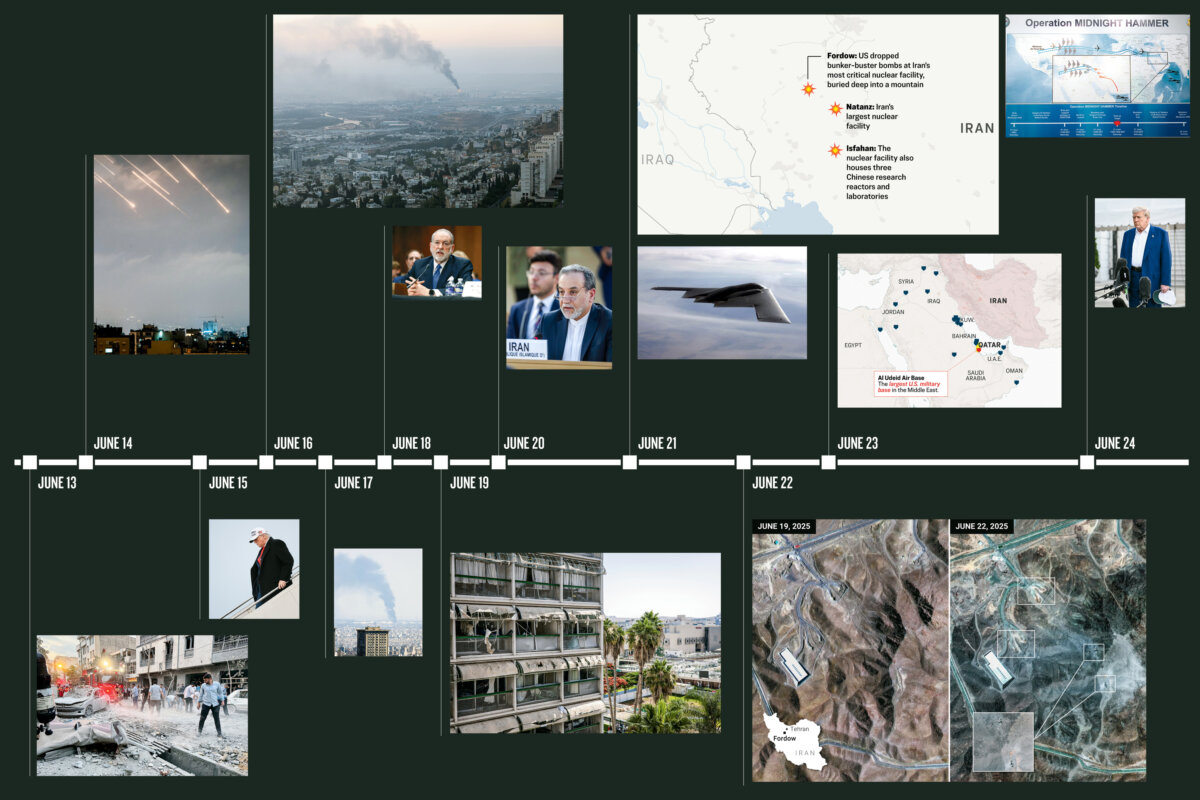
June 13
- In the early hours of June 13, Israeli warplanes conduct a surprise attack across Iran, targeting Iranian military and nuclear facilities, multiple top Iranian military officials, and leading nuclear scientists.
- Israeli Prime Minister Benjamin Netanyahu, claiming that Iran was drawing closer to a nuclear weapon, says the attacks “struck at the heart” of Iran’s nuclear enrichment program.
- In a post on social media, U.S. President Donald Trump says he had given Iran a 60-day window to make a deal to constrain its nuclear program, and says Israel’s strikes were conducted on the 61st day. Trump urges Iran to seek a deal limiting its nuclear program.
- In the waning hours of June 13, Iranian forces begin a retaliatory strike, launching salvos of missiles and explosive drones toward Israel.
June 14
- Iranian representatives back out of June 14 talks with U.S. representatives in Oman. The talks had been scheduled before the June 13 Israeli surprise attack.
- Israeli and Iranian forces continue to launch strikes at each other.
June 15
- Trump posts on social media that there will soon be peace between Israel and Iran and says there are “many calls and meetings now taking place.”
June 16
- Iranian missiles hit four areas in Israel.
- Iranian Foreign Minister Abbas Araqchi says if Trump genuinely wants an end to the war, he needs to rein in Israel.
- Israeli aircraft strike a studio operated by Iran’s state-run Islamic Republic of Iran Broadcasting network, claiming it was being used for military purposes.
- Leaders of the G7—the United States, the UK, Japan, France, Italy, Germany, and Canada—hold a summit in Canada. They issue a joint statement affirming support for Israel, calling Iran “the principal source of regional instability and terror,” and declaring that Iran cannot obtain a nuclear weapon.
- Trump departs the summit early to return to Washington as the Israel–Iran conflict rages on. On board Air Force One on the return flight, Trump says, “I’m not looking for a cease-fire. We’re looking at better than a cease-fire.”
June 17
- Israeli forces issue an evacuation order for Area 3 of the Iranian capital of Tehran, where an estimated 330,000 people live.
- Trump posts in all caps on social media, “Unconditional surrender!”
June 18
- The U.S. Embassy in Israel announces it will be closed from June 18 to 20.
- U.S. Ambassador to Israel Mike Huckabee announces efforts are underway to evacuate U.S. citizens and lawful permanent residents in Israel.
June 19
- An Iranian missile damages the Soroka Medical Center in Be’er Sheva, Israel, injuring 240 people.
- Israeli Defense Minister Israel Katz issues a threat to Iranian leader Ali Khamenei after the hospital strike, saying, “This man absolutely should not continue to exist.”
- The White House announces Trump will decide within the next two weeks whether the United States should join the conflict between Israel and Iran.
June 20
- Israeli forces say they carried out strikes on dozens of Iranian military targets.
- The British, French, and German foreign ministers, along with the European Union’s foreign policy chief, hold talks with Iran’s foreign minister to find ways to resolve the conflict. The Iranian foreign minister states, “As long as the aggression and attacks continue, there is simply no room for talk of dialogue or diplomacy.”
June 21
- Just after midnight ET: U.S. Air Force B-2 Spirit bombers depart Whiteman Air Force Base, Missouri, heading east across the Atlantic.
- 5 p.m. ET: B-2 bombers enter the U.S. Central Command area of responsibility, while U.S. warships begin launching Tomahawk cruise missiles at Iran’s Isfahan nuclear facility.
- 6 p.m. ET: U.S. fighter jets flying ahead of B-2 bombers begin striking Iranian air defense systems along the route to the Fordow and Natanz nuclear facilities.
- Between 6:40 p.m. and 7 p.m. ET: B-2 bombers drop bunker-buster bombs on Fordow and Natanz.
- 7:05 p.m. ET: The last U.S. Tomahawk missiles fall on Iran’s Isfahan nuclear facility.
- 7:30 p.m. ET: B-2 bomber crews exit Iranian airspace.
- 7:50 p.m. ET: Trump announces the U.S. strike on Iran.
June 22
- Briefing the press, Defense Secretary Pete Hegseth says the goal of the operation was not regime change in Iran and was “intentionally limited.”
- Trump announces the B-2 bombers have all returned back to the Whiteman base, nearly two days after they departed.
- Trump publishes a social media post stating: “It’s not politically correct to use the term, ‘Regime Change’, but if the current Iranian Regime is unable to MAKE IRAN GREAT AGAIN, why wouldn’t there be a Regime change??? MIGA!!!”
- Iran’s Supreme National Security Council begins deliberations on whether or not to close the Strait of Hormuz following the U.S. strikes.
- In an interview with Fox News’ “Sunday Morning Futures,” U.S. Secretary of State Marco Rubio says it would be “economic suicide” for Iran to block the Strait of Hormuz. Rubio calls on China to help sway Iran against such a move.
June 23
- White House press secretary Karoline Leavitt again warns Iran against closing the Strait of Hormuz.
- Iran launches a missile barrage at the Al Udeid Air Base in Qatar. Airspaces close around Qatar, Bahrain, and United Arab Emirates.
- U.S. forces report they successfully intercepted the Iranian missiles. Trump reports that of the 14 missiles fired by Iran, U.S. forces “knocked down” 13 and “set free” another that was heading in a nonthreatening direction. Qatar’s government reports that 19 missiles were fired, with only one striking a military base, without causing casualties.
- Trump announces that Iran gave advanced notice of the attack, and no U.S. personnel or Qataris were harmed.
- At 6 p.m. ET, Trump says Israel and Iran have agreed to a cease-fire, which will be phased in over the ensuing 24 hours.
June 24
- In the hours following Trump’s cease-fire announcement, Israel and Iran both report attacks emanating from the other side.
- While departing for the NATO summit in the Netherlands, Trump criticizes Israel and Iran for continuing to carry out attacks during the cease-fire phase-in period.
- Trump distances himself from talk of regime change in Iran. “I’d like to see everything calm down as quickly as possible,” he says.
- Netanyahu announces that Israel called off additional strikes on Iran following a call with Trump.
 Friends Read Free
Copy
Facebook
Tweet
Friends Read Free
Copy
Facebook
Tweet