
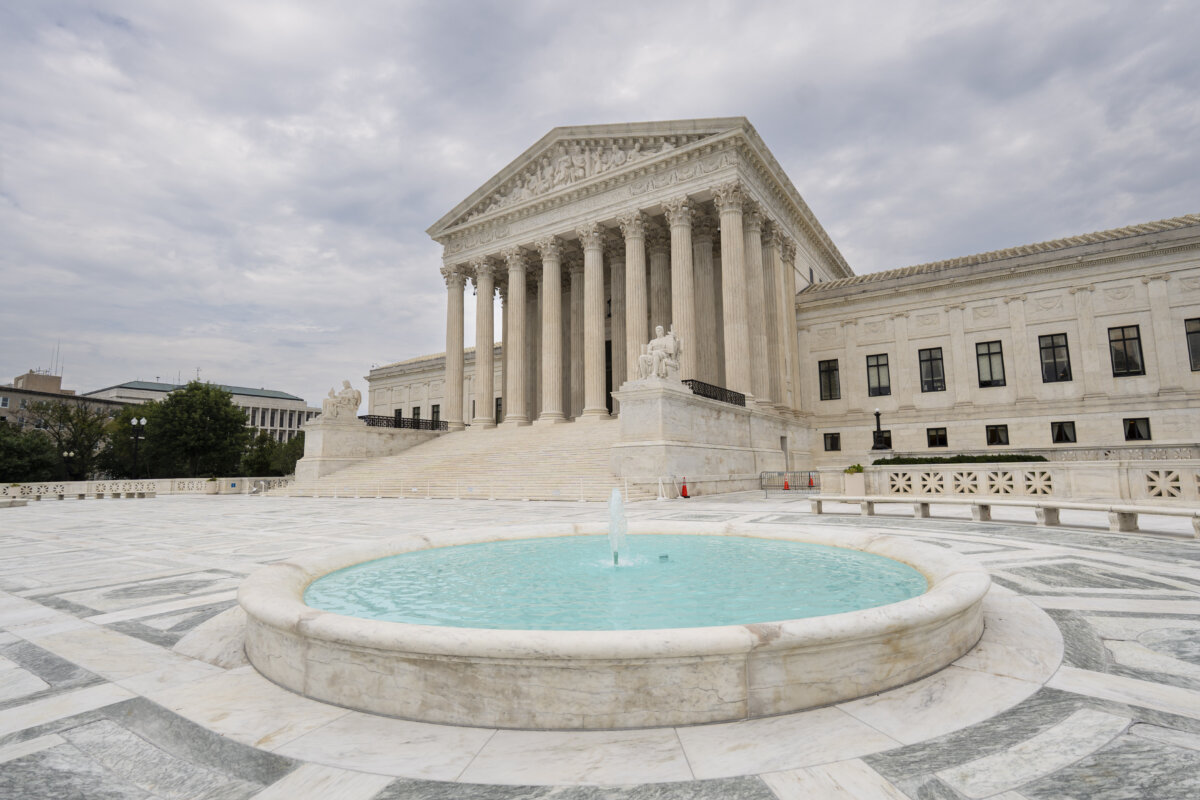

The Supreme Court on Sept. 4 released the final part of its fall argument calendar, assigning dates in five cases concerning parental authority, workplace sex-discrimination claims under Title IX, bans on AR-15-style rifles, civil asset forfeiture, and proof-of-citizenship rules for voter registration.
The scheduling order places these five high-profile legal disputes on a two-week stretch on the calendar running from Nov. 30 to Dec. 8.
The justices will consider whether Title IX lets school employees sue for workplace discrimination; whether Alaska can seize a $95,000 airplane over a six-pack that was to be flown to a dry village; whether the Second Amendment covers AR-15-style rifles banned in Cook County, Illinois, and Connecticut; whether Washington state parents have standing to challenge a runaway-shelter rule that withholds notice when a child seeks so-called gender-transition treatment; and whether Arizona may demand proof-of-citizenship to register voters in the 90 days before a federal election.
Taken as a whole, the arguments will test how far states may go in regulating guns, voting, parental authority, civil forfeiture, and the reach of federal civil rights statutes—and whether the justices will reverse lower-court rulings that blocked those challenges.
Sex Discrimination Claims
In Crowther v. Board of Regents of the University System of Georgia, to be heard Nov. 30, the court will decide whether Title IX of the federal Education Amendments Act of 1972 bestows on employees of federally funded schools a private right to sue for sex discrimination at work. Title IX is a civil rights law that forbids discrimination “on the basis of sex” at any school that receives federal funding.
The appeal consolidates claims by Thomas Crowther, a former Augusta University art professor, and MaChelle Joseph, formerly a women’s basketball coach at Georgia Tech.
Crowther was investigated after students accused him of sexual harassment in 2020. He denies the allegations and says the process was biased against him because he was a man. The university later declined to renew his contract. Joseph says she was fired after she complained that the women’s program received inferior resources compared with the men’s team.
Both sued under Title IX. The U.S. Court of Appeals for the 11th Circuit held that Title IX creates no implied private right of action for employment discrimination and that such claims instead be brought under Title VII of the Civil Rights Act of 1964.
Eight other circuits allow employee Title IX suits; three do not. Crowther and Joseph say Title IX offers broader remedies and fewer procedural hurdles than Title VII. The university system says Congress intended Title VII, instead of Title IX, to be the exclusive private legal avenue for workplace sex-discrimination claims.
U.S. Solicitor General D. John Sauer filed a brief agreeing with the university system and argued that Title IX doesn’t give employees a private right to sue for workplace sex discrimination.
Gun Rights Cases
On Dec. 2, the court will hear two gun-rights cases together: Viramontes v. Cook County and Grant v. Higgins. The justices will consider whether the Second and 14th Amendments protect the right to possess AR-15-style and similar semiautomatic rifles.
Cutberto Viramontes and others challenged Cook County, Illinois’s ban on so-called assault weapons, including AR-15s and AK-47-style rifles and certain feature-based configurations.
Eddie Grant Jr. and gun-rights groups challenged Connecticut’s similar statewide ban. Lower courts in the Seventh and Second Circuits upheld both laws, treating the rifles as akin to military weapons that governments may prohibit.
Challengers, including the Second Amendment Foundation and Firearms Policy Coalition, say AR-15-style rifles are among the most commonly owned long guns in the United States, in civilian use since the 1960s, and that they are therefore “arms” in common use for lawful purposes under the Supreme Court’s landmark rulings in District of Columbia v. Heller (2008) and New York State Rifle and Pistol Association v. Bruen (2022).
Cook County has called the rifles “the weapon of choice for criminals and terrorists set on quickly massacring innocents.”
About a dozen states and several major cities have similar bans. Congress allowed a federal ban on so-called assault weapons to expire in 2004.
Notifying Parents About Gender Transitions
On Dec. 7, the court will hear International Partners for Ethical Care Inc. v. Ferguson. The case is about whether parents have standing—the legal right to sue by showing a stake in the outcome of a dispute—to challenge a Washington state policy that, they say, removes them from decisions about so-called gender transitions for their children.
At one time, Washington required licensed youth shelters to notify parents within 72 hours when a runaway minor arrived. Later amendments created an exception when a minor is “seeking or receiving protected health care services,” defined to include “gender-affirming treatment.”
In such a situation, the shelter notifies the state rather than the parents. There is no set timeline for reunification, and parents are provided no information about the child’s location or condition.
International Partners for Ethical Care, an advocacy group, and five sets of Washington parents sued Gov. Bob Ferguson, a Democrat, and other officials. They say the system deprives them of their constitutional right to direct their children’s upbringing. A federal district court and the Ninth Circuit dismissed the case for lack of standing.
The legal question is whether parents have standing to challenge a law that displaces their decision-making role regarding gender transitions and creates impediments to parenting.
Seizing A Plane Over Beer
In Jouppi v. Alaska on Dec. 1, the justices will decide whether Alaska may forfeit, or seize, a $95,000 Cessna plane after troopers found a six-pack of beer on a flight bound for a dry village.
In 2012, bush pilot Ken Jouppi was loading a flight from Fairbanks to Beaver, a community that bans alcohol, when police found Budweiser in a grocery bag among a passenger’s belongings. Jouppi was convicted of a misdemeanor for knowingly transporting alcohol. He received a short jail sentence and a fine.
Then the state sought the plane through a legal process known as civil asset forfeiture, under which property, including a vehicle, used to commit a crime is deemed an instrumentality of the crime and can be seized.
Civil libertarians and those subject to asset forfeitures arising from criminal convictions—as well as in cases where a person is merely suspected of a crime—have long complained that the practice can be arbitrary and excessive.
Jouppi’s attorneys said he does not search passengers’ luggage and that taking the aircraft for a small quantity of beer violates the Eighth Amendment’s ban on excessive fines. The Alaska Supreme Court disagreed, holding that “the illegal importation of even a six-pack of beer causes grave societal harm” and that forfeiture was not grossly disproportional to the gravity of the offense.
The justices will consider whether the forfeiture can be justified by the seriousness of the crime in general, or whether courts have to look at what Jouppi himself did.
Citizenship Proof in Elections
In Republican National Committee v. Mi Familia Vota, to be heard on Dec. 8, the court will decide two Arizona voting rules.
The first is whether the state may require a passport, birth certificate, or other proof of citizenship from people who register on a state form. The second is whether, in the 90 days before a federal election, Arizona may still remove voters after officials confirm they are not U.S. citizens.
A 2022 Arizona law, signed by then-Gov. Doug Ducey, a Republican, requires “satisfactory evidence” of U.S. citizenship—such as a passport, birth certificate, or naturalization papers—when a person registers on a state form. Because only U.S. citizens are allowed to vote in federal elections, officials are also directed to cancel a registration if roll checks confirm the person is not a citizen.
Mi Familia Vota and other advocacy groups sued, arguing the National Voter Registration Act of 1993 and a 2018 consent decree—a legally binding settlement agreement—forbid the proof requirement and barred systematic name removals during the act’s pre-election “quiet period.”
The Ninth Circuit agreed with their arguments and kept much of the law blocked. The Supreme Court had earlier allowed Arizona, pending a final ruling, to enforce the proof rule for new voter registration applicants who use the state form.
The Republican National Committee says the Ninth Circuit’s decision stopped Arizona from enforcing a basic citizenship qualification. The U.S. Department of Justice has supported the cancellation of confirmed noncitizen registrations. Voting rights groups say last-minute voter roll cleanups risk dropping eligible voters too late to correct errors.
Jack Phillips and Stacy Robinson contributed to this report.
 Friends Read Free
Copy
Facebook
Tweet
Friends Read Free
Copy
Facebook
Tweet



























