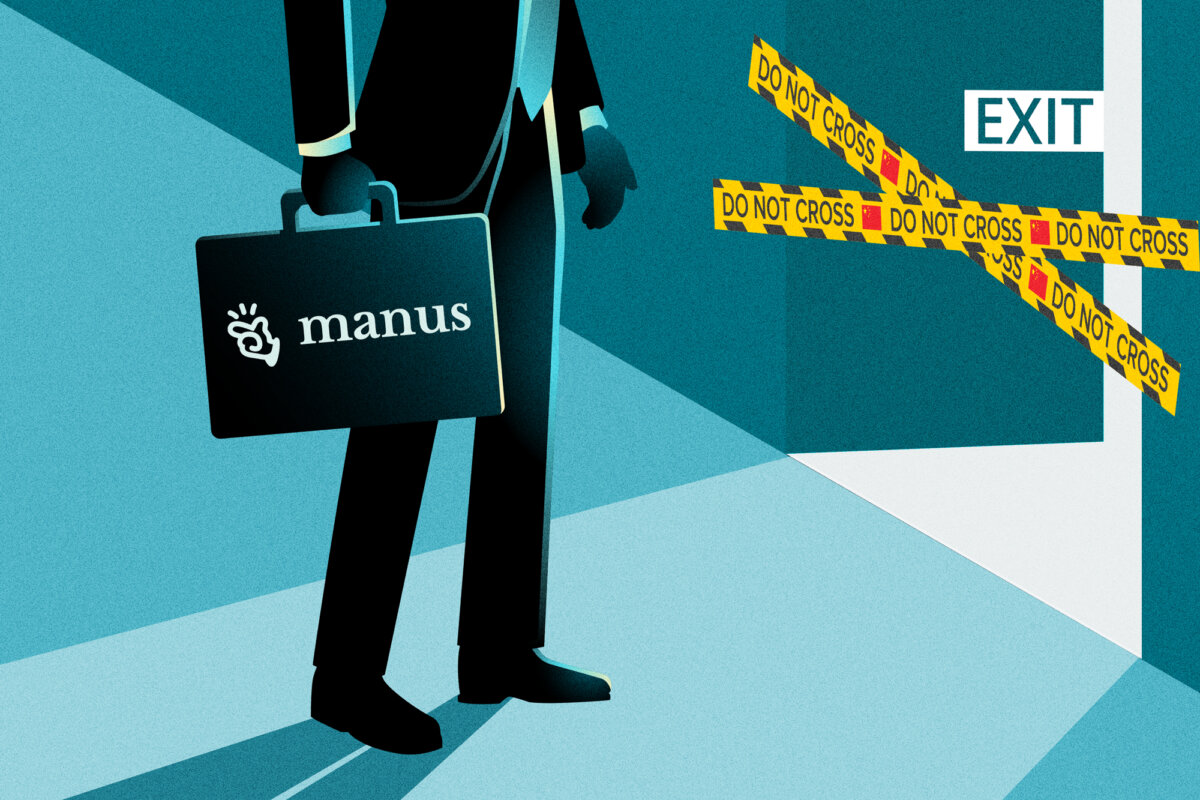
Before Beijing formally blocked Meta’s roughly $2 billion acquisition of the AI startup Manus, it first made sure the company’s two top executives couldn’t leave the country.
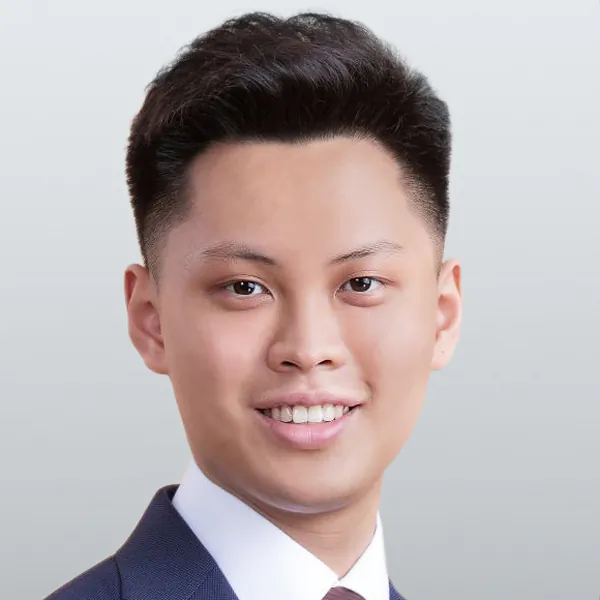
In March, Chinese authorities summoned Manus CEO Xiao Hong and chief scientist Ji Yichao to a meeting in Beijing. Both men were based in Singapore, where Manus had moved its headquarters nine months earlier. They were questioned by officials from the National Development and Reform Commission (NDRC) over what regulators framed as possible violations of foreign investment reporting rules.
After the meeting, they were told they could not leave mainland China, a development the Financial Times first reported on March 25, citing people familiar with the matter.
A month later, on April 27, the NDRC ordered Meta to reverse the acquisition—a process that involved disentangling rights, capital, and intellectual property—within several weeks.
When asked by the AFP news agency about the decision to block the deal and bar Manus’s cofounders from leaving the country, Chinese Foreign Ministry spokesman Lin Jian said that Beijing only reviews foreign investment “in accordance with laws and regulations.”
The case is without precedent. It is the first time Beijing has used exit bans on company executives to derail a multibillion-dollar foreign tech acquisition, and the first publicly blocked foreign deal under China’s 2021 foreign investment security review system.
Analysts told The Epoch Times that it marks a striking expansion of how far the Chinese Communist Party (CCP) is willing to go to stop technology, capital, and talent it considers strategically important from leaving its grasp—even when the target is, on paper, a Singapore-incorporated company with no remaining Chinese ownership.
They say the chilling effect is likely to ripple across China’s AI industry, scaring off foreign investors, closing exit options, and pushing some of the country’s most ambitious entrepreneurs to build outside China from day one—or to leave earlier than they otherwise would.
How Manus Tried to Leave
Manus was founded in Beijing in 2022 under parent company Butterfly Effect Technology. It became one of China’s most-watched AI startups in March 2025 when it unveiled a general-purpose AI agent that could complete complex tasks—drafting reports, building slide decks, screening résumés—with little human direction. Coming weeks after DeepSeek’s breakout moment, it was hailed in Chinese state media as the country’s next AI star.
The company then moved quickly to put distance between itself and China. In April 2025, it raised $75 million in a Series B led by U.S. venture firm Benchmark, at a valuation of roughly $500 million. By mid-2025, it had relocated its global headquarters to Singapore. By July, it had laid off most of its Beijing staff and stopped operating in China.
On Dec. 29, 2025, Meta announced it would acquire Manus for about $2 billion, saying there would be no continuing Chinese ownership and that Manus would shut down its remaining China services. Within days, Meta began folding the technology and roughly 100 Manus employees into its Singapore office. In January, the Chinese Ministry of Commerce announced a probe into the deal. By March, the founders were trapped in Beijing. By late April, the deal was dead.
Why Beijing Intervened
The intervention drew international attention because, by any conventional reading, Manus had already left China. Its parent company was reincorporated in Singapore, and it had no operations in China. Its U.S.-acquirer had pledged to sever any remaining ties.
Chinese state media defended the move anyway. CCTV said Beijing was targeting a “bath-style overseas expansion”—when companies strip out their China registration but still benefit from Chinese-trained engineers, research, and data. The Global Times argued that the bigger concern was whether Meta was using the deal to “acqui-hire” a team that Beijing considered strategically important.
Wang Shiow-Wen, an assistant research fellow at Taiwan’s Institute for National Defense and Security Research, told The Epoch Times that Beijing views Manus the same way it views DeepSeek: as a strategic asset.
She said Manus’s effort to “de-China-ize” by moving offshore and selling to a U.S. buyer angered authorities who saw the relocation as an attempt to escape Chinese oversight while the underlying technology and people remained tied to the mainland.
Her colleague Domingo I-Kwei Yang, an assistant research fellow at the institute’s Division of National Security Research, said the decision was meant to deter other Chinese AI firms from following the same playbook.
Beijing now treats AI as part of China’s sovereign capability, Yang said, and the timing—only weeks before President Donald Trump’s May 14–15 summit with Xi Jinping in Beijing—suggests Beijing also wanted to demonstrate it has tools of its own in the AI competition with Washington.
U.S.-based China affairs analyst Wang He drew a comparison to Didi, the ride-hailing giant that listed on the New York Stock Exchange in 2021 and was forced to delist after a regulatory crackdown from Beijing.
The Manus decision, he said, is more political than commercial. The reported exit bans on the founders make that obvious—“calling executives back to China and confiscating their freedom of movement is not how a normal regulatory review works.”
Manus did not respond to a request for comment.
Cost to China’s AI Sector
The irony is that Beijing’s move could damage the industry it is trying to protect, Yang said.
U.S. AI startups raised nearly $270 billion in the first quarter of 2026, according to accounting and consulting firm KPMG—more than 13 times what Chinese AI startups raised.
For Chinese founders, securing foreign capital, global customers, and overseas buyers is often the difference between scaling up and dying, Wang He said.
Many Chinese startups need to go abroad to find serious financing and meaningful international visibility. By blocking the Manus deal, Beijing has effectively cut off that path. He called it a “strangling” of a business model that could have helped Chinese AI companies compete globally.
Yang said the broader chilling effect is the bigger problem. Companies that had been considering offshore relocation, restructuring, or foreign investment will now hesitate. Founders may worry that even if they leave, Beijing will still claim jurisdiction—or summon them back later for “questioning” they cannot decline.
That leaves Chinese AI entrepreneurs with a stark choice, Yang said: stay home and accept tighter state control, or build outside China from the start. Staying carries its own costs—U.S. export controls on chips, Chinese ideological reviews, national security regulations, and dependence on U.S.-controlled software ecosystems all push up R&D costs.
Wang Shiow-Wen warned that without overseas expansion, some Chinese AI startups may simply run out of money before they mature, falling into what she called the innovation “valley of death.”
She also pointed to a broader pattern of tightening control over tech talent, citing reports that members of DeepSeek’s core team have had their passports taken and been restricted from meeting with foreign visitors.
Controls on AI talent outflows, she said, are likely to keep getting stricter.
What the US Would—and Would Not—Do
The case has reignited debate over whether Washington would behave the same way.
Chris McGuire, a senior fellow for China and emerging technologies at the Council on Foreign Relations, argued that Beijing’s logic effectively means any AI company founded in China remains permanently subject to CCP control, regardless of where it is legally based.
“After China’s cancellation of Meta’s purchase of Manus, why would any founder start an AI company in China if they had a choice?” he wrote on X. “In China, you have access to less compute, less capital, and salaries are lower than in the West.”
When Fang Tianyu, a Chinese doctoral student in the history of science at Harvard University, pushed back on McGuire’s X post—suggesting the United States would do something similar if a hot California startup were sold to a Chinese buyer—McGuire rejected the comparison, arguing that the U.S. system would not produce this outcome for three reasons.
First, exit bans on executives would be illegal under U.S. law. Second, Manus by the time of the deal was no longer a Chinese company in any meaningful legal sense—it was a Singaporean company with no remaining Chinese operations.
The Committee on Foreign Investment in the United States (CFIUS), McGuire said, would have no jurisdiction over an equivalent case in which a U.S.-founded company had deregistered in the United States, reincorporated in Singapore, closed its U.S. offices, and then been acquired by a Chinese firm.
Third, even if CFIUS did overstep, U.S. courts can and have overturned its decisions. China has no independent judiciary capable of doing the same.
McGuire’s broader point was that if a government wants to control where its strategic technology ends up, the time to act is before the company leaves. Beijing imposed no export controls on Manus’s technology while it was still inside China. Neither did the United States. In his reading, the exit bans and the unwinding order are retroactive interventions with no clear legal basis.
Wang He cited the 2012 Ralls Corp. case as the textbook contrast.
Ralls, a U.S. subsidiary of China’s Sany Group, bought four small Oregon wind farms; the Obama administration blocked the deal on national security grounds. Ralls sued the federal government and President Barack Obama. In 2014, a U.S. appeals court found the government had violated Ralls’s due process rights, and the case was settled the following year.
That kind of legal recourse, Wang He said, is impossible in China.
In the United States, a company that disagrees with a CFIUS decision can go to court. In China, the CCP has the final say, and companies have little meaningful protection, Wang added.
US–China Tech Split
A Meta spokesperson told The Epoch Times on April 27 that the “transaction complied fully with applicable law,” noting that the company anticipates “an appropriate resolution to the inquiry.”
That same day, Beijing ordered the parties to withdraw the Manus acquisition.
Under China’s foreign investment security review rules, regulators can require parties to unwind an already implemented investment by disposing of equity or assets within a time limit and restoring the pre-transaction state.
Reversing the deal cleanly may not be possible, Wang He said, citing Wall Street Journal and Bloomberg reports based on anonymous sources. Manus employees have already moved into Meta’s Singapore offices, while foreign investors, including Benchmark, have already collected returns. Chinese backers Tencent and HongShan have also reportedly been paid out.
None of that, Wang He said, would be easy to claw back.
White House spokesman Kush Desai said on April 27 that the Trump administration “will continue defending America’s leading and innovative technology sector against undue foreign interference of any sort.”
Wang Shiow-Wen said the case confirms that both Washington and Beijing now treat AI as a strategic asset, accelerating a broader decoupling across hardware, capital, talent, and AI ecosystems.
Yang predicts that two parallel AI worlds will emerge: one centered on the United States and its allies, built around advanced chips, global cloud infrastructure, and open capital, and one centered on China, built around domestic self-reliance, data control, and large-scale market deployment.
For now, the more immediate fallout is psychological, Wang He said.
He said the Manus case is likely to push China’s best entrepreneurial talent out of the country earlier and more permanently than before. Founders who once believed they could build at home and scale abroad now have a clear data point that says otherwise. Unless they choose Singapore, or somewhere like it, from the very beginning, they should expect Beijing to follow them.
McGuire said in his X post: “Given the Chinese government clearly believes that the U.S. and Chinese AI ecosystems should be completely separate, we should stop helping their ecosystem succeed!”
Ning Haizhong and Yi Ru contributed to this report.
 Friends Read Free
Copy
Facebook
Tweet
Friends Read Free
Copy
Facebook
Tweet