
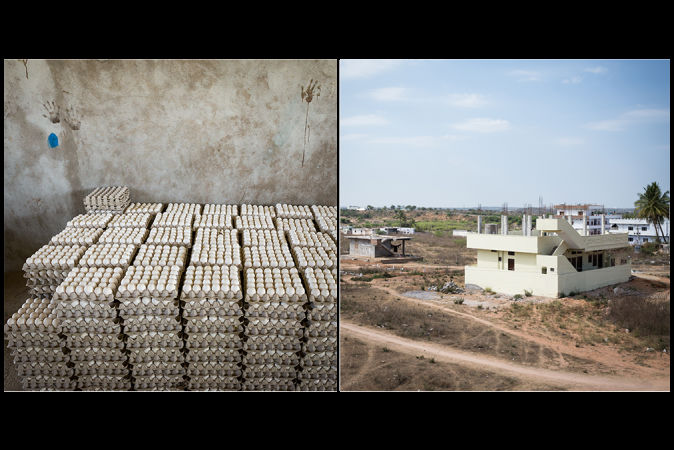
A warm egg, white shell almost translucent, plops into the wire mesh gutter and rolls forward. There is no let-up in the clucking din of the 16,000 other chickens in cages that stretch to the far end of the shed. They won’t survive more than a couple of years here, but their feces will be shovelled up for fertiliser and their eggs sold on for a few rupees each.
The concrete shed stands between two rice fields, patches of green in the otherwise brown, dusty landscape of this part of central southern India. The farm belongs to Narasimha Reddy, who also grows oil palms and a traditional cereal called jowar. It is hard work but he says he is satisfied with his lot. Most of his neighbours have sold their land, which Reddy claims has made them less happy. He also says they are less healthy because they now don’t work as hard and have changed from jowar to rice in their diet.
Reddy strives to be more traditional. He sticks to the same diet his elderly parents have eaten all their lives, and unlike many neighbouring families, he and his three brothers have all stayed in the village. He envisages his children living out their lives here as well. It is a rare vision of the future. Across India, so many people are leaving the land in favour of the rapidly growing towns and cities that the rural population is predicted to peak around 900 million before starting to shrink in 2025. Already, this trend is bringing profound economic and social changes to individuals, families and the nation as a whole. It is changing the way people live. It may also change the way they die.
As more Indians adopt more urban lives, chronic conditions like diabetes, obesity and heart disease are on the rise, replacing malnutrition and infectious diseases as the country’s most urgent health worries. Reddy doesn’t want to risk his family’s health. He has decided that being healthy and poor is better than taking their chances in the modern, more developed, more open India.
But they are not immune in the familiar confines of the village, either. The same chronic diseases are rising in rural India too, albeit more slowly than in its cities. So what really lies behind this national trend, threatening the health of hundreds of millions of people in villages and cities alike? And is Reddy’s strategy of keeping his family locked in a traditional life of jowar and agricultural labour the answer, or is he spurning potential new opportunities in vain?
§
Sanjay Kinra is an urbane doctor with a lively, witty intelligence – good company as we drive out to Reddy’s village. It is one of 29 villages between 50 and 100 km south of Hyderabad, India’s fourth-largest city, that Kinra believes could unlock some answers about the rise in chronic, non-communicable diseases. A study of nutrition took place in the area some 25 years ago and Kinra, a paediatrician and public health researcher, has since recruited thousands of people in the 29 villages to revisit that long-forgotten study. He now wants to follow the participants’ long-term health in order to understand what factors have the most influence on their wellbeing.
Two doors up from Reddy’s house just off the village square, Kinra and I meet Mahmad Babumia, a retired police official. He wears a neat white beard on his chin and a neat white shirt with a ballpoint pen in the breast pocket. Life in the village was bad 30 years ago, he reports. The buildings were all kachcha – mud huts – and everyone laboured on the land but there wasn’t enough to eat, even with the government providing subsidised rice at 2 rupees a kilo.
A welfare scheme, initiated across India in the 1970s, aimed to supplement the diets of pregnant women, breastfeeding mothers and children under six. In 1987, researchers from the National Institute of Nutrition in Hyderabad identified 29 nearby villages where they would be able to assess how well this programme was working. When they started the Hyderabad Nutrition Trial, 15 of the villages were receiving free food for mothers and children; the other 14 were still waiting to start the programme, so acted as controls in the experiment. Over the next three years, researchers recorded the weight of babies born in all the villages to see what difference, if any, the extra food was making. One of the 4,300 babies born during the trial was Babumia’s son Mustak.
Overall, the results suggested that babies like Mustak, born in villages with the programme, were on average 60 to 80 grams heavier than those born in villages without it. And that was that. The findings were not widely disseminated and the study seemed destined for obscurity – until 2003, when Sanjay Kinra dusted it off and saw untapped potential.
Having trained as a doctor in his hometown of Delhi, Kinra had then moved to the UK to practise medicine. He specialised in paediatrics but developed parallel interests in environmental health and epidemiology. When he began to wonder if there was a tangible link between a child’s diet and their risk of heart disease in adulthood, he looked for a PhD research project that would let him investigate further. He got wind of an old study that had tested the effect of supplementing the nutrition of children in some rural Indian villages. Perfect, thought Kinra: he could go back to these people and see whether differences in the children’s diet had produced any differences in health as they had grown up.
There was a problem, though. When he got hold of the old trial records, they were incomplete and existed only on paper and outdated computer disks. Even when he was able to go through them, Kinra realised he didn’t have the names of the children born during the trial, only their dates of birth.
Undaunted, he went to each of the 29 villages and tracked down as many of the original trial participants as he could. The mothers were relatively easy to find, but it’s rare for rural parents to know their child’s date of birth. By comparing lunar calendar dates and significant local events with the dates of birth recorded by the researchers 15 years before, he managed to identify about half of the children from the original trial. Together with parents and siblings, this gave Kinra a cohort of 7,000 people with whom he could do a follow-up study.
However, it soon became clear to him that there was much more to be gained here: if he could continue to follow these children over many years, he might be able to find associations between childhood nutrition, lifestyle, environment and other factors and the risk of developing chronic health conditions.
The children were already teenagers by this time, of course. And in their lifetime, conditions in the 29 villages had been transformed – not by government welfare schemes, but by India’s rampant economy.
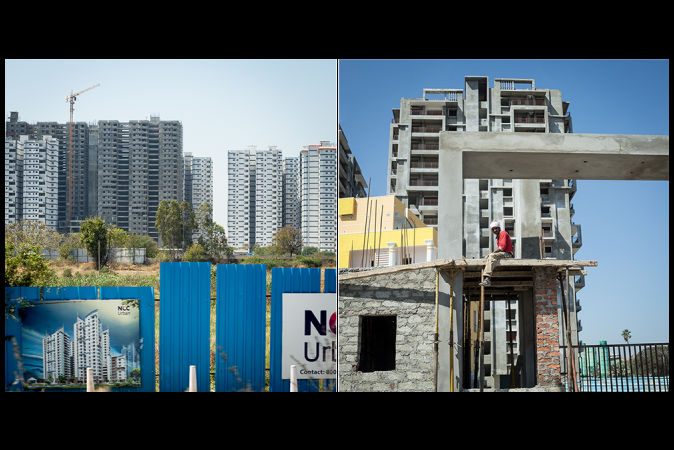
Just a few kilometres north-west of Reddy’s farm lies Ramoji Film City, a sprawling gated compound where the Hyderabad film industry rolls out enough movies each year to rival Bollywood. Busloads of workers are disgorged onto the 1,700-acre site each day to make films on elaborate sets and sound stages. The morning we drove through on our way to the villages, I saw a mock-up of Chennai airport with a biplane parked in front of it, a stationary steam locomotive ready to play its part, and a side street with no main road to turn off but every type of urban housing you could wish for. All in the middle of the semi-arid, all-but-deserted countryside outside Hyderabad.
This ‘dreamscape’ was the vision of Ramoji Rao, a wealthy entrepreneur and film producer, and he was able to realise it in the boom times of the mid-1990s. When he opened Film City in 1996, everything changed for the nearby villages. Their land suddenly became worth something – developers thought that Hyderabad’s urban sprawl would be inevitably drawn their way.
Unlike Reddy, Mahmad Babumia was keen to cash in. Three-quarters of the families in their village have since sold up, although their former fields sit brown, barren and undeveloped, still waiting for the anticipated demand to materialise. Babumia used the windfall to buy a concrete house in the village; others built their own, used the money to move away, or took the opportunity to stop breaking their backs in the fields. Many found new jobs in Film City: Babumia’s five sons all work there now, handling the cameras and lights. They are earning cash, which they spend in the nearby town, occasionally going shopping in Hyderabad itself. Two of them have moved out and live in the town, closer to schools, healthcare and shops superior to anything the village has to offer.
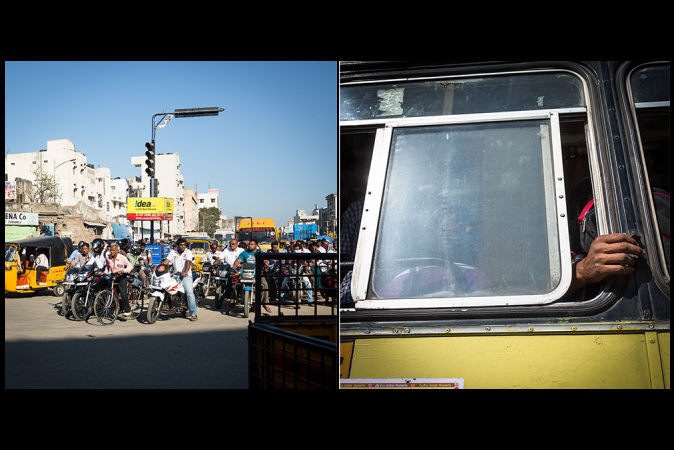
Outside a small shop on the far side of the village square, men in white shirts and linen trousers perch on bicycles or motorbikes while women walk by in saris of green, burgundy or yellow. A rooster struts past the back door of Babumia’s new house, stopping occasionally to crow at the cloudless spring morning sky. Indoors, the house is cool and clean with white and blue walls. A TV stands in one corner opposite rough shelves holding a mobile phone, toiletries and medicines. Now in his 60s, Babumia takes tablets for diabetes and high blood pressure that cost him 150 rupees a week, and he sees his doctor three or four times a year, paying between 100 and 500 rupees each time.
Kinra asks him why he thinks he got diabetes and high blood pressure. Babumia answers that earlier generations didn’t get these conditions. He says his father was healthier at his age than he is now because the quality of food has deteriorated even as quantity has increased. “The food has no power,” he grumbles. “The younger generation eat less vegetables, just white rice, and they get sick younger.”
But this is inconsistent. Although Babumia remembers his parents’ generation living to 100 compared with 60 or 70 today, his father died during the food shortages, while Kinra knows that life expectancy in India 20 years ago was just 46.
As for future generations, Babumia’s son Mustak, one of the original Hyderabad Nutrition Trial babies, still lives in the village – for now. But it’s when young men get married and start a family that they think about moving, so in a few years Mustak may well decide to join his two brothers who are already in the town. There are undoubtedly better opportunities for their children there, but would there also be a long-term cost?
 Friends Read Free
Copy
Facebook
Tweet
Friends Read Free
Copy
Facebook
Tweet