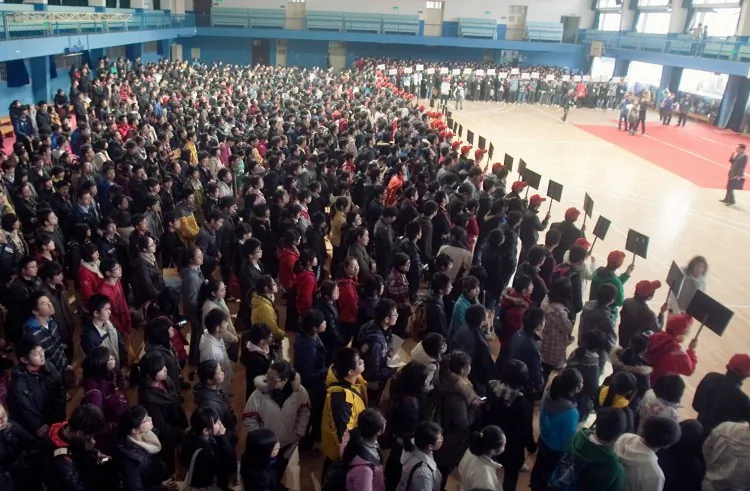


About 9 million Chinese high school graduates applied for this year’s national college entrance exams, which began June 7. But according to China Education online, the number of exam takers nationwide has fallen by 1.4 million over the past four years, even though many colleges have consecutively lowered test score requirements every year.
In the years between 2008 and 2011, the number of students taking the national college entrance exams was 10.5 million, 10.2 million, 9.46 million, and 9.33 million, respectively. This year, only 9 million applied.
According to a June 5 report on China National Radio, the number of exam takers in Henan Province fell by 16 percent between 2008 and 2012—from 985,000 to 825,000.
Contributing Factors
A number of factors contribute to the decline of students taking the entrance exams. Among them are China’s falling birth rate, rising costs, and larger numbers of students studying abroad.
China’s falling birth rate is regarded as one of the main reasons for the declining numbers of exam takers. Census data shows that the country’s population of 18-year-olds has decreased every year since 2008.
Rising costs have also become a factor for high school graduates to avoid the national exams. A quote widely circulated on the Internet said: “In the 70s, to prepare for the exams, it took just .50 yuan ($0.08) to purchase a book of practice questions and a bowl of green bean soup. In the 80s, you only had to invest 10 yuan ($1.57) for a good set of stationary. But in 2010, it took 40,000 yuan ($6,286) to hire a private tutor, buy nutritious meals, and rent a special dormitory room.”
Another factor is that more Chinese students choose to study at universities and colleges outside the country. The rate has steadily increased by 20 percent every year over the past few years, to a current figure of about 300,000. This is a reflection of the high value many Chinese place on an overseas education.
Admission Requirements Lowered
In 2011, many of China’s colleges and universities were unable to fulfill their admission quotas. Because of a shortage of applicants, some vocational colleges lowered their admission scores to 150, from a maximum possible score of 750. But registration rates continued to fall all the same.
In Shandong Province, for example, admission requirements for vocational colleges have been lowered every year. Compared to an average admission score of 350 required in 2002, the score was lowered to 190 in 2010, and 180 in 2011.
Despite the falling numbers of exam takers, the total number of students in higher education institutes has jumped from six million in 2008 to nearly seven million in 2012 due to the growing ease of college admission requirements. The admission rate among exam takers rose to 72.3 percent in 2011, and is expected to rise further this year.
The policy has been widely criticized as cheapening the value of higher education, and for creating a glut of university graduates who enter a labor market that does not have the capacity to employ all of them.
Xiong Bingqi, deputy director of the 21st Century Education Research Institute, commented on Chinese college graduates’ poor job prospects on qq.com: “Finding a job after college graduation has become harder now. Some students believe that the current rate of return on a college education is too low, and that the quality of college education is not competitive enough, so they choose not to take the college exams.”
Some experts predict that many Chinese institutions of higher education will either face bankruptcy or closure within the next 10 years.
Read the original Chinese article.
Click www.ept.ms/ccp-crisis to read about the most recent developments in the ongoing crisis within the Chinese communist regime. In this special topic, we provide readers with the necessary context to understand the situation. Get the RSS feed. Get the new interactive Timeline of Events. Who are the Major Players? 
The Epoch Times publishes in 35 countries and in 19 languages. Subscribe to our e-newsletter.
 Friends Read Free
Copy
Facebook
Tweet
Friends Read Free
Copy
Facebook
Tweet