
The tax holiday legislation, as it is called by opponents of corporate tax cuts and officially called the “Freedom to Invest Act of 2011,” was introduced by U.S. Representatives Kevin Patrick Brady, a Texas Republican, and James David “Jim” Matheson, a Utah Democrat, in May. The bill was sponsored by 13 Republicans and five Democrats.
This piece of legislation temporarily (for 2011 and perhaps 2012) modifies the Internal Revenue Code of 1986 for U.S. corporations, allowing firms to deduct dividends earned by their foreign subsidiaries from their taxable income. It also calls for a penalty if the firm does not maintain a certain number of full-time U.S. employees.
Tax reduction proponent Grant Thornton LLP claimed that a corporate tax cut would bring jobs back to the United States, and therefore “Grant Thornton supports tax reform aimed at lowering effective business tax rates in order to promote global competitiveness for U.S. businesses.
“Low effective tax rates encourage investment and business activity, [and] spur job creation,” testified Mark Stutman, national managing partner of tax services at Grant Thornton, at a June U.S. House Ways and Means Committee hearing.
Corporations are spending millions in an effort to push favorable corporate tax legislation through the House and the Senate.
Apple Inc. noted in its most recent disclosure report that it paid $560,000 to lobby the legislature and government officials during the first three months of 2011, according to the AppleInsider website. However, Apple spent only one-third of what Google Inc. ($1.2 million) and Microsoft Corp. ($1.7 million) paid to lobbyists during the same time.
During 2010, Microsoft spent $6.9 million, up from $6.7 million in 2009, on lobbyists, according to the seattlepi website. Google spent 25 percent less on lobbying during 2010, but still spent $5.16 million, up from $4.03 million in 2009. Wells Fargo & Co. spent $1.9 million during the first quarter of 2011, almost doubling its 2010 spending, according to the Pro Public blog.
“Lobbyists for big business, along with many Republican political leaders … call for changes that would reduce corporate tax payments by trillions of dollars over the upcoming decade,” stated Citizens for Tax Justice (CTJ) in a press release.
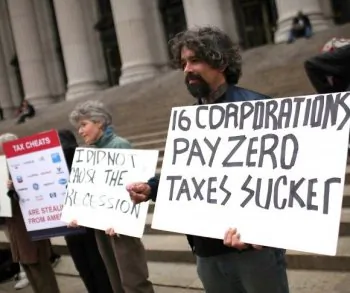
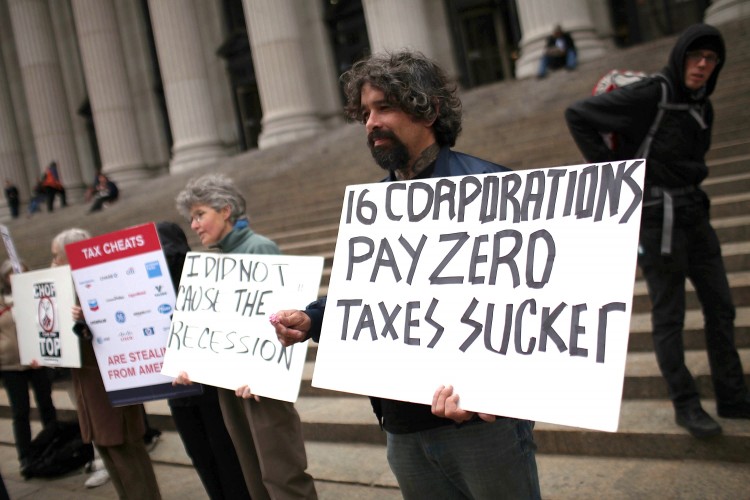
Apple found itself beleaguered because of its corporate tax cut lobbying efforts in early June. US Uncut, in an effort to expose what it calls “corporate tax cheaters,” tricked people attending an Apple conference in San Francisco into listening to the music video “Apple: Tax Cheating Doesn’t Sync with My Values.”
Also, beginning in June, US Uncut protested in front of a number of Apple stores, claiming that Apple could receive a $4 million tax break should the corporation successfully lobby Congress to pass tax cut legislation. US Uncut is a grassroots movement that takes on corporate tax evaders.
The picketers demanded that Apple withdraw from the Win America Campaign (WAC), which claims that the proposed tax cuts would bring $1 trillion back to America and put people back on the payroll. In effect, the supporting firms are saying that they refuse to invest in America, preferring to keep the money invested in foreign countries because of the U.S. tax system.
US Uncut alleges in a press release that “if Congress gives the corporations in the WAC coalition this tax loophole, it would cost American taxpayers over $80 billion.”
Putting Corporate Taxes Under a Microscope
Neither side appears to have taken the time to look at the actual taxes paid by corporations, such as Exxon Mobil Corp., The Boeing Company, Verizon Communications Inc., FedEx Corp., General Electric Co. (GE), and numerous other corporations.
CTJ analyzed 12 of America’s Fortune 500 companies and suggested that with the exception of two of the companies, 10 paid no taxes during at least one year between 2008 and 2010.
More than half of these companies were awarded $62.4 billion in tax subsidies, and at the same time, the combined companies showed a negative $2.5 billion federal income tax when including loopholes, tax credits, and subsidies, while filling the corporate coffers with $171 billion in profits.
President Barack Obama went on record saying that he favors simplifying the corporate tax system, calling for the reduction or elimination of existing corporate tax subsidies.
“Over the years, a parade of lobbyists has rigged the tax code to benefit particular companies and industries. Those with accountants or lawyers to work the system can end up paying no taxes at all. But all the rest are hit with one of the highest corporate tax rates in the world. It makes no sense, and it has to change,” said Obama in his State of Union Address.
Although the effective corporate tax rate for companies based or operating in the United States is 35 percent, GE collected $4.7 billion in tax benefits on a pretax profit of $4.7 billion. Although Exxon Mobil was found to pay the highest taxes among the 12 companies, it only filled America’s tax coffers at a 14.2 effective tax rate, which is 59 percent lower than the 35 percent tax rate for corporations.
The companies in the CTJ study would have paid close to $60 billion in taxes at the 35 percent tax rate, yet given the subsidies, these companies made a killing by not paying $62.4 billion in taxes.
“It is our view that significantly reducing the corporate tax rate will improve U.S. competitiveness. We believe lowering the corporate rate would dramatically reduce tax policy pressure and rhetoric by ensuring that U.S. companies are competitive,” testified James Zrust, vice president at The Boeing Company, at the Committee on Ways and Means hearing.
Next…Challenging the Corporate Tax Cut
 Friends Read Free
Copy
Facebook
Tweet
Friends Read Free
Copy
Facebook
Tweet