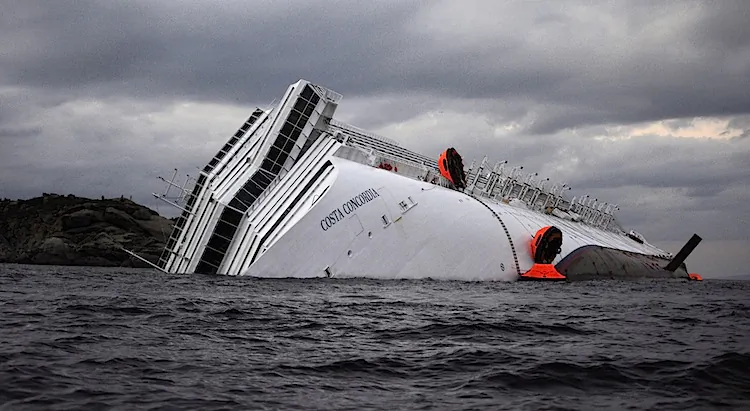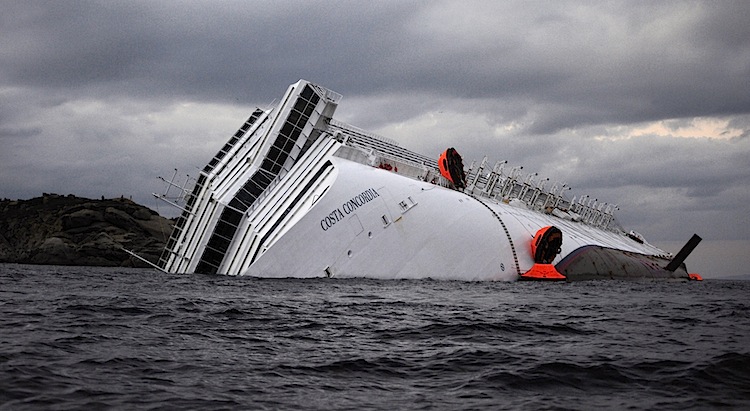

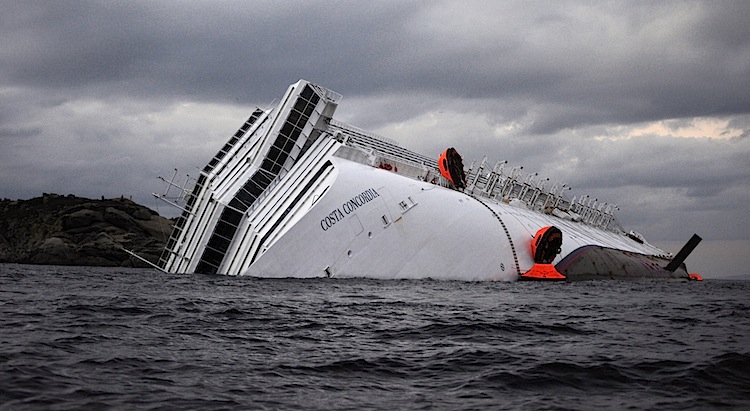
Three more people have been rescued more than 24 hours after the cruise ship Costa Concordia hit the rocks and ran aground off Giglio Island in Italy. The death toll from the accident has risen to five people: one Italian national, two French, and one each from Spain and Peru. About 15 people are still missing from the over 4,000 passengers and crew who were on board, according to Italian press agency ANSA as of 2:00 p.m. local time.
The ship’s captain, Francesco Schettino is now under arrest in Grosseto’s jail, charged with multiple homicides, shipwreck, and abandoning his ship. First officer Ciro Ambrosio has also been detained. Public prosecutor Francesco Verusio, who is to question Schettino, said, “It must have been a human failing,” which led to the incident, reported press agency AGI.
Schettino said during an interview with TGCOM24 that there was nothing wrong with the route they followed, and the rocks the ship hit “were not on the map, they couldn’t have been there,” adding, “The crew and I were the last to leave the ship.” The Costa Crociere company said in a statement that it will have an internal investigation to satisfy “all the questions we can’t answer yet,” reported ANSA.
However, the proximity of the ship to the island is something anomalous. Capt. Cosimo Nicastro of the Italian Coast Guard commented, “The rocks are on the maps. The thing is that the ship went really close to these rocks, and we don’t know why,” reported ANSA. He added, “It might have been a technical issue, but the ship got in contact with us only when the evacuation procedures were already underway.”
Controversy over the emergency procedures on board has been raised by many survivors. Giuseppe Lanzafame, a passenger and former sailor who worked in the oil industry, criticized the crew. “They made us wait for over an hour on the deck without telling us anything. Many people were panicked—I saw some of them jumping off. I had to drop myself into the lifeboat. Most of the crew couldn’t communicate with us, they spoke neither Italian nor English,” he told ANSA in a phone interview.
The incident, involving people from 61 countries, was quickly picked up around the world via social media. The word “Titanic” has been widely used to reflect the similarity with that incident—fortunately with a lower loss of life—as this year is the 100th anniversary of one of the worst maritime tragedies of all time.
The large size of the ship has raised questions about safety issues. Nautilus International, an independent maritime trade union headquartered in London, commented on the incident on its website, calling it a “wake-up call to regulators.”
In the statement, the union, which represents 23,000 shipping industry staff, highlighted its concerns about the recent rapid increase in the size of passenger ships. Over the past decade the average tonnage has doubled.
“Many ships are now effectively small towns at sea, and the sheer number of people on board raises serious questions about evacuation,” said General-Secretary Mark Dickinson. “The growth in the size of such ships has also raised questions about their watertight integrity and firefighting protection,” he added.
The Concordia is the biggest ship of the Costa Crociere fleet and the largest ship to be built in Italy, at 114,500 gross tons. Built in 2006, the Concordia was on a Mediterranean cruise from Rome, with stops in Savona, Marseille, Barcelona, Palma de Mallorca, Cagliari, and Palermo.
 Friends Read Free
Copy
Facebook
Tweet
Friends Read Free
Copy
Facebook
Tweet