
The United States and Iran signed an agreement to end the conflict between the nations on June 17 after almost four months of war.
The memorandum of understanding, signed by President Donald Trump and Iranian President Mahmoud Pezeshkian, terminates military hostilities, opens the Strait of Hormuz, and provides for a potential reconstruction fund for Iran.
The latter is only applicable if Tehran agrees to give up its nuclear program and commits to more negotiations within the next 60 days, among other concessions.
When polled on the issue, many Epoch Times readers were vocal that they don’t believe Iran can be trusted, despite the signed deal.
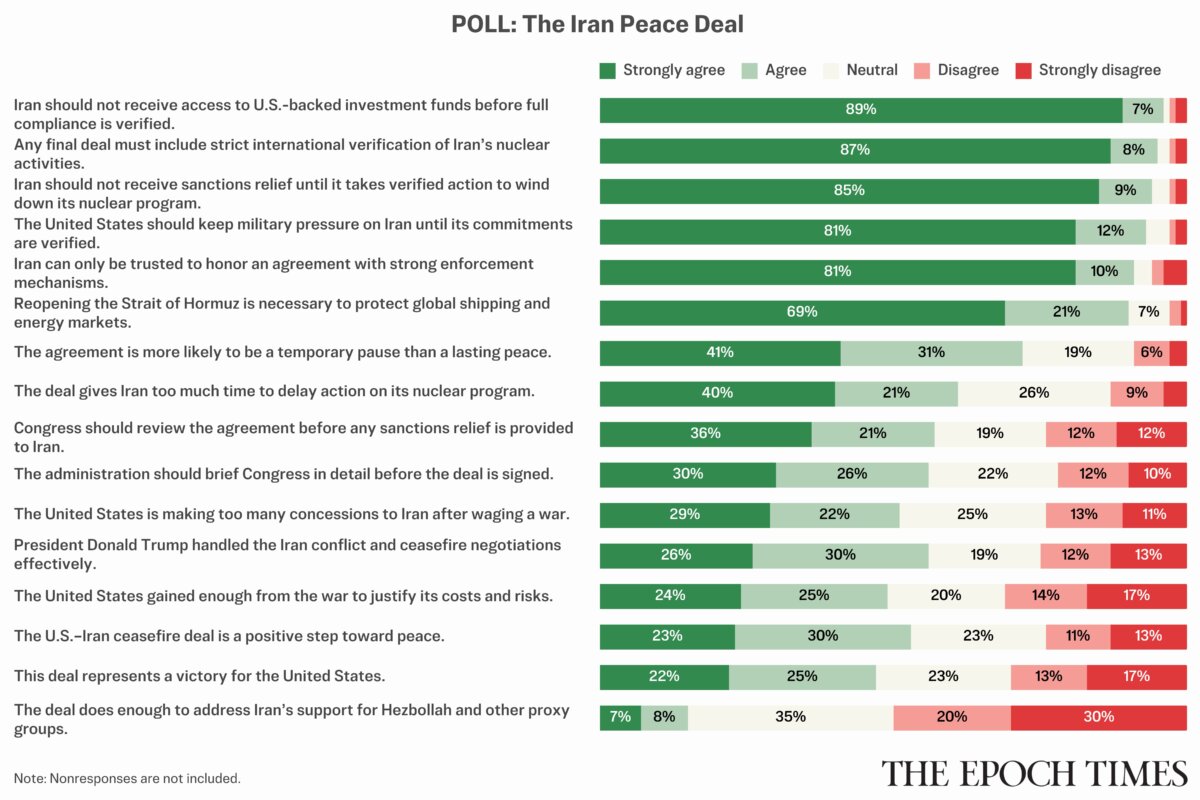
About 53 percent of those polled believe that the U.S.–Iran ceasefire deal is a positive step toward peace. Another 23 percent are neutral on the subject.
Implications for the United States
In addition to military loss of life and resources, the war has put a strain on oil availability in the United States, and some feel that this conflict hasn’t been a net win for the country, at least not yet.
A little less than half (47 percent) of those polled believe that the deal recently signed represents a victory for the United States. Another 23 percent are neutral on the subject.
About 49 percent of those polled agreed that the United States gained enough from the war to justify its costs and risks.
Fifty-one percent of respondents think the United States has made too many concessions to Iran after waging a war, and 93 percent think America should keep military pressure on Iran until its commitments are verified.
When asked, half of those polled (50 percent) disagreed with the statement that the United States’ deal does enough to address Iran’s support for Hezbollah and other proxy groups. Another 35 percent are neutral on the subject.
One reader said: “While leaders talk, the warmongers will continue to do what they do.”
Frustration with the deal was widespread, with one saying: “The framework reads like Iran won the conflict. Not good. There will never be a lasting peace as long as Iran is governed by a terrorist theocracy.”
The Dealmakers
While many concerns surrounded the deal itself, some readers voiced concern about the reliability of the negotiators.
About 56 percent of respondents believe Trump handled the Iran conflict and ceasefire negotiations effectively. Another 19 percent had a neutral opinion.
Seventy-two percent of those polled said they believe the agreement is more likely to be a temporary pause than a lasting peace. A whopping 91 percent of those polled think Iran can only be trusted to honor an agreement with strong enforcement mechanisms.
About 57 percent of respondents believe Congress should review the agreement before any sanctions relief is provided to Iran, and 56 percent believe the administration should brief Congress in detail before any deal is signed.
Going Forward
Many have questioned what the path forward looks like, whether a lasting compromise is found between the United States and Iran or not.
Secretary of War Pete Hegseth said on June 18 that the U.S. military will reimpose its blockade of Iranian ports if the Middle Eastern nation doesn’t fulfill its portions of the agreement with the United States.
Ninety percent of those polled agreed that reopening the Strait of Hormuz is necessary to protect global shipping and energy markets.
However, that’s not necessarily indicative of public opinion’s support for leniency toward Iran. A whopping 96 percent of respondents agree that Iran should not receive access to U.S.-backed investment funds before full compliance is verified.
“The Iranian Regime and the IRGC cannot be trusted,” said one reader. “Everything must be verified in a reliable way.”
Similarly, 95 percent of respondents agreed that any final deal must include strict international verification of Iran’s nuclear activities.
And 94 percent agree that Iran should not receive sanctions relief until it takes verified action to wind down its nuclear program.
After details of the deal were made public, 61 percent of respondents agreed that the deal gives Iran too much time to delay action on its nuclear program.
When questioned on which factors are more likely to influence their view on the U.S.–Iran ceasefire deal, 31 percent said Iran’s nuclear commitments were the most important issue. Another 19 percent said they thought the highest priority was the possibility of lasting peace. Less than 10 percent (9.4 percent) said the reopening of the Strait of Hormuz and lower energy risks were the most crucial.
The Epoch Times conducted this reader survey on June 17–18, 2026, by email and social media, generating 1,956 responses.
 Friends Read Free
Copy
Facebook
Tweet
Friends Read Free
Copy
Facebook
Tweet