
The Trump administration’s 50 percent tariffs on goods from Canada have sparked debate and concern.
The Epoch Times asked readers about the tariffs, which the administration initially delayed, then put in place in August. The tariffs will apply to an estimated $20 billion worth of goods coming from Canada.
Readers are somewhat divided about the tariffs, as they pertain to the United States’ relationship with Canada, but united in concern over China’s possible use of Canada as a workaround to U.S. trade policy.
Concern About Trade With Canada
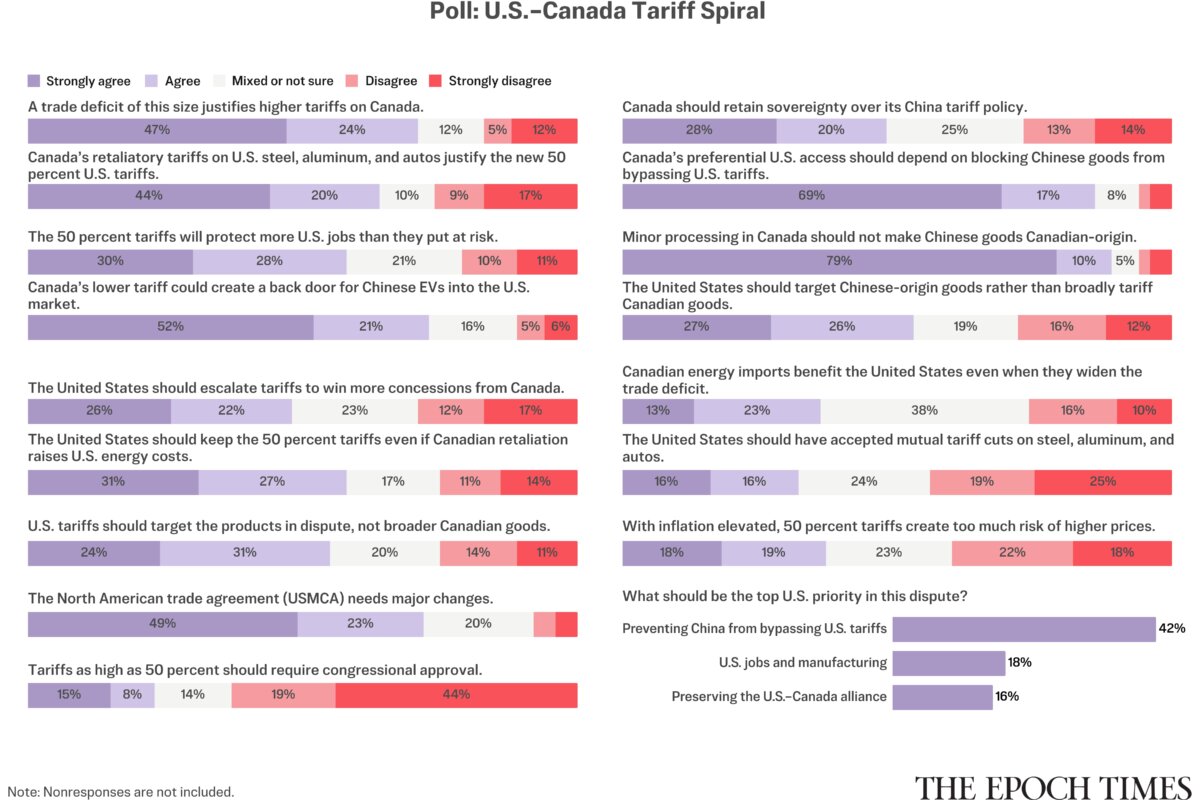
The tariffs were enacted under Section 338, which was passed as part of the Tariff Act of 1930, and according to our survey, 71 percent of respondents agree that a trade deficit of $48 billion with Canada justifies higher tariffs on our neighbor.
Additionally, 64 percent of those surveyed agree that Canada’s retaliatory tariffs, which will come into force on Sept. 8, on U.S. steel, aluminum, and autos, justify the new 50 percent U.S. tariffs.
Overall, about 58 percent of readers believe that the 50 percent tariffs on Canadian imports will protect more U.S. jobs than they put at risk. However, 21 percent either don’t know or are not sure.
A large majority (73 percent) agreed that Canada’s lower tariff could create a back door for Chinese electric vehicles into the U.S. market, which was just one of several concerns about a possible Chinese and Canadian skirting of American policy.
International Concerns
Fewer than half of readers surveyed (48 percent) believe that Canada should retain sovereignty over its China tariff policy, while 86 percent said they believe Canada’s preferential U.S. access should depend on blocking Chinese goods from bypassing U.S. tariffs.
Meanwhile, 89 percent of readers said that minor processing in Canada should not make Chinese goods be considered of Canadian origin. Additionally, 53 percent agree that the United States should target Chinese-origin goods rather than broadly tariff Canadian goods.
A Call for Change
International negotiations continue, but around half of those polled (48 percent) believe that the United States should escalate tariffs to win more concessions from Canada.
“Canada is more dependent on the U.S. and should not have oppressive tariffs on our goods heading to Canada while thinking we won’t reciprocate,” one reader commented.
When asked whether the United States should keep the 50 percent tariffs even if Canadian retaliation raises U.S. energy costs, 58 percent agreed, and 55 percent agreed that U.S. tariffs should target the products in dispute, not broader Canadian goods.
While this diplomatic conflict has dominated the news for weeks, it’s not the first time North American trade has taken the spotlight. Seventy-two percent of readers agree that the United States-Mexico-Canada Agreement, signed in July of 2020 under the first Trump administration, needs major changes.
The agreement, which was meant to protect trade and business, is sometimes thought to cause damage to both.
While some have posited that the president alone shouldn’t be responsible for this kind of decision, 23 percent of readers polled said they believe that tariffs as high as 50 percent should require congressional approval.
Support for Conciliatory Responses to Canada
Thirty-six percent of our readers agreed that Canadian energy imports benefit the United States even when they widen the trade deficit. However, the largest percentage of readers (38 percent) responding to this question said they either don’t know or are just unsure, and 26 percent disagreed with the assertion.
However, when asked if the United States should have accepted mutual tariff cuts on steel, aluminum, and autos, 44 percent disagreed, and 24 percent said they are either unsure or don’t know.
When asked whether 50 percent tariffs create too much risk of higher prices amid elevated inflation, 40 percent disagreed, and 37 percent agreed.
When asked what should be the top U.S. priority in this dispute, 42 percent said it should be preventing China from bypassing U.S. tariffs.
About 18 percent said the top priority should be U.S. jobs and manufacturing, and 16 percent said it should be preserving the U.S.–Canada alliance.
“USA needs to retain good relationship with Canada but not at the expense of allowing them to either take advantage of [the] USA or sneak around strengthening relationship with any country (i.e., China) that costs the safety of either,” said one reader.
The Epoch Times conducted this reader survey on Sept. 2–3, 2026, by email and social media, generating 3,184 responses. Friends Read Free
Copy
Facebook
Tweet
Friends Read Free
Copy
Facebook
Tweet