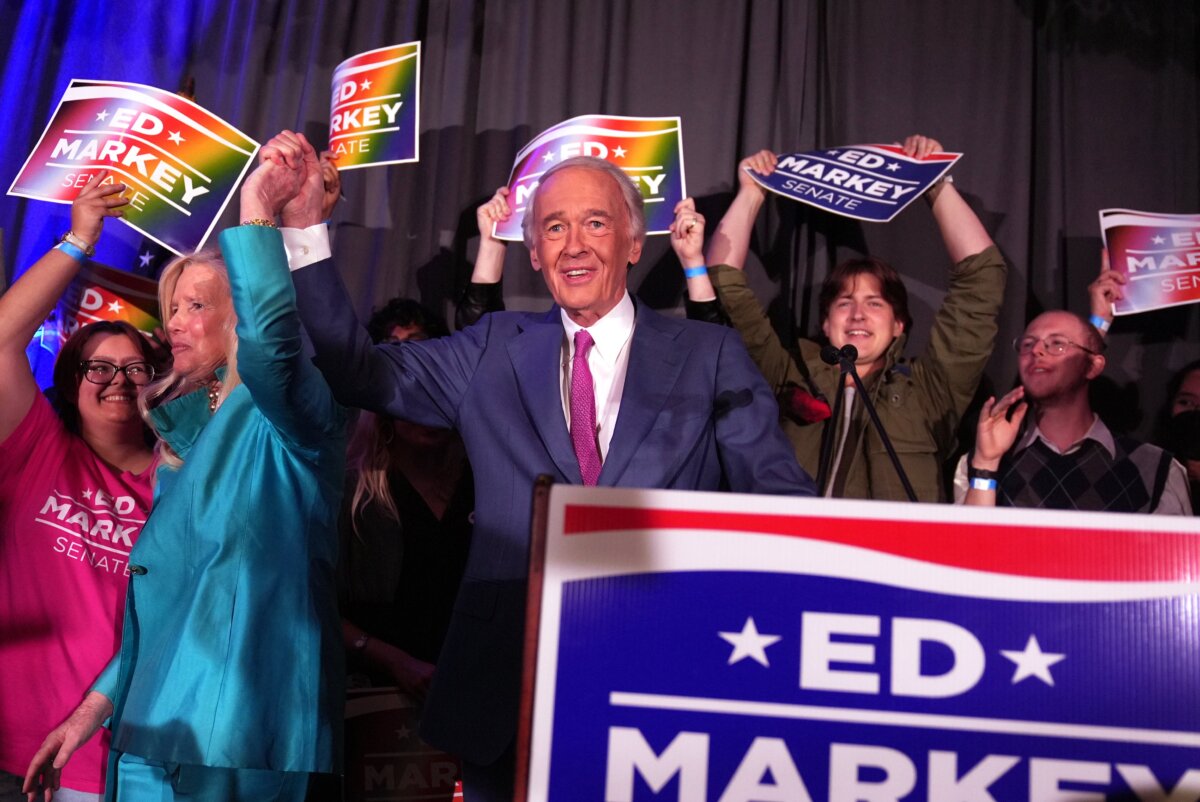

Sen. Ed Markey (D-Mass.) easily fended off a primary challenge from Rep. Seth Moulton (D-Mass.), who made the 80-year-old progressive senator’s age a top issue.
The Associated Press called the race for Markey at 8:31 pm. With just three percent of the vote counted, Markey led with 74.2 percent to Moulton’s 25.8 percent.
The race was an outlier from the norms seen in Democratic races this cycle.
In many elections, younger candidates declaring support for progressive and democratic socialist ideals have competed—and won upset victories against—older, more established, and often more centrist incumbents.
But in the Massachusetts Senate race this year, that was turned on its head.
In this contest, the octogenarian Markey—who has made a career boosting environmentalist initiatives such as the Green New Deal and anti-Big Oil stances—was widely seen as the more progressive pick. He won key progressive endorsements from figures including Rep. Alexandria Ocasio-Cortez (D-N.Y.), who sponsored the Green New Deal in the House, and Senate heavyweights such as Sens. Bernie Sanders (I-Vt.) and Elizabeth Warren (D-Mass.).
Meanwhile, Moulton is widely seen as the more centrist figure.
Markey agreed with a reporter’s question about whether Moulton is “too moderate” for Massachusetts, noting that the challenger had opposed Medicare for All in the past.
Moulton has pressed the age argument in the campaign’s final stretch.
“The world has changed, and Senator Markey is very much running the same campaign he did back in 2020,” Moulton told CBS’s “Face the Nation” on Aug. 23.
He pointed to a moment in a recent debate in which he said Markey, asked whether he used artificial intelligence, responded that he used “whatever is inside of [his] iPhone and [his] iPad, whatever comes up.”
“The world has just moved on,” Moulton said. “It’s not a personal thing with Ed Markey. It’s about whether one Senate seat should belong to one person while the world is moving on without him.”
Markey has shot back against these criticisms, telling reporters at the U.S. Capitol, “It’s not your age, it’s the age of your ideas.”
He said that in this respect, “I’m the youngest guy in the race.”
Though the race had drawn national attention for its unusual age and political dynamics, the result ultimately came as little surprise: Markey had been overwhelmingly favored to win the contest, having led by double-digit margins in every poll conducted of the race.
He also maintained strong support from the state-level Democratic Party. A majority of delegates to the state party convention in May voted to endorse him, though Moulton drew enough support to qualify for the ballot.
Experts who discussed the race with The Epoch Times before Tuesday’s election took a skeptical tone toward Moulton’s odds based on the age argument alone.
“Massachusetts is testing whether generational change is actually an ideology or merely an attribute,” said Michael Fahey, founder and CEO of Fahey Communications. He’s a Boston political and public relations strategist and former television news executive who covered both men as a journalist.
“In many Democratic primaries, younger challengers have succeeded because youth came packaged with a different ideological vision. Massachusetts is different. Moulton has the generational argument, while Markey has the stronger claim on the progressive movement.”
Markey, who first entered the Senate in 2013 after nearly 37 years in the House, has faced similar electoral challenges based on his age before this one.
In 2020, he turned back a primary challenge from then-Rep. Joseph Kennedy III, 55 percent to 45 percent, running with the backing of younger progressives and campaigning on the Green New Deal.
However, the issue drew greater attention this time in part due to the lingering impacts of the 2024 election, when questions about former President Joe Biden’s age ultimately forced him to depart the race months before the election.
“Moulton’s age argument is still more potent today than it would have been six years ago. Joe Biden fundamentally changed how voters think about age, capacity and longevity in public office,” Fahey said. “But politically, Moulton has to turn age into consequence.”
Chase Smith contributed to this report.
 Friends Read Free
Copy
Facebook
Tweet
Friends Read Free
Copy
Facebook
Tweet