

Massachusetts Democrats vote Tuesday in a Senate primary that runs against the pattern of the party’s other contested races this year.
In New York and elsewhere this cycle, younger challengers unseated incumbents by running to their left. In Massachusetts, the older candidate holds the stronger claim on the party’s progressive wing.
Sen. Ed Markey (D-Mass.), who turned 80 in July, was the Senate sponsor of the Green New Deal alongside Rep. Alexandria Ocasio-Cortez (D-N.Y.). His challenger, Rep. Seth Moulton (D-Mass.), 47, is running on generational turnover rather than a move to the left.
Markey’s endorsements track that split. Ocasio-Cortez is backing him, as are Sens. Bernie Sanders (I-Vt.) and Elizabeth Warren (D-Mass.). A majority of delegates to the state party convention in May voted to endorse him, though Moulton drew enough support to qualify for the ballot.
Moulton was endorsed by The Boston Globe and by several current and former House colleagues, including New Jersey Gov. Mikie Sherrill.
That makes the race a test of whether Democratic voters respond to youth on its own, or only to youth paired with a shift in ideology, said Michael Fahey, founder and CEO of Fahey Communications, a Boston political and public relations strategist and former television news executive who covered both men as a journalist.
“Massachusetts is testing whether generational change is actually an ideology or merely an attribute,” Fahey said.
“In many Democratic primaries, younger challengers have succeeded because youth came packaged with a different ideological vision. Massachusetts is different. Moulton has the generational argument, while Markey has the stronger claim on the progressive movement.”
Moulton has pressed the age argument in the campaign’s final stretch. In an interview on CBS’s “Face the Nation” on Aug. 23, he pointed to an exchange in the candidates’ final debate.
“The world has changed, and Senator Markey is very much running the same campaign he did back in 2020,” Moulton said.
He pointed to a moment in a recent debate in which he said Sen. Markey “explained to Massachusetts voters that he can’t understand the different apps on his phone.”
Markey was asked whether he used AI, to which he responded that he used “whatever is inside of my iPhone and my iPad, whatever comes up, and I don’t know what companies my iPad might be using.”
“He doesn’t know which ones use AI, and then he tried to clean it up by explaining that AI is like an automobile. The world has just moved on. It’s not a personal thing with Ed Markey. It’s about whether one Senate seat should belong to one person while the world is moving on without him,” Moulton responded.
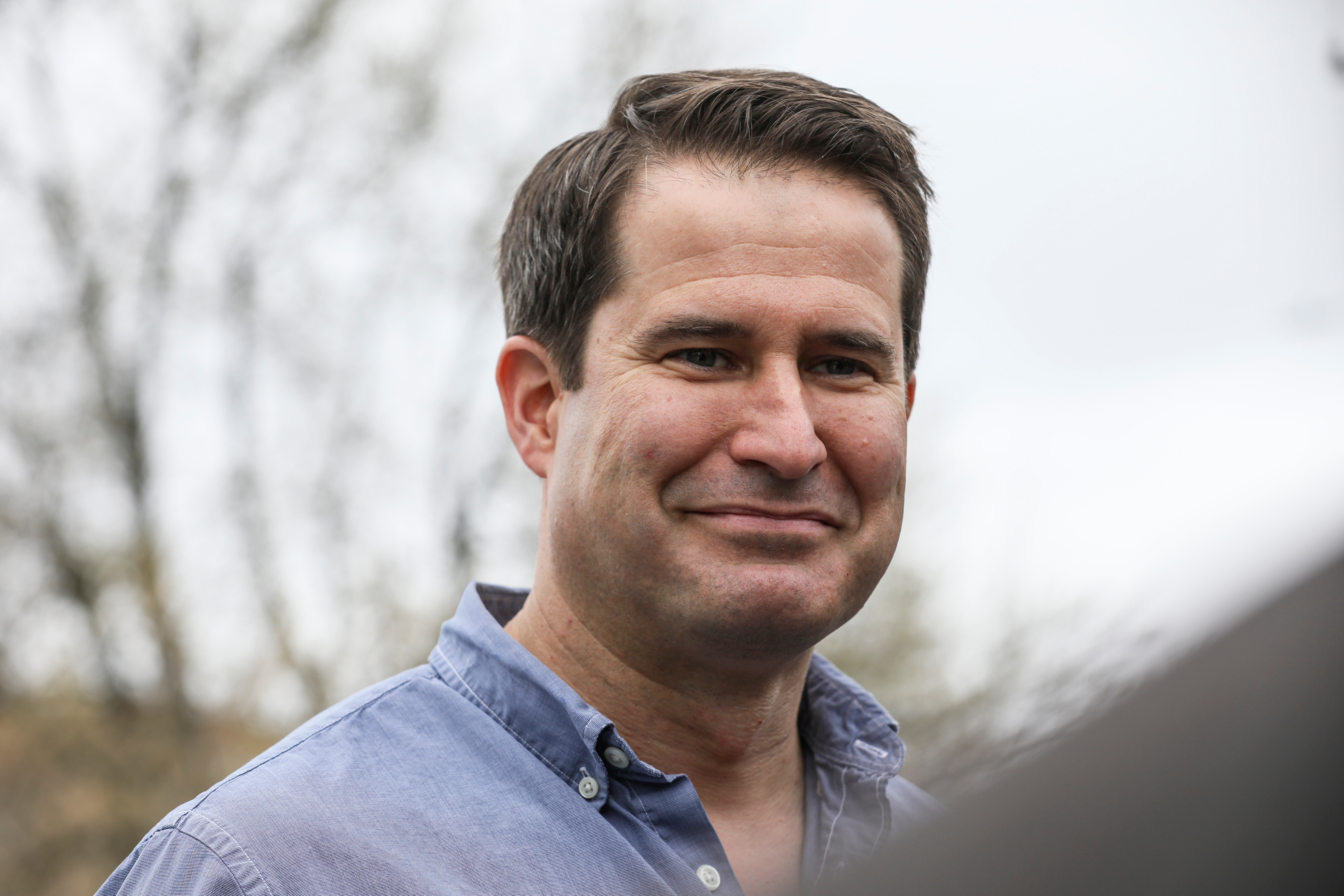 Rep. Seth Moulton (D-Mass.) during a campaign event in Manchester, N.H., on April 23, 2019. (AP Photo/Cheryl Senter, File)
Fahey said that result is the reason Moulton’s case has to go beyond the incumbent’s birthday.
“Democratic primary voters often care more about generational change in ideas than generational change in birthdays,” he said.
“Moulton’s age argument is still more potent today than it would have been six years ago. Joe Biden fundamentally changed how voters think about age, capacity and longevity in public office. But politically, Moulton has to turn age into consequence.”
Fahey said the central challenge for Moulton is that he is “asking voters who say they want change to replace an incumbent many progressive Democrats do not believe is standing in the way of change.”
He said a decisive Markey win should not be read as a rejection of younger candidates.
“If Markey wins decisively, I would not interpret that as Democrats rejecting younger leadership,” Fahey said.
“The lesson would be narrower: Youth alone is not enough to create a political movement. A younger challenger still has to show voters how replacing the incumbent would materially change the direction of the party.”
The dynamics at play are what make this race so interesting nationally, Fahey added.
“In other primaries, age and ideology have often been intertwined,” he said. “Here, voters essentially get to separate the variables: Do you want the younger Democrat, or do you want the more progressive Democrat?”
Markey has raised and spent more than $8 million over the course of the campaign, compared with more than $6 million for Moulton.
Polls close at 8 p.m. EST. About 468,000 ballots had already been cast as of Thursday, roughly 390,000 of them by Democrats.
The winner will be favored in November in a state that has not elected a Republican senator since Scott Brown in 2010. The winner will face Republican John Deaton, who is unopposed in that party’s primary. Deaton lost to Warren in 2024 at around 38 percent to the incumbent’s 58 percent of the 3.5 million votes cast.
Both Markey and Moulton’s campaigns were contacted for comment but did not respond prior to publication.
The Associated Press contributed to this report.
 Friends Read Free
Copy
Facebook
Tweet
Friends Read Free
Copy
Facebook
Tweet