
DUFUR, Oregon—Decades before he grew Azure Standard into one of the largest independent distributors of organic and non-GMO food in the United States, David Stelzer faced a health crisis that threatened to cut his life short just a few years after he was born.
It was the late 1960s, and he was a sickly child raised on his family’s multigenerational farm in central Oregon, plagued with severe asthma symptoms and autoimmune afflictions.
“My parents took me to doctor after doctor, and those doctors told my parents they didn’t expect me to live long,” Stelzer told The Epoch Times from Azure Standard’s corporate office in downtown Dufur, Oregon.
Stelzer’s health improved after the family consulted with a naturopathic physician who urged them to embrace a whole foods diet.
Through the 1960s, Stelzer’s grandfather struggled with heart issues and high blood pressure, which impacted his ability to work the farm.
Once the family shifted to consuming only whole foods, Stelzer and his grandfather gradually saw their medical issues improve, which marked a turning point at the farm.
The conclusion was clear: Food matters.
That realization would eventually grow into Azure Standard, and the “healthy soil, healthy families” slogan. That is “a way of life” for Stelzer, who is now 60.
An Unconventional Decision
Stelzer’s grandparents purchased property west of Dufur in the foothills of Mount Hood and began farming in the mid-1950s.
His parents married and moved to the farm in 1956.
Azure Standard’s story can be traced back to 1971 when Stelzer’s family “made radical changes” in the operation of their 2,000-acre dry-land wheat and cattle ranch, he said. The last year that chemicals were used on Azure Farm was 1973.
Those initial years of transitioning from conventional farming practices to organic methods were hard, Stelzer said.
“We chose not to use pesticides, herbicides, and chemical fertilizers, and the weeds and pests multiplied because the soil balance of good organic soil had not yet been established to prevent this,” Stelzer said.
“We had a lack of knowledge about how to farm without chemicals. Our ancestors farmed for centuries without industrial chemicals, but to us, organic farming seemed new.”
In the first year, the chemical-dependent land produced only a small percentage of what it had formerly generated.
“Most farmers would have gone back to chemical use for economic survival, but we fought ignorance and lack of information to keep on without the chemicals. As the years passed, the soil slowly regained its natural fertility,” Stelzer said.
Stelzer dreamed of earning an agriculture degree and becoming a horticulturalist, but his direction changed when he was in high school, and his father found himself in a tangle with the IRS.
“He really hadn’t done anything wrong, but they sent him a great big bill,” Stelzer said. “My father thought and lived like a farmer. Either it’s right or it’s wrong, either I owe this money or I don’t owe this money.
“He felt like there should be an arbitration to decide whether to pay the bill, but with the IRS, it doesn’t work that way.”
The IRS placed a lien on Stelzer’s father, Alfred, and everything he owned.
One morning, “around 27 IRS agents, and a group of tow-truck drivers and loading people” descended upon the farm and “took every piece of farm equipment worth taking.”
“They seized every bit of money and all bank accounts that he had until he pretty much didn’t have a cent left to his name,” Stelzer said. “And the IRS would take 100 percent of any payment he received for any work that he might do in the future.
“He couldn’t sell anything. He couldn’t buy anything. He couldn’t get paid to work. It seemed that the IRS was trying to break him completely.”
The younger Stelzer decided to quit high school and go to work so the family could have enough money to pay property taxes and keep the farm.
“I made an arrangement with a neighboring farm where I would get 15 minutes of time using his equipment for our farm for every hour I worked on his,” Stelzer said.
Using the neighbor’s equipment, Stelzer worked on his family’s farm on nights and weekends to raise organic grain.
Stelzer’s father had already made the unconventional decision to farm organically long before it was fashionable or profitable. For a time, the farm supplied grain to Bob’s Red Mill. That contract ultimately ended in 1984, when the company lost its contract with a large chain store. The Stelzers were left with plenty of organic grain, but no market.
The young Stelzer loaded up the bulk grains and began visiting small health food stores across Oregon and Washington.
“I was young and stupid. I figured that someone was buying this grain, and I needed to go find them,” he said with a grin.
Friends, family members, and their friends and neighbors asked him to pick up “natural” food items when they learned he would be in Portland or Seattle. He obliged.
Store owners wanted additional products. He also obliged those requests.
Stelzer created a two-page stapled paper catalog assembled on a decades-old word processor, and that marked the birth of Azure Standard in 1987.
Raising the Standard
The name “Azure Standard” signifies the family’s mission, Stelzer said.
“Azure is a shade of blue which has been associated with law, justice, and honesty. In raising an azure standard, we want to place an honest standard in the marketing of food,” he explained.
“The right way to effect a positive change is not to attack the way it is being done, but to begin to do it right.”
By the early 2000s, consolidation was reshaping the natural food industry. Smaller regional distributors were acquired or forced out by large conglomerates. Survival required scale, Stelzer recognized.
He tried to build a cooperative national network with other independent distributors, but that didn’t work. Stelzer moved forward alone.
Azure Standard’s warehouse in Moro, Oregon, spans 62,400 square feet. From this central distribution hub, the company ships organic and natural foods to customers nationwide. Azure Standard is building a new distribution center in southern Ohio to serve the East Coast.
National organic food distribution is dominated by giant multinational companies, and getting products to customers proved difficult in Azure’s early days, Stelzer said.
“I just came up against roadblock after roadblock,” Stelzer said.
The Stelzers created a product catalog and began selling directly to local families. That grassroots effort evolved into a nationwide operation. Azure Standard now delivers natural and organic goods to more than 4,000 community drop points across all 50 states, each coordinated by a local volunteer. Their customer base also includes around 1,000 retail stores, mostly on the West Coast.
Long before Amazon purchased Whole Foods, “many small, independent health food distributors and manufacturers had been gobbled up by big corporations who were in it for the money,” Stelzer said. “If the food supply is monopolized, your ability to get good food at affordable prices could be affected.”
Stelzer recognized that “an independent food-supply chain that includes the farmer, manufacturer, distributor, and the local store” provides access to “affordable, healthy food.”
Azure does not rely on centralized retail chains. It centers around a decentralized drop-point system.
The drop-point delivery system allows the company to offer “a more affordable option for families and people who really care about what they eat,” Stelzer said.
Customers start the ordering process by creating a free account on the company’s website and entering their zip code to find the closest drop location. Customers can start a new order if an existing drop point is not nearby.
After placing an order, customers get an estimated delivery date that is eventually followed by an email with a confirmed pickup date, time, and location.
People gather monthly at churches, parking lots, and rural hubs to get bulk deliveries.
“This model not only lowers costs, but it also strengthens a sense of community and creates direct relationships between consumers and the food supply chain. People develop a bond over a like-minded purpose,” Stelzer said.
Healthy Soil, Healthy People
Azure Standard farms more than 4,000 acres of organic produce and partners with vetted producers to source additional items, Stelzer said.
Its online store features more than 12,000 products.
All items must meet Azure’s strict standards, which require that products contain no preservatives, artificial food coloring, refined sugars, pesticides, or GMOs. Many items are also certified organic.
Azure Standard carries multiple items not typically stocked in conventional stores, such as bulk quinoa flakes, milled flours, and rolled organic barley flakes.
The company also sells non-food items, including health and beauty products.
The list of what Azure does is vast.
The company grinds its grain at its Unifine mill, which is different from a traditional roller mill and stone mill, Stelzer noted.
“A Unifine mill shatters the grain. This keeps it cool during processing and retains the bran and germ without damaging them. This gives our whole wheat flours a longer shelf life,” he said.
The milled products are under the brand names of Azure Market, Azure Market Organics, and Azure Mills.
The company also repackages many items from bulk sizes into smaller packages “that individuals and families can use and fit nicely on store shelves and in the pantry,” Stelzer said.
Under the Azure Farm brand name, the company raises organic and grain-free beef.
“With the popularity of the term ‘grass-fed,’ many folks forget that if it’s not grass-fed and organic, that grass could have been sprayed with chemicals before the cow ate it, and hormones and antibiotics could still be used,” Stelzer explained.
Through Azure Husbandry, Stelzer sells eggs from “chickens that are completely free to run around and they lay their eggs in real nests.”
Azure’s Bread for Life bread starter “includes natural living plant bacteria and is a natural, yeast-free leaven” that is used to make bread, pizza crust, and waffle and pancake dough, among other items.
Azure Farm has more than 2,000 acres in Dufur and another 2,000 acres in Moro.
In the farm’s hoop houses, Azure grows peppers, carrots, radishes, leeks, and other produce.
In open fields, strawberries, rhubarb, pickling cucumbers, corn, tomatoes, chard, summer and winter squash, and a variety of other crops flourish.
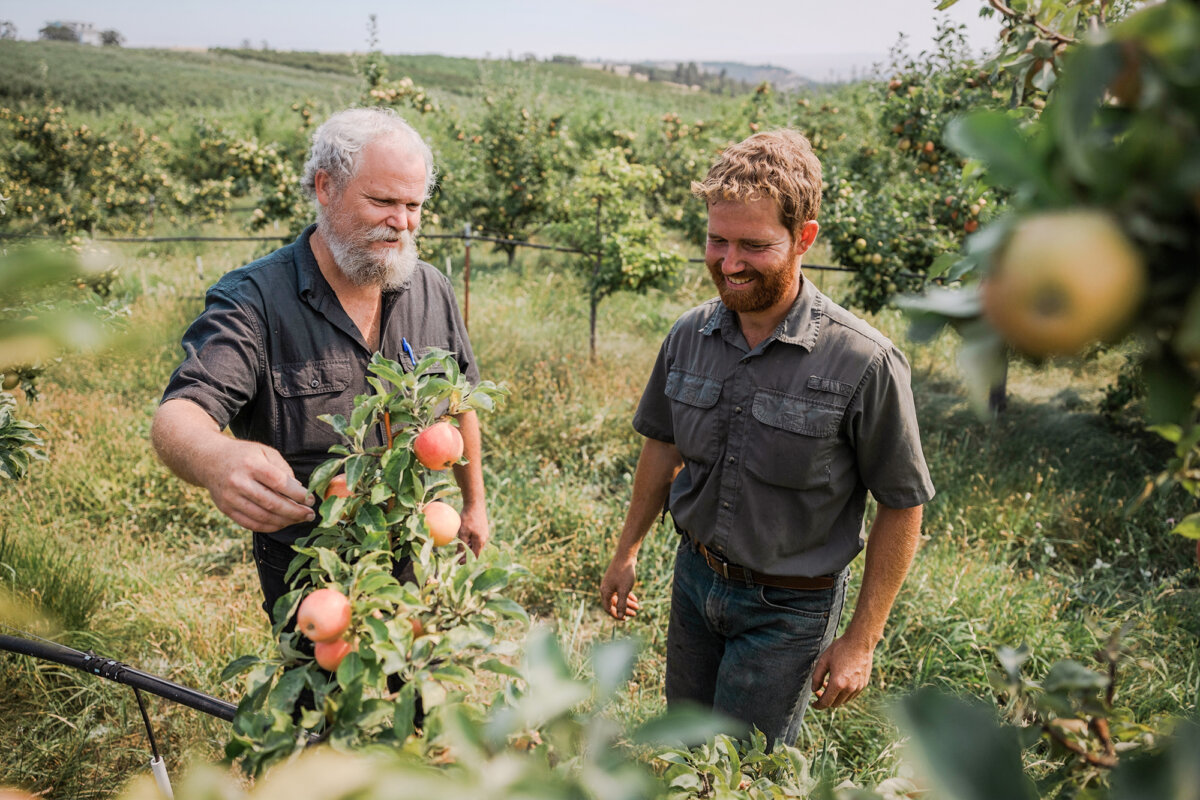
Orchards are lined with apples, peaches, apricots, and pears
“We even have a vineyard growing grapes,” Stelzer said.
Azure also grows garden seeds and plant starts for gardens with the brand name of Ellie’s Eden. Through Wolf Run Organics, Azure grows and markets industrial hemp.
A cannery on the farm supplies shelf-stable goods.
In a building near the gas station in downtown Dufur, a side door leads to Azure Standard’s carob product manufacturing facility.
In Azure Standard’s early years, when Stelzer would visit stores, he took homemade carob candies made by his sister, Anita, to hand out.
In 1994, his father-in-law took over the manufacturing, and the candies were called Doc’s Choice.
“When we could no longer source pre-made carob coating without GMOs, we set out to make our own organic recipe,” Stelzer said.
The company created special equipment that makes “ultra-smooth carob.” The company’s carob bars and carob chips are sold under the Uncommon Carob brand name.
In downtown Dufur, Azure has a bakery that makes bread, mixes, and other products. The company is preparing to add granola and sourdough bread from private local recipes instead of selling the items from a third-party source.
Beyond food, Azure Standard has grown into an economic anchor in Dufur. The company employs around 550 people across multiple locations.
On Aug. 29 and 30, Stelzer will host the Azure Harvest Festival at Azure Farm.
The annual event is one of multiple avenues Stelzer incorporates to educate consumers about the benefits of organic farming and consuming whole foods.
For him, regenerative agriculture is about stewardship and “recognizing farmers as guardians of public health rather than mere commodity producers.”
Stelzer said he wrote his soon-to-be-released book, “Seeds of Hope: The Azure Standard Story,” to further the vision of rebuilding the American food system.
“The book, the festival, speaking at homesteading conferences we’re invited to, doing as many podcasts and interviews as possible—it’s all part of doing everything we can to create a demand for a healthier lifestyle,” he said.
“I’m living proof that food is medicine, and what you eat can negatively or positively impact your health.”
Stelzer and his team have traveled around the world searching for vendors that “meet the Azure standard.”
He said that organic certification is a minimum guideline when his company considers working with a vendor. Olive oil is one example.
“Almost all the conventional olive oil that’s not organic, and even some of the organic olive oils, tend to be blended. I traveled all over the Mediterranean looking for the right place to get olive oil,” he explained.
“We looked at olive oil from Italy, Spain, Greece, and Egypt. The one we trusted the most is made in Tunisia. It’s certified organic and made from wild trees. Some of those trees are 1,000-plus years old, they grow them in the desert, and the company is very careful with their supply chain,” Stelzer added, noting that testing shows it is not blended.
Azure Standard’s sourcing philosophy is shaped by organic and regenerative farming practices that prioritize soil health and biological diversity.
Soil health influences plant health, and plant health influences food quality. That makes soil a central variable in human nutrition, Stelzer believes.
Animal products trace back to the same system, he added. Livestock depends on plant-based feed, which in turn relies on soil conditions. Soil is the base layer of the food economy, Stelzer said.
“Everyone is on their own path to better health. Some have been perfecting their diet and lifestyle for years, while others are just starting that journey to move away from foods and habits that will make them sick. We do our best to share what we know so that everyone can make incremental improvement in their health, no matter where they are at right now,” he said.
Organic does not always mean non-GMO, Stelzer said.
Certifiers such as Oregon Tilth Certified Organic help ensure that organic foods are not sprayed with glyphosate, he explained.
Stelzer produced a video titled “Myths and Truths of Gluten Intolerance.”
“The bottom line is that GMOs damage gut bacteria and gut lining, while glyphosate poisons the system. In America’s food supply, they can create gluten intolerance. Grains sustained animals and people for thousands of years before all of this, which is why it’s important for overall health to consume food that is free of these chemicals,” Stelzer said.
Stelzer and his wife, Kimberly, married in 1986. They have raised 11 children on the farm, and many are involved in the business or related family enterprises.
Loyalty to family was embedded in Stelzer by his father, who died at the age of 90 in 2024.
“My father never let anything stand in his way, and he embraced things before they were mainstream, including farming organically,” Stelzer said.
“To him, religion should encompass all of your life, not just Sunday. He kept the Sabbath, even observing the Sabbath years on the farm—things no one else was doing. When he saw what was going on in public schools, he pulled all of us out and we were homeschooled. This was when people were still going to prison for homeschooling, way before it was a movement.”
The elder Stelzer played a supportive role in helping the younger Stelzer and his brother, Nathan, build Azure Standard.
“When faced with a challenge, my dad would go learn how to conquer, and he helped me to do the same,” Stelzer said.
“There were many times when things weren’t going so well, and times I felt very alone, and in those times, my dad was one of my only supporters. Others would tell me to give up, but dad would say, ‘If you don’t know what you’re doing, you can learn. You’re not the only one who has had to learn to run a business.’”
 Friends Read Free
Copy
Facebook
Tweet
Friends Read Free
Copy
Facebook
Tweet