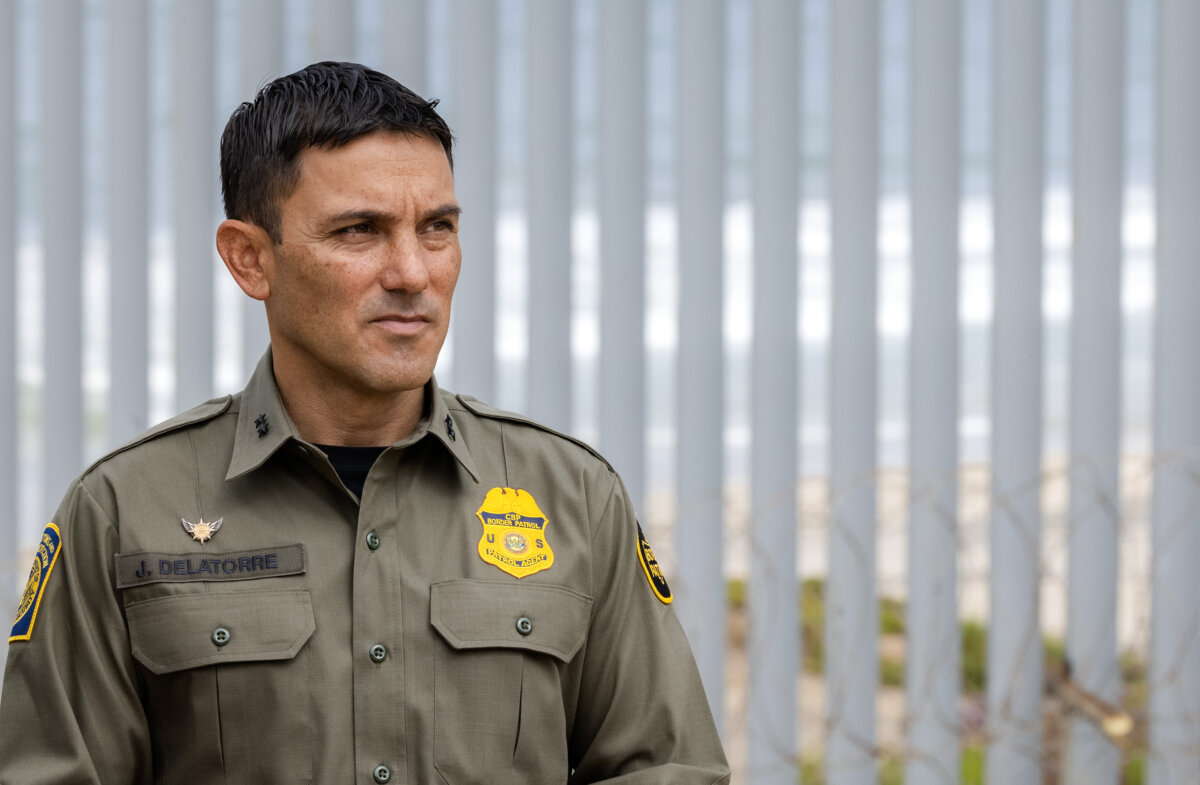

SAN DIEGO—At the western-most point of the international divide, where the Pacific’s waves crash against the sand and metal border walls, San Diego Chief Patrol Agent Justin De La Torre draws attention to a series of contrasts at the border.
“When I first started, we didn’t have any of this infrastructure, so families would come out to visit this park,” he told The Epoch Times while driving down the final stretch of roadway between the primary and secondary border walls.
“They’d show up with two kids, they’d be mingling down on the beach. Next, they’re leaving with like five kids, and you’re sitting here by yourself. It’s really hard to differentiate.
“They used to easily be able to pass things back and forth—[including] drugs.”
The chief parked at the top of a hill before it sloped down to the ocean only a couple hundred yards away. A small patch of dry grass, an unkempt palm tree, and a light pole with a surveillance camera are nestled together at the crest of the hill. A white and weathered lighthouse looms a stone’s throw away in Mexican territory.
The border walls stretch into the ocean and as far in the opposite direction as the eye can see.
The land here is part of Border Field State Park.
De La Torre wore a steely expression as he walked to the edge of the hill and gazed out at the ocean, noting that the park was inaugurated by former First Lady Pat Nixon in 1971. The small area between the border walls where he stood was named Friendship Circle, a place for people from both sides of the U.S.–Mexico border to meet without legally migrating.
Back then, against the sound of a mariachi band, Nixon smiled as she entered a beach that De La Torre would later portray as a battlefield for immigration authorities.
Footage from that day showed Nixon quickly crossing a border and a thin fence to greet Mexicans. During an interview, Nixon said, “We’re such good friends with Mexico, I don’t think we need a border.”
By the time De La Torre spoke to The Epoch Times 55 years later, it was roughly 18 months into an administration often compared to that of Pat Nixon’s husband, Richard Nixon. Less than 14 miles of wall, De La Torre said, remained to be built in his sector to completely seal the border.
It’s one piece of a sprawling, multifaceted security apparatus that makes a first-lady meet-and-greet seem not just unlikely but out of place. Foreign nationals attempting the swim have used wetsuits and scuba gear to stay underwater for the entire illegal crossing. Other times, they use jet skis, panga boats, or sailboats.
Far from the upbeat tempo of mariachi music that accompanied Pat Nixon’s visit, the current scene at the border is one of strength, steel, and surveillance.
De La Torre recounted the surges of thousands of foreign nationals who flooded across every day just a few years ago, and the despair and dead bodies of those who perished in their attempts.
De La Torre’s career with Border Patrol spans about 28 years, but his interest in law enforcement goes back as far as he can remember.
“It could have been from watching shows like ‘Cops’ and ‘Rescue 911,’” he said. “My uncle was in the San Diego Police Department. I looked up to him quite a bit, and some other friends of the family who were in law enforcement, so I just knew at an early age that I wanted to be in law enforcement … [and had] a desire to help other people.”
Fulfilling that childhood dream has been somewhat bittersweet for De La Torre. As border chief, he’s come across tragic deaths, including those of children trying to cross the border.
Evolving Mission
By the late 1970s, border enforcement became a national priority. There was little to no security or infrastructure along the U.S.–Mexico boundary, and the number of immigrants crossing illegally kept increasing.
This trend continued through the 1980s and ’90s, when there was a “tremendous increase” in illegal immigration to the United States, according to historical Border Patrol documentation of the time period.
Border Patrol responded to the increase in illegal immigration decades ago with increases of its own in manpower and technology, while launching two initiatives in the 1990s to bring the situation at the border under control.
De La Torre was a teenager during this period, training with the Boy Scouts and learning skills he never realized would serve him for decades to come.
Although local police departments in San Diego didn’t hire until candidates were 23 years old, De La Torre was a teen when Border Patrol hired at 18.
“I didn’t know much about the mission at first,” the chief said. “But once I started … I was thoroughly fulfilled in the job knowing that we have the ability to make a difference in our nation’s security by preventing dangerous people and drugs from getting into our communities.”
From being raised just north of the border to now being responsible for his homeland’s security, the chief commands more than 2,000 agents in San Diego alone, nearly as many as the total number of agents decades ago when he was a young Boy Scout.
Similarly, with the drop in illegal crossings in the 1990s, De La Torre lived and worked through the border crisis under the previous administration and has been part of the effective locking down of the border under President Donald Trump.
Today, Border Patrol is having even greater success in stemming illegal cross-border activity than its predecessors.
In 2026, border security, with its sensors, cameras, razor wire, and fortified walls ranging from 18 to 30 feet in height, has become so advanced that authorities catch nearly all illegal crossings. Only a fraction occur today compared to the amounts under the previous administration.
At times, the border’s unpredictable climate and diverse terrain make the job difficult for De La Torre and his agents.
“A lot of the human smuggling through here is an organization out of Acapulco, Guerrero, Mexico, and they’re all really good swimmers,” he said, still fixing his eyes on the Pacific as if he was actively trying to spot an illegal crossing attempt.
“When the fog rolls in, they know it, and that’s when they try to hit us. We’ve had 100 people try to cross at once, swimming in the fog.”
As border enforcement has improved, the chief said human and drug smugglers are going further and further out into the deep Pacific to avoid detection.
For those opting to swim, De La Torre noted, some will spend several hours in the ocean, often wading through the water for miles from south of the border to Imperial Beach, the station where he took up his first post in the agency.
Mass rushes of foreign nationals aren’t new to the border chief, who grew up in San Diego and served in multiple border patrol roles before leading the sector.
Standing atop a small mountain miles inland from the Pacific, De La Torre recalls how things were much different a few years ago. “Hundreds of people a day walking in,” he said about this specific area, when asked about the contrast with the present day.
“All we could do is just receive them, and then get their biographical data. We’d set them up for a court date, and then we’d release them,” he said, adding that NGOs would facilitate lodging and transportation for the migrants.
But the picture looks much different under Trump.
In Trump’s first term, Border Patrol began rolling out fiber-optic infrastructure to improve communications. But once the president left office, “all border wall construction stopped,” De La Torre said. “We did not continue any of the tech deployments. So now, we’re getting that all back up.”
De La Torre estimated the border wall construction and technology rollout in the San Diego Sector will be completed in 2028.
While he credited Trump for building the wall, he said a mass enforcement effort under the Clinton administration made that progress possible.
Dubbed Operation Gatekeeper, it focused on the San Diego sector and reduced illegal crossings by 75 percent. The agency had about 2,400 agents at that time.
The chief keeps portraits up in his conference room at the San Diego Sector’s headquarters of what one section of the border here looked like all those decades ago, when masses of foreign nationals would rush across the border every night.
“Back in the ’80s, we were only deploying 10 agents out there at night in this area, so come nightfall, they would all rush into the U.S.,” he said, pointing to one of the portraits of massive groups of illegal aliens coming into the country.
“Agents would grab as many people as they could, and another 100 or 1,000 would rush past, so it was completely out of control back then.”
De La Torre began drawing on a whiteboard, showing how Operation Gatekeeper was carried out to handle this surge of illegal crossings.
“We lined up agents all throughout this region, boom, we put the landing mat fence in and lined up agents like that,” the chief said, marking X’s on the whiteboard.
He drew out how border agents were lined up every 150 yards across a roughly 14-mile stretch of the border for Operation Gatekeeper, accompanied by a Vietnam-era landing-mat fence.
“That worked. We shut down this area in the late ’90s, early 2000s, by saturating it with agents,” De La Torre said.
But this strategy could not possibly be applied to the nearly 2,000-mile-long U.S.–Mexico border. It wasn’t reasonable or feasible, the chief said.
This is when Border Patrol began adopting a strategy of combining infrastructure, barriers, technology, and agents. Today, a five-mile stretch of border in San Diego can be monitored by a handful of agents, with an ATV unit for backup. Despite the sensors, cameras, and other measures, people still try to illegally cross “every night.”
Floating Fences
The Vietnam-era landing-mat fence was technically the first, real border wall between the United States and Mexico. Although it was easy to knock over, climb over, and cut through, De La Torre said.
The chief drove The Epoch Times out to an area covered by Operation Gatekeeper, where some of the old fencing still stands. It now appears primitive and dwarfed by the newer border walls and infrastructure.
At this location where masses of foreign nationals would cross every night, there is now a shopping mall.
“When I started, this mall didn’t exist, and I gotta say, there’s no way they would have been able to build this wall had we not made the gains we made during Operation Gatekeeper,” De La Torre said.
Listening to De La Torre and his agents, one thing was clear: They see illegal immigration as anything but a static threat.
From tunneling and drones to advertisements on social media, the tactics cartels use are as varied as the terrain.
Off the coast of Friendship Park, the Pacific creates a current for migrants to swim along a nearby mountain.
Due west, the terrain turns mountainous and barren.
“That’s what they call a floating fence, because the dunes shift, so the fence can be adjusted,” said another agent who accompanied De La Torre and The Epoch Times on the ridealong.
The arduous, unforgiving terrain alone poses a serious threat to border agents, as they often must traverse miles on foot, away from their vehicles and roads, through open desert or along steep, mountainous paths amid extreme heat.
Now there is much more roadway infrastructure along the border than there was years ago, but even so, an agent may still get stuck and need assistance.
Agents have died from battling the terrain and conditions, falling from a cliff, vehicle accidents on narrow roadways, and heat exhaustion.
The chief has had his own close calls.
He reflected on a particularly dangerous encounter while on patrol years ago. As he was climbing the face of a massive, multi-ton boulder, it dislodged and began rolling back on him. De La Torre was able to move laterally out of the trajectory and fell back into a tree.
“I just remember kind of landing and having a moment, a good period of time, just sitting there thinking, ‘Wow, that was really close,’” he said.
As Border Patrol ramps up its capacity, maintaining this level of operational flexibility requires funding from a sometimes inflexible source: the U.S. Congress.
A partial shutdown earlier this year stemmed from Democratic lawmakers’ unwillingness to fund the Department of Homeland Security, specifically Border Patrol and Immigration and Customs Enforcement, after the fatal shooting of two U.S. citizens by federal agents.
Trump signed a $70-billion funding bill for Border Patrol and ICE in June. The measure is intended to fund the agencies for three years through the end of the president’s term.
“To not enforce these laws creates so much despair for other humans,” De La Torre said.
Personal Toll
Those financial costs can translate into real costs to human lives—both those of foreign nationals and the border agents themselves.
Under Trump, recruitment is at an all-time high, with 20 to 40 new personnel sworn in each week, De La Torre said. Yet agents continue to face varying difficulties even as security increases.
As advanced as surveillance is across the border, cartels employ their own forms of surveillance to watch for vulnerabilities, using spotters or drones.
The constant vigilance required is the toughest part of the job, De La Torre told The Epoch Times.
“You can’t get complacent; you always have to be thinking of what’s next,” the chief said.
“Having a job where you’re always on high vigilance has an effect on people in general, so being able to turn that off when you go home to your families and just relax and enjoy good quality family time, that could be a challenge.”
The heavy burden border agents carry in fulfilling their duties is often borne in silence.
It’s not just how they prepare, but what they see as well.
Sometimes, agents can burn out, especially during the “rough times” along the border, De La Torre said.
“I’ve had agents bawling in my office about why we’re doing what we’re doing … CPR on babies,” the chief said. “All the chaotic stuff that you see can wear on you.”
De La Torre previously served as deputy chief patrol agent of the Tucson Sector during the Biden administration. At one point, Border Patrol was handling 1,200 foreign nationals a night—men, women, children, the elderly.
The agency would transport these masses of individuals to a staging area designed to hold thousands of people. During the winter, it became an impossible task to keep them warm.
Border Patrol sacrificed their own space heaters used at checkpoints to keep foreign nationals warm at the staging area.
“Well, this one kid wearing a nylon jacket, he backed up, not looking where he’s going, backed up into the space heater, and his jacket caught on fire, so now the kid’s on fire. An agent jumped on him,” the chief said.
“Third-degree burns on his hands, burns on the kid’s back. … The frustration … this chaos is leading to ridiculous things like that.”
In April 2001, on a detail to Ajo, Arizona, he was patrolling and came across a young Mexican couple in the middle of the desert on a bicycle. Their infant child was with them.
The family was 30 miles north of the border and still a long way from the nearest town, the chief said. All of them showed signs of severe dehydration.
“They were on the verge of death,” De La Torre said.
“I asked the young man, because he’s with his wife and child, and I’m like, ‘Man, what were you thinking? Why would you take your family? Why would you risk your baby’s life like this?’ I couldn’t understand it.”
The man explained that the smugglers had lied to him and that the individual who sold the family the bike had said it was only a 10- to 15-minute ride. It was actually a 50-mile ride through the scorching desert.
“Had I not found this young man and his family, they would have died,” De La Torre said.
When asked if he missed the front-line positions he once served in, De La Torre said, “100 percent.”
“I definitely miss being a part of a team of agents that goes out on patrol, gets into some of the arduous terrain, the hiking, the interdictions,” he said. “I had a sense back then that I would do it for free because I enjoyed it so much. To this day, I still miss doing that type of work.”
Becoming chief was never a goal for De La Torre, but he prepared himself in case he were ever asked to take on those responsibilities.
“You don’t have to look at things like, ‘How [do I] become a chief?’” he said. “The question doesn’t have to be answered if you show up, put in the hard work, stay competent on your job knowledge—someone’s going to call you and ask you if you’re willing to step up.”
While speaking with The Epoch Times, he reflected on the oath he swore as a Boy Scout decades earlier.
“On my honor, I will do my best to do my duty to God and my country and to obey the Scout Law; to help other people at all times; to keep myself physically strong, mentally awake, and morally straight,” it reads.
The part about helping others stuck out in De La Torre’s memory.
“You see that with border patrol agents throughout the country,” he said. “I mean, if an agent comes across somebody in distress, whether they’re a U.S. citizen or a foreign national, an agent is going to do everything they can to help those people out.”
 Friends Read Free
Copy
Facebook
Tweet
Friends Read Free
Copy
Facebook
Tweet