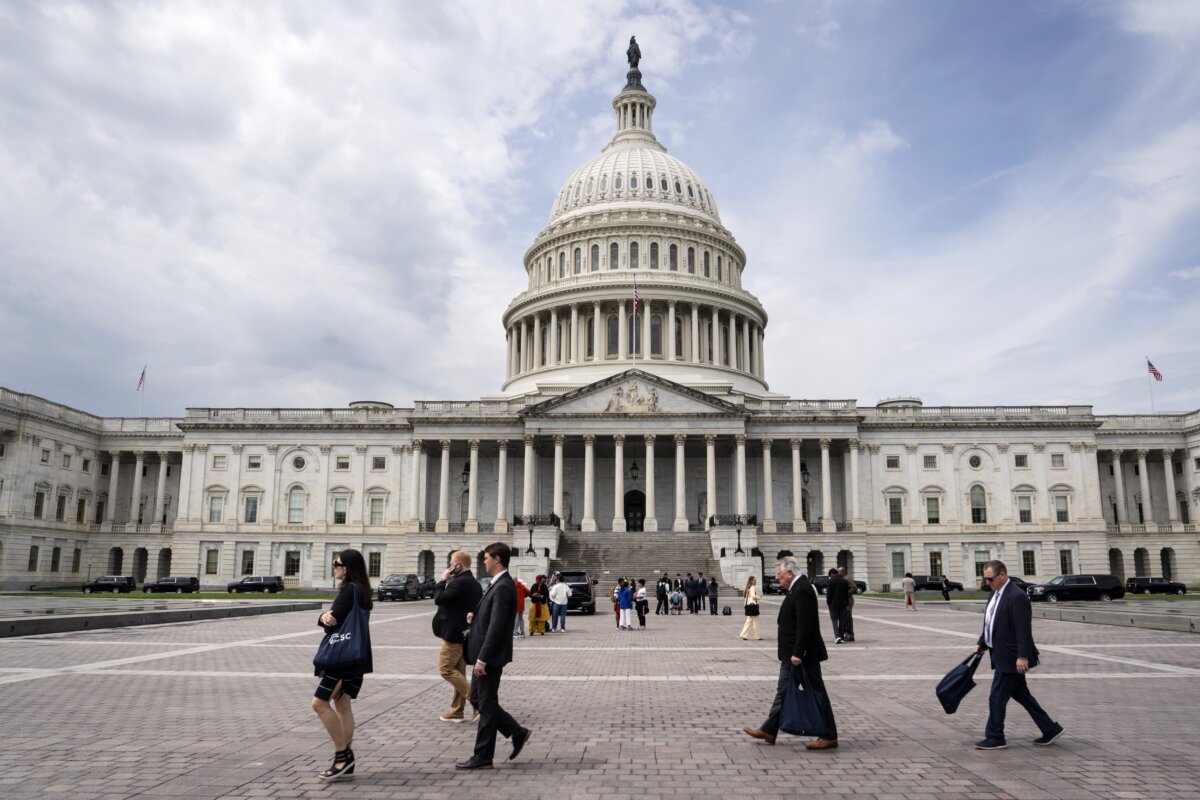

Lawmakers have a lengthy to-do list as leadership works to finalize passage of several key legislative priorities.
The top priority will be to continue work on a $70 billion package to fund Immigration and Customs Enforcement (ICE) and Border Patrol, as the two remain at the center of a funding impasse amid a record-long partial government shutdown.
They’ll also continue to work on renewing the controversial Section 702 of the Foreign Intelligence Surveillance Act (FISA), a law that grants the government wide authority to conduct warrantless surveillance.
Lawmakers are also addressing running disputes on the all-important Farm Bill.
Here’s what to know.
Senate Republicans last week agreed to move forward on a blueprint for a party-line budget resolution to fund the Department of Homeland Security’s immigration law enforcement functions.
In a 52–46 vote, the Senate approved advancing the measure put forward by Senate Budget Chairman Lindsey Graham (R-S.C.).
The measure started the budget reconciliation process, ordering House and Senate committees to write legislation that would provide up to $70 billion for ICE and Border Patrol.
Work to pass the measure will continue this week.
Under the reconciliation process, which is governed by strict rules, lawmakers can bypass the normal filibuster requirements and pass party-line legislation in the upper chamber.
Because reconciliation is exempt from filibuster rules, it has been an appealing tool for both parties when failing to secure a supermajority in the Senate. It was used by Democrats to pass the Inflation Reduction Act of 2021 and by Republicans to pass the One Big Beautiful Bill Act of 2025, but it is subject to significant restrictions.
Namely, it must include only federal budget items, with no items that have a “merely incidental” effect on revenue or spending.
Senate Majority Leader John Thune (R-S.D.) indicated that Republicans had been forced to use the process to end the shutdown impacting the Department of Homeland Security (DHS).
“It’s not my preference, but it is reality,” Thune said.
The now 67-day partial shutdown started in mid-February, when Democrats vowed to deny funding to the department until changes they wanted were made to ICE and CBP policy. They justified their demands as the minority party to the fatal shootings of Renée Good and Alex Pretti by immigration agents in Minneapolis.
If funding for the agencies is approved through the reconciliation process, it would leave only the generally non-controversial DHS funding items for the regular appropriations bill: the Transportation Security Administration, the Coast Guard, the Federal Emergency Management Agency, and others.
Such a move would likely make it politically costly for Democrats to continue opposing funding for the agency.
A separate bill to fund all of DHS, except immigration enforcement, has passed the Senate and is now pending in the House.
The U.S. House of Representatives on April 17 passed a bill extending the controversial Section 702 of FISA.
The bill cleared the House by unanimous consent, extending the deadline of FISA to April 30. The measure was later approved by the Senate and signed into law.
The shortened extension comes as lawmakers in both parties and chambers are split on President Donald Trump’s calls for a clean extension of the law to the floor.
Trump said he had personally experienced what he called the “worst and most illegal abuse of FISA in our Nation’s History,” referencing disclosures that revealed the FBI had used Section 702 of FISA to spy on his 2016 presidential campaign as part of the Crossfire Hurricane operation.
Nevertheless, Trump said that the U.S. military “desperately needs” Section 702 of FISA to protect national security and carry out its missions.
Section 702 targets intelligence from foreign nationals thought to be outside the United States. Yet it also enables intelligence agencies to gather “incidental” information from Americans who come into contact with targeted non-U.S. persons—all without a warrant.
Last week, House Republican leadership unveiled a 3-year extension to FISA that doesn’t include a warrant requirement.
Section 702 has long caused bipartisan discomfort on Capitol Hill and beyond.
Rep. Jim Himes (D-Conn.) offered an amendment on April 15 that would require the Justice Department to obtain a court order before the FBI can access data collected from Americans, political groups, and nonprofits, with limited exceptions for addressing “significant and time-sensitive national security threats.”
“FISA 702 is too critical to allow it to expire, but the legitimate concerns about the possibility of abuse also demand that we consider additional reforms, exactly what my amendment seeks to accomplish,” Himes said in an April 15 statement.
Congress is also working to pass the Farm Bill.
However, passage of the bill is currently being slowed by a contingent of Republicans who oppose a provision in the legislation that would change the rules governing pesticide labeling.
Under the proposed 2026 Farm Bill, state-level warning labels on pesticide products would be banned. This move, seen as a win for chemical companies, would dictate the removal of warning labels such as California’s “Prop 65 Warning” seen on many common products. The Prop 65 label warns that a product is known to the state of California to be carcinogenic.
But some Republicans in Congress—including Reps. Thomas Massie (R-Ky.) and Anna Paulina Luna (R-Fla.)—have opposed the change, which could force leadership to rely on Democratic votes to pass the measure.
—Joseph Lord
BOOKMARKS
Cole Allen, the suspect in the White House correspondents’ dinner shooting, has been charged with attempted assassination of President Donald Trump, along with two other offenses.
White House press secretary Karoline Leavitt said on Monday that members of Trump’s administration have discussed options for a new peace proposal in Iran. “I would just say that there was a discussion this morning that I don’t want to get ahead of, and you’ll hear directly from the president, I’m sure, on this topic,” she told reporters.
What would happen to NATO if the United States pulled out? John Haughey asks the experts in his latest report.
The U.S. Supreme Court heard oral arguments on April 27 in Monsanto’s appeal to block thousands of lawsuits alleging the company failed to warn consumers that Roundup, its popular weedkiller, could cause cancer. A jury previously awarded $1.25 million in damages to John Durnell, a Missouri man who developed non-Hodgkin lymphoma after exposure to the chemical.
Air taxis may soon cut travel times for commuters weary of dealing with traffic jams. Read all about it in Rob Sabo’s latest report.
Five former Pennsylvania governors are asking state officials to beef up security for Gov. Josh Shapiro and his family in the wake of this weekend’s attempted attack on Trump. “In the aftermath of that attack, we ask the state’s current leaders and legislators to make the safety and security of the governor and his family a priority,” the former governors wrote in a statement.
—Stacy Robinson
 Friends Read Free
Copy
Facebook
Tweet
Friends Read Free
Copy
Facebook
Tweet