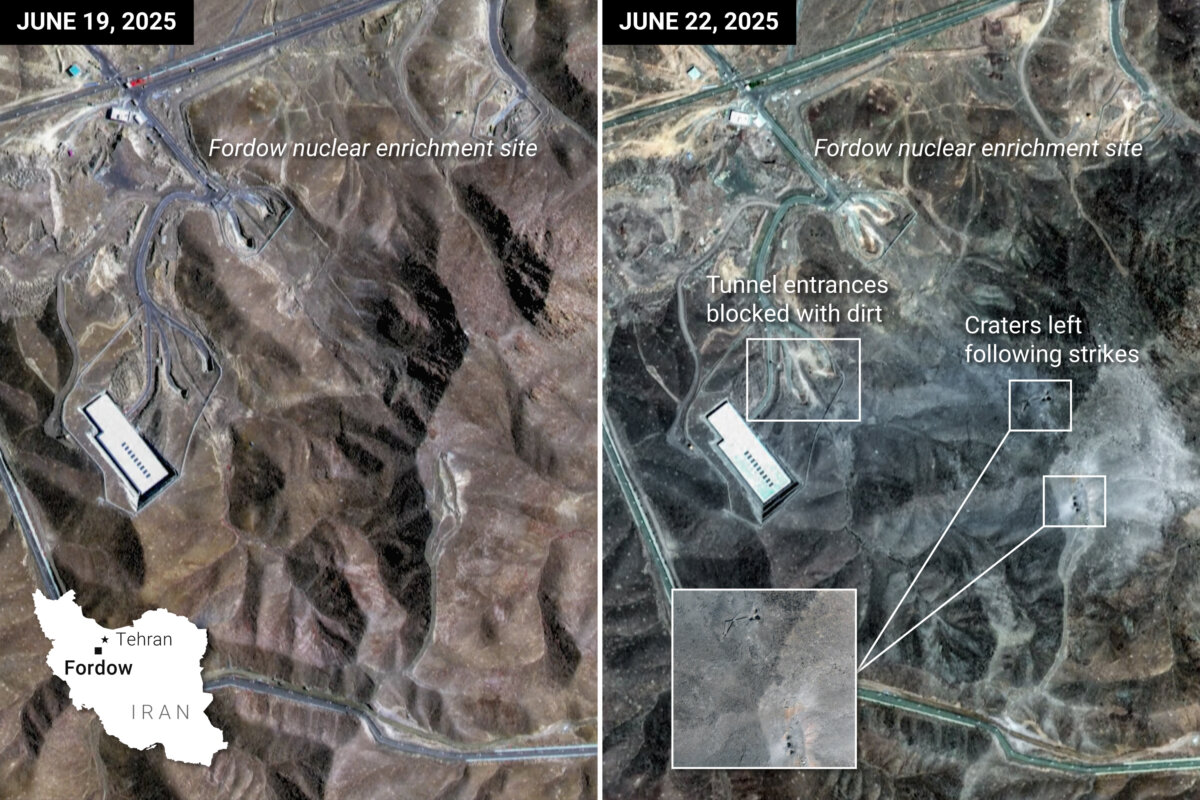

The U.S. strike on three Iranian nuclear facilities overnight on June 21–22 followed a highly intricate plan that entailed more than 125 U.S. aircraft and warships and layers of deception, Defense Secretary Pete Hegseth said during a Pentagon news briefing.
Hegseth said preparation for the mission—dubbed Operation Midnight Hammer—took place over weeks and months, “so that we could be ready when the president of the United States called.”
The U.S. strikes were made a week after Israel launched a series of surprise airstrikes across Iran, aimed at degrading the country’s nuclear programs and military capabilities.
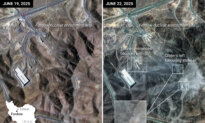
Joining the conflict that Israel initiated, U.S. military planners set Iran’s Fordow uranium enrichment facility as their primary target.
With the Fordow facility situated hundreds of feet underground in a mountainous region of Iran, U.S. Air Force B-2 Spirit stealth bombers carrying 30,000-pound bunker-busting bombs, called GBU-57A/B Massive Ordnance Penetrators, offered one of the best options to destroy the facility.
The Pentagon presented a timeline of the attack during a June 22 press conference. All times provided are Eastern time.
The operation began just after midnight Eastern time on June 21, as seven B-2 bombers departed Whiteman Air Force Base, Missouri, heading east on their way to Iran. The B-2 bombers received refueling support from dozens of aerial refueling aircraft along their journey across the Atlantic Ocean and over the Mediterranean Sea.
The bombers reached the U.S. Central Command area of responsibility at about 5 p.m. on June 22. Just before these bombers entered the Central Command area, U.S. submarines began launching Tomahawk cruise missiles at targets in Iran.
U.S. fighter jets flew ahead of the bombers, and the airstrike package entered Iranian airspace at approximately 6 p.m. The jets began preemptively suppressing Iranian air defense systems around the Fordow and Natanz nuclear facilities, clearing the way for the bomber crews.
At approximately 6:40 p.m., the lead bomber crews reached the Fordow nuclear facility and dropped two GBU-57 bombs. Over the next 20 minutes, the rest of the bomber crews dropped their payloads over Fordow and Natanz.
The sea-launched Tomahawk cruise missiles reached the third and final target, Iran’s Isfahan nuclear facility, and concluded the strike operation at approximately 7:05 p.m.
The B-2 bomber crews exited the Iranian airspace at approximately 7:30 p.m. In total, these bombers dropped 14 bunker buster bombs.
Detailing the operation, Gen. Dan Caine, chairman of the Joint Chiefs of Staff, said the U.S. submarines involved in the strikes began firing “more than two dozen Tomahawk land attack cruise missiles against key surface infrastructure targets at Isfahan.”
The air and sea components of the U.S. strike package were carefully sequenced so that the Tomahawk missile impacts could coincide with the narrow time frame of the rest of the strike package.
The U.S. strike operation entailed several elements of deception to misdirect Iran’s defenses.
While the bomber crews responsible for conducting the strikes flew east from Whiteman Air Force Base, Caine announced that some bombers were headed west over the Pacific Ocean.
Caine said it was “a deception effort known only to an extremely small number of planners and key leaders here in Washington and in Tampa.”
The top U.S. general said U.S. forces employed other deception tactics in the course of the mission, but did not specify what those tactics were.
More than 125 military aircraft participated in Operation Midnight Hammer, according to Caine.
He said this included the B-2 stealth bombers, “multiple flights of fourth and fifth generation fighters,” and “dozens and dozens of air refueling tankers.”
Emphasizing the surprise nature of the operation, Caine said the U.S. military is unaware of any Iranian forces firing on the U.S. warplanes during the mission.
“Iran’s fighters did not fly, and it appears that Iran’s surface-to-air missile systems did not see us throughout the mission,” Caine said. “We retained the element of surprise in total.”
Hegseth also said the capabilities and coordination demonstrated by the U.S. forces during the operation will be a key factor dissuading Iran from retaliating.
“We believe that will have a clear psychological impact on how they view the future, and we certainly hope they take the path of negotiated peace,” he said. “But I could not be more proud of how this building operated, of the precision, the sensitivity, and the professionalism of the troops involved in this effort.”
—Ryan Morgan and Joseph Lord
BOOKMARKS
Seven presidents and trillions of dollars after its inception, the Trump administration has cut the agency in half and seeks to eliminate the Department of Education. But, The Epoch Times’ Aaron Gifford reported, the conservative fight to undo President Jimmy Carter’s creation goes back decades.
Texas Gov. Greg Abbott on June 20 signed a bill into law that would require all public school classrooms in his state to display the biblical Ten Commandments, The Epoch Times’ Melanie Sun reported. The law, which goes into effect on Sept. 1, requires classrooms to display a poster or framed English translation of the commandments that is at least 16-by-20 inches and is able to be read from anywhere in the classroom.
In Brazil, local auto industry and labor associations have expressed growing concerns over the impact of the flood of cheap Chinese cars, The Epoch Times’ Alex Wu reported. China’s largest EV and plug-in hybrid car company, BYD, has shipped four batches of its products to Brazil so far this year, totaling about 22,000 vehicles.
Three major U.S. cities indicated that they’re on heightened alert following the U.S. military airstrikes targeting Iranian nuclear facilities, The Epoch Times’ Jack Phillips reported. Specifically, officials in New York City, Los Angeles, and Washington issued statements after the U.S. military operation.
 Friends Read Free
Copy
Facebook
Tweet
Friends Read Free
Copy
Facebook
Tweet