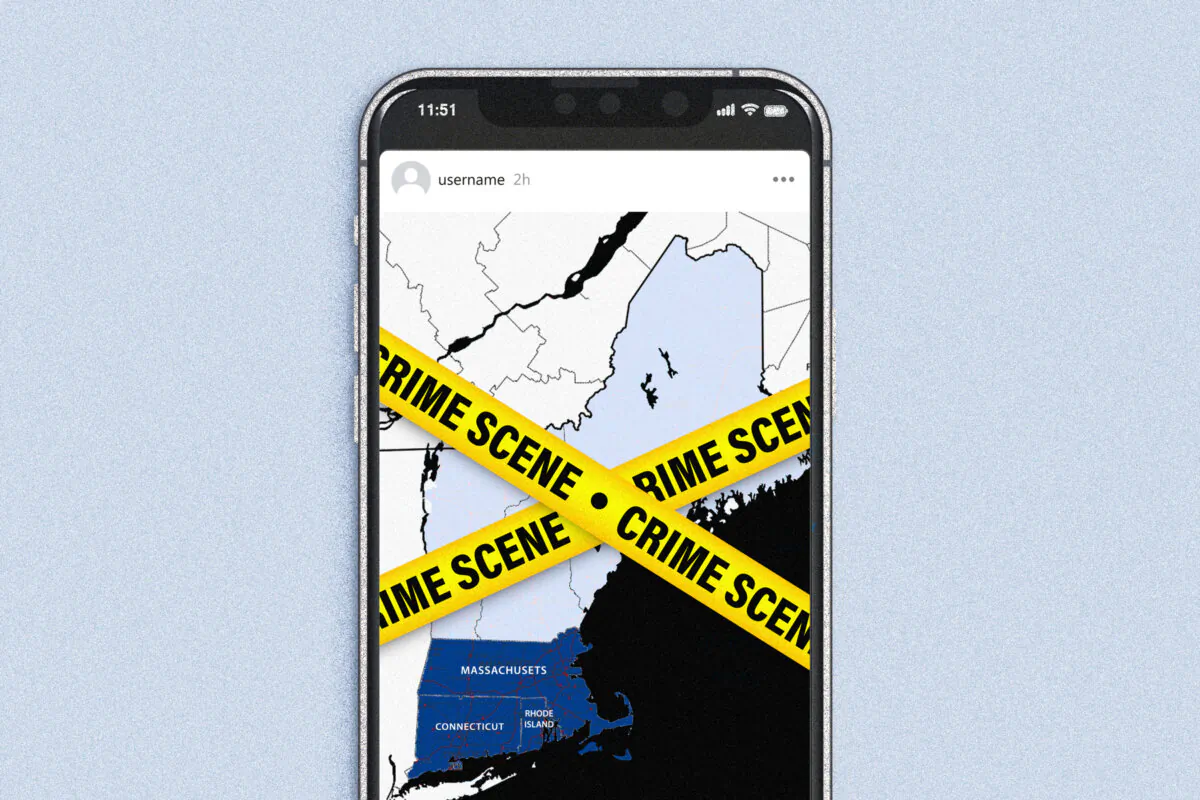
NEW ENGLAND—On the eve of Easter Sunday, detectives in Narragansett, Rhode Island, were busy investigating crimes when messages began to pour in.
“It came from everywhere,” Detective Sgt. Brent Kuzman said, referring to the flurry of emails and phone calls to dispatch that pointed to an anonymous Facebook post in a group called New England SK (“SK” stands for “serial killer”).
While the identity of the person behind the post was unavailable publicly, the post itself suggested the possibility of six bodies buried at Black Point near Scarborough Beach, each positioned vertically and facing the ocean.
And despite that the post also stated that it was a piece of fiction, Kuzman said he believed that the message contained enough credibility to prompt further investigation.
That same day, on April 19, four detectives from the Narragansett Police Department and two Rhode Island State Police cadaver dog teams began searching along woodland trails and the Scarborough beachfront. The department also contacted the FBI.
The search lasted 20 hours and yielded nothing.
“We used our whole detective division over two days,” Kuzman told The Epoch Times. “We had to put off every other case. The area we looked at was an extensive amount of land.”
Kuzman said the investigation concluded that the post was “100 percent” a hoax, noting that the creator of the post has since deleted the message, canceled the account, and remains unidentified. The police declined to provide a screenshot of the post to The Epoch Times.
However, this is just one chapter in a story of murder, conspiracy, and hoaxes revolving around a supposed serial killer, all being played out on social media.
On the Side of Caution
Social media had been buzzing for months following the discovery of 13 bodies and skeletal remains in Connecticut, Massachusetts, and Rhode Island between March and April.
Most of the remains found were female, including the bodies of two women who had been reported missing in 2024.
In Massachusetts, three cases were identified as homicides, which led to two separate arrests on murder charges. Other causes of death are still undetermined or involve circumstances that police are unable to disclose.
Two cases involve incomplete sets of human remains.
On March 27, a hunter searching for deer antlers found a portion of a human skull in Plymouth, Massachusetts, according to Boston 25 News. Police closed off the area as part of the ongoing investigation.
The department released a statement the next day, stating that there was “no threat to public safety.”
On May 4, police reported the discovery of a possible human leg bone near the home of pop singer Taylor Swift in an upscale area of Westerly, Rhode Island. The remains have not been identified.
The Epoch Times contacted the Westerly police for comment.
Linking Cases
The chatter and differing opinions on social media about a possible serial killer have continued with each grisly discovery.
“LE [law enforcement] still saying it is not a SK [serial killer],” one Facebook post reads. “I think now is when they should be most concerned. This ‘killer(s)’ is getting more brazen. They are calling out for recognition.”
Another Facebook post reads, “I can understand not wanting to jump to conclusions or cause a panic, but why does it always seem like the police are just dead set against even considering the possibility of a serial killer?”
A May 1 post states, “While some of the people found have indeed been victims of foul play, there are others who seem more like a victim of their own demons.”
Kuzman said he believes that there is no evidence linking all the cases and that social media users have been selectively focusing on certain cases to support a serial killer narrative.
“I feel like the whole movement behind this is cherry-picking—like they have a conclusion—and they’re trying to justify whatever data they have of there being a serial killer,” he said.
“There’s been nothing [from law enforcement] about a potential suspect in a serial killing in this region at all.”
But the story has developed a “life of its own.”
On April 24, Hampden County District Attorney Anthony Gulluni issued a statement addressing growing concerns after police found a woman unresponsive on a bike path near the Naismith Memorial Basketball Hall of Fame in Springfield, Massachusetts.
Meggan Meredith, 45, was pronounced dead shortly after 8 a.m. on April 22. Authorities have classified her death as a homicide.
“We understand the unease that comes with such acts of violence, and we want the community to know that each of these cases is being thoroughly investigated in close coordination with our law enforcement partners,” Gulluni said.
He advised people to exercise caution when sharing social media posts that aim to spread fear and misinformation.
“Unverified claims can compromise active investigations and contribute to a sense of chaos that does not reflect the full picture,” Gulluni said.
Serial Killers Everywhere
Multiple law enforcement agencies across the country have expressed similar concerns about social media posts claiming that serial killers are active throughout the United States.
Law enforcement classifies a serial killer as someone who murders two or more individuals in separate incidents. Usually, it is for psychological pleasure, thrill seeking, attention, or financial gain.
On Dec. 5, 2024, the San Bernardino County Sheriff’s Department addressed social media claims about a serial killer targeting individuals as part of a nationwide “scam.”
“Please be assured that we would inform you immediately of any potential threat to your safety or the safety of our community,” the department posted on Facebook. “Your safety is our greatest priority.”
On Dec. 9, 2024, police in Odessa, Texas, posted a similar warning on Facebook about a possible serial killer “knocking on doors in Odessa.”
“These posts are intended to cause unwarranted public harm and have been determined to be false,” the police said.
The Eastland Police Department in Texas also addressed allegations that a serial killer was active, determining them to be false.
“Please be assured that there is no credible threat to our community,” the department wrote on its Facebook page. “Similar posts have appeared in various regions and are designed to create panic and fear.
“We urge everyone to verify information through your local law enforcement departments before sharing.”
On Jan. 31, police in Camden, South Carolina, warned residents about a scam circulating on social media that falsely claimed that serial killers were targeting several states.
The posts included random names and mugshots to lend credibility to the misinformation.
“Once the post goes viral, they edit the content to promote scams (fake rental listings, phishing links),” the police said. “Do not share or engage these posts.
“Stay informed and always verify information from trusted sources.”
Serial killings make up less than 1 percent of all homicides, according to the World Population Review.
Since the 1990s, the rate of serial killings has declined, with California having the highest number of known victims between 1992 and 2019, at 1,777. Texas had the second-highest number of victims, 984, followed by Florida with 933. Illinois and New York rounded out the top five.
Trolling Law Enforcement
Spreading or discussing false information or rumors on social media is generally not considered a crime under federal law. However, it can lead to legal consequences if done with malicious intent or if it causes harm.
Under Title 18 U.S. Code 1038, known as the false information and hoaxes law, it is a federal offense to engage in any conduct intended to convey false or misleading statements about a major crisis to incite fear and panic.
Kuzman said the Facebook post mentioning a gravesite in Narragansett seemed intended to provoke reactions from social media users. Nonetheless, investigators determined that it did not constitute a crime.
However, in some cases, misleading others through social media can result in criminal charges.
On May 25, a grand jury in Navajo County indicted a woman from Show Low, Arizona, on felony charges related to the disappearance of Jarrett Brooks, 16, who went missing on July 4, 2023.
Molly Ottman, 50, is charged with obstructing an investigation and committing fraudulent schemes and artifices after she allegedly contacted law enforcement officials to report posts from a Reddit account she claimed belonged to the boy’s father.
Law enforcement agencies investigated the posts and searched the father’s residence and the offices of a private investigator hired by the Brooks family in the Phoenix area, according to the Navajo County Attorney’s Office.
Further investigations by the sheriff’s office and the county attorney’s office eventually led officials to conclude that Ottman had allegedly created the Reddit account and posted the fraudulent content herself.
Running With a Narrative
As a coastal community with a population of a little more than 14,000, Narragansett is a popular rental destination for University of Rhode Island students.
For three weeks after the anonymous Facebook post, Kuzman received phone calls from residents and parents who were concerned about their children’s safety. The department responded to concerns twice on its Facebook page.
“I’ve been doing this job for 15 years,” Kuzman said, noting that “it was incredible to read” the anonymous post on Facebook, especially with the rumors about a potential serial killer already circulating.
“I could see how invested people were; they just ran with it,” he told The Epoch Times.
“I can’t say which came first: the chicken or the egg,” he said, referring to the social media frenzy and the media coverage.
“There have been serial killers in New England in the past. But it grew because of the bodies that were turning up.”
Kuzman and other law enforcement officials recognize the advantages of social media in police investigations and crime solving.
“If there is public concern on social media, we will investigate,” Kuzman said. “You have to respond. But you can’t overdo the response because it might benefit the hoaxer. You have to balance public safety with your response.”
He compared the current controversy to a fire department responding to a false alarm at a school.
Failing to respond could lead to negative consequences, including a loss of trust in public safety.
“We don’t want to be the department that doesn’t do anything because something sounded outlandish,” Kuzman said.
The FBI’s Boston field office spokeswoman, Kristen Setera, told The Epoch Times that the agency knows about the rumors.
“I’m not going to give credence to internet rumors,” Setera said. “All I can say is that at this point in time there is no known threat to public safety.”
Frank Frederickson, executive director of the New England Association of Chiefs of Police, said he considers the situation a “dilemma” for law enforcement.
He said it raises the issue of balancing freedom of speech with public safety, as social media can be both a valuable tool and a potential risk.
When used responsibly, social media has been proven to be extremely helpful, Frederickson told The Epoch Times.
But investigators also encounter significant challenges when false leads circulate on social media, as this can instill fear in the community, he said.
Frederickson, formerly a police chief in Yarmouth, Massachusetts, observed that social media users often feel the need to fill the information gap when law enforcement is unable to share details with the public.
“That’s the dilemma in law enforcement,” Frederickson said. “Is there enough to put out there without jeopardizing the case?
“It’s damned if I do, damned if I don’t.”
Fatal Attraction
David Gerzof Richard, professor of public relations at Emerson College in Boston, said he believes that social media often exploits the public’s fascination with mortality.
“We kind of zone in on this stuff. … High-profile murders, whether it’s on trial or when it happens,” Richard told The Epoch Times. “If it bleeds, it leads.
“When it happens to be around a serial killer who could potentially be in our backyard, that’s going to get eyeballs. It starts to get legs. It gets shared.
“Before you know it, you have enough people sharing that there is noise and critical mass. The calls start coming to law enforcement from the community because of concern. That’s how all this comes about.”
Richard cited the Boston Marathon bombing on April 15, 2013, as a prime example.
Following the tragedy, he said, “internet sleuths” flooded social media with theories about potential motives and suspects.
“It just gets amplified with the social media side of things,” Richard said. “We all know we’re not supposed to yell fire in a theater. Causing panic is never a good thing.”
Richard stressed the need to evaluate the reliability of information and its sources on social media.
“These internet sleuths are looking for what they want to find,” he said. “They are not law enforcement. They are not journalists. They are people that could be on their mom’s couch in the basement, trying to figure this out.
“That’s where some of these ideas are coming from.”
The Abt Law Firm in Atlanta recognizes that social media can be beneficial and detrimental to law enforcement, depending on the situation.
“In an era where community engagement can be as simple as a click or a share, law enforcement agencies are leveraging social media to enlist the public’s help in solving crimes,” Abt said in a report.
“The success stories are numerous, with cases being cracked open thanks to vigilant citizens responding to social media appeals.”
The report notes that although social media can be helpful in this context, it also has drawbacks.
“Misinformation can spread rapidly, complicating investigations and sometimes leading to unwarranted suspicion or panic,” it reads.
According to the report, law enforcement must navigate these challenges with care, ensuring that its “calls for public assistance are measured, lawful, and respectful of the community’s trust.”
Treading Lightly
Kuzman said his department was fortunate because the two-day investigation did not require overtime costs or expensive specialized equipment.
He said he believes that like most social media trends, the narrative around a serial killer will eventually yield to more reasonable explanations as investigators collect more evidence.
Meanwhile, he urges the public to remember the humanity of the victims.
“They had lives,” Kuzman said. “They had loved ones.
“When we talk about these people, they were people. We can’t forget the human element.”
 Friends Read Free
Copy
Facebook
Tweet
Friends Read Free
Copy
Facebook
Tweet