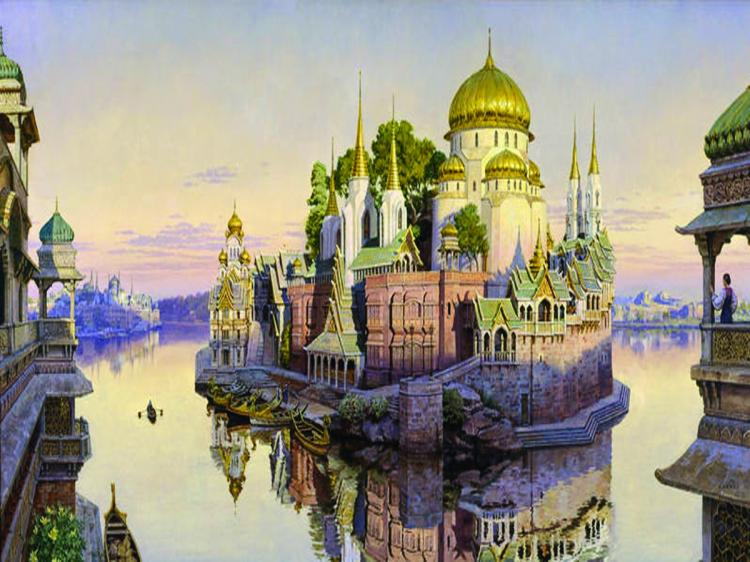
EPOCH TIMES: During your career you have been working in such different fields as book cover illustration and animated films like Frank Frazetta and Ralph Bakshi’s Fire and Ice; you have celebrated the outstanding success of your Dinotopia books, which also have been turned into a TV series; and you give lectures for creative professionals (for example, those at DreamWorks Animation SKG and Lucasfilm Ltd).
What in your perspective has changed within the field of visual art in general and for the artists and the requirements of them compared to 20–25 years ago?
JAMES GURNEY: The most obvious change in the last two decades is the emergence of digital tools, both in illustration and in filmmaking. Although I work in traditional oil paints, I find this new technology very interesting, particularly the breakthroughs in 3D modeling, lighting, and animation, because it has brought about a renaissance of new understanding of the visual world. It has brought artists together with physicists and mathematicians to better understand such things as subsurface scattering, caustics, occlusion shadows, and particle behavior. All of these new insights have influenced me, even though I work entirely in traditional media.
But I think your question touches on another and perhaps less obvious change. Emerging forms of digital distribution offer artists new ways to market and promote their work.
These tools have given artists a lot of choices for how to use their talents. If they enjoy working collaboratively on a large enterprise like a film or a video game, there are huge opportunities. The term “concept artist” didn’t exist when I was in art school. But artists can also work alone to write, illustrate, and design their own illustrated stories, graphic novels, or even animated films, and connect with the readers before the works are published.
ET: Considering platforms like deviantART or Conceptart.org, in which artists seem to produce outstanding artwork en masse every day, one provokingly may ask: Is there still a demand for illustration/imaginative artwork, and what does this mean for the individual artist of today?
JG: I can’t say too much about those forums simply because I don’t have enough time online to be able to explore them, but I realize they’re a rich resource for both emerging artists and professionals.
People are hungrier than ever for images from the imagination. Imaginative artwork is healthier than ever today. The most successful exhibit in recent years at the American Society of Illustrators was the Spectrum Exhibition. Most young people have grown up loving comics, games, science fiction, and fantasy, so it’s not going away soon. 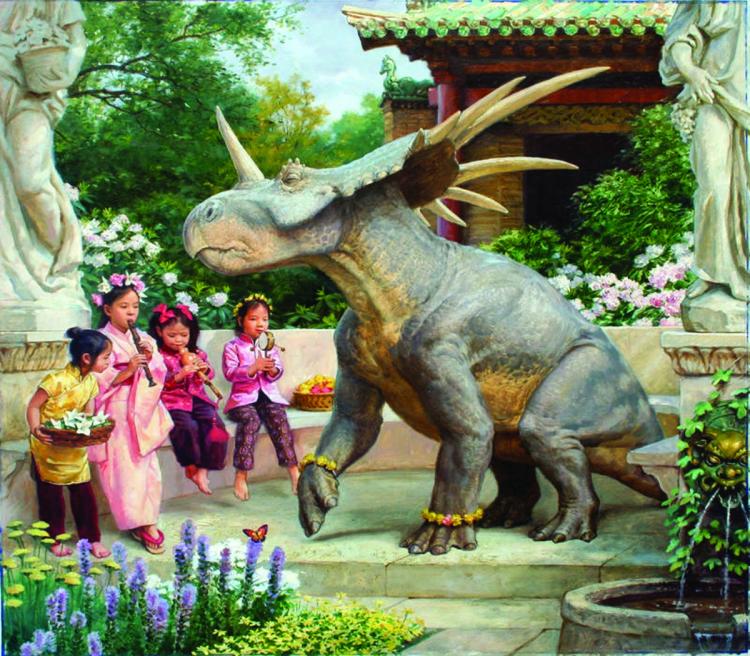
ET: In your first instructional book on illustration, Imaginative Realism: How to Paint What Doesn’t Exist, you give an extensive overview on how to create imaginative artwork in an encompassing way that I didn’t find in such form yet, drawing from the treasure-trove of the golden age of illustrators, as well as providing a generous insight into your personal methods and experiences.
Will there be further publications after Color and Light? What was your initial starting point and motivation to go for a how-to book?
JG: Yes, there will be more books after Color and Light, including another art-instruction book, sketchbooks, and new illustrated fantasies along the lines of Dinotopia. I’m also keenly interested in video, e-book, and app formats, so I will find at least a little bit of time on the side to develop those ideas.
To answer your second question, like a lot of artists in my generation, I found that art school didn’t answer all the questions that were burning in my mind. I was hungry for certain chunks of information, and I could never find it, so I wrote the books to answer all those questions.
 Friends Read Free
Copy
Facebook
Tweet
Friends Read Free
Copy
Facebook
Tweet