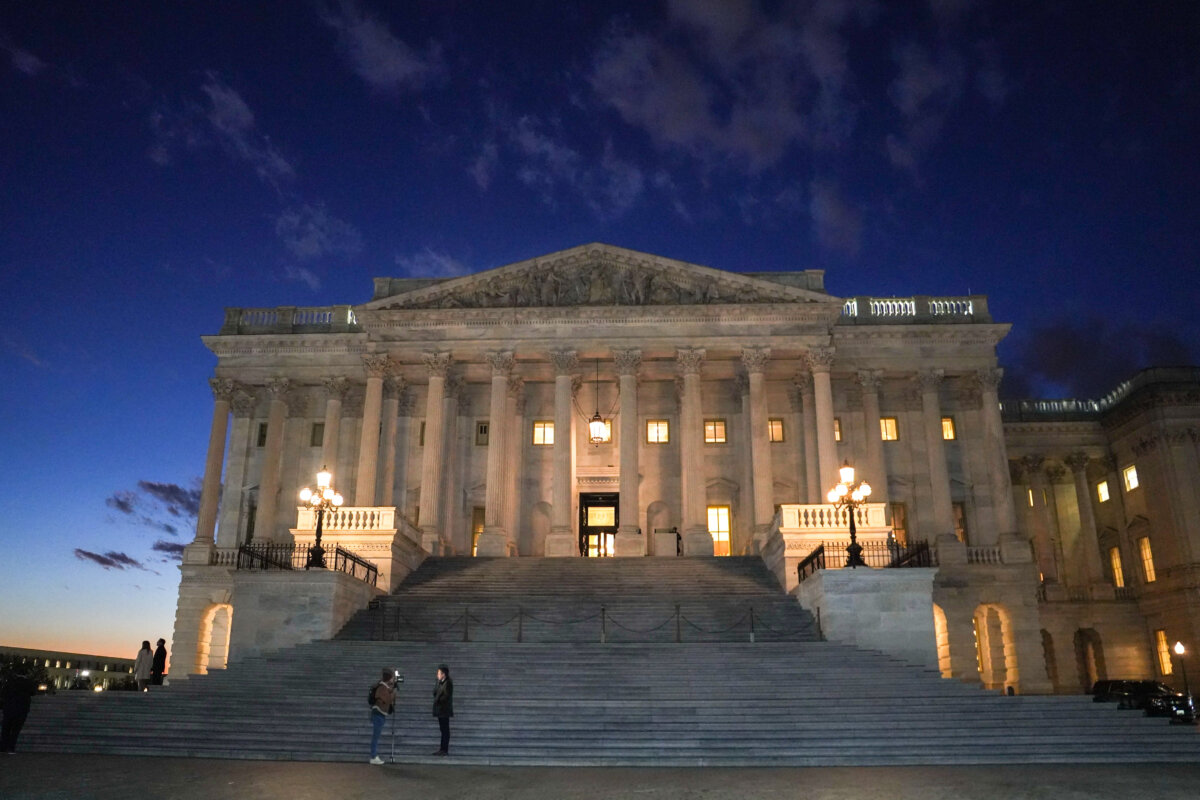

This government shutdown, which ended after 43 days last night, was different. It lasted longer, cost more, and probably accomplished less than any in history.
That’s because the country is deeply divided, and a lot of people are mad about it, some experts say.
Here’s how that played out and what it could mean for the future.
First, this one was about frustration, not legislation.
Democrats presented lots of health care spending ideas, but never laser-focused it down to a specific ask. Instead, they called Republicans to negotiate over the “health care crisis.”
The party was more motivated by signaling their opposition to President Donald Trump than by achieving a specific policy goal, said Matthew Wilson of Southern Methodist University.
“There’s widespread anger among Democrats about everything associated with this administration,” Wilson said. “There are a lot of people on the Democratic side that wanted to do something dramatic.”
Democrats and their allies sometimes stated that directly when speaking about the shutdown.
“The American people want us to stand up to Trumpism, to his war against working-class people, to his authoritarianism,” Sen. Bernie Sanders (I-Vt.) said about the end of the shutdown.
“America is too expensive, and far too many people are struggling to live paycheck to paycheck,” House Majority Leader Hakeem Jeffries (D-N.Y.) told reporters on Nov. 10. “That’s why Democrats have been waging this fight.”
Second, both parties were more comfortable with the cost.
“Shutting down the government seemed to have no political effect for about the first four weeks of the shutdown,” Henry Olsen of the Ethics and Public Policy Center, told The Epoch Times.
“That’s unusual, and I think that’s attributable to the polarization,” Olsen added.
Even as the shutdown droned on, both parties appeared to believe the public would blame the other.
“When both sides think they’re winning, there’s no incentive to stop,” Olsen said.
The shutdown will create a permanent loss of $7 billion to $14 billion in gross domestic product, according to government estimates. That makes it the most expensive shutdown ever.
Third, the tactics are evolving.
Most administrations try to minimize the impact on their constituents and heighten the effect on their opponents’ voters, Wilson said, but this administration took that to a new level.
He noted that the administration arranged for active duty service members to be paid in mid-October, which was likely to please Republicans. The administration did that for civil service employees, which resulted in the employees’ union calling on Democrats to end the shutdown.
The administration also laid off about 4,000 federal employees during the shutdown. Those were intended to be permanent, but Republicans agreed to rehire them during negotiations to end the shutdown.
“This was a step beyond what we have seen in the past,” Wilson said.
As long as we’re deeply divided, shutdowns could grow longer and costlier. “It is becoming the new normal,” Nicholas Higgins of North Greenville University, told The Epoch Times.
“When 90 percent of America is pretty much dug in, there’s not a whole lot of room to move,” Olsen said.
—Lawrence Wilson
BOOKMARKS
Millions of people worldwide continue to contract tuberculosis, but 2024 saw a slight decline in that number, according to a report by the World Health Organization. Deaths from the disease also fell by about 3 percent to 1.23 million.
Trump thinks the H-1B visa program is a good way to fill job slots while training more Americans to perform those complex tasks. “You can’t take people off an unemployment line and say, ‘I’m going to put you into a factory where we’re going to make missiles,’” he said this week.
Food stamps may be distributed again soon, after hiccups in the program caused by the government shutdown. Check out Zach Stieber’s latest report to find out the details.
The Consumer Financial Protection Bureau shouldn’t be funded by the Federal Reserve, the Department of Justice said in a court filing this week. Read Savannah Hulsey Pointer’s latest report to learn more about how that lack of funding might lead to its closure.
A $2000 tariff dividend sounds great, but Treasury Secretary Scott Bessent hinted on Wednesday that there may be income-based limits on who receives that cash. He suggested it might be families making less than $100,000—but the matter is still under discussion, he said on Fox & Friends.
—Stacy Robinson
 Friends Read Free
Copy
Facebook
Tweet
Friends Read Free
Copy
Facebook
Tweet