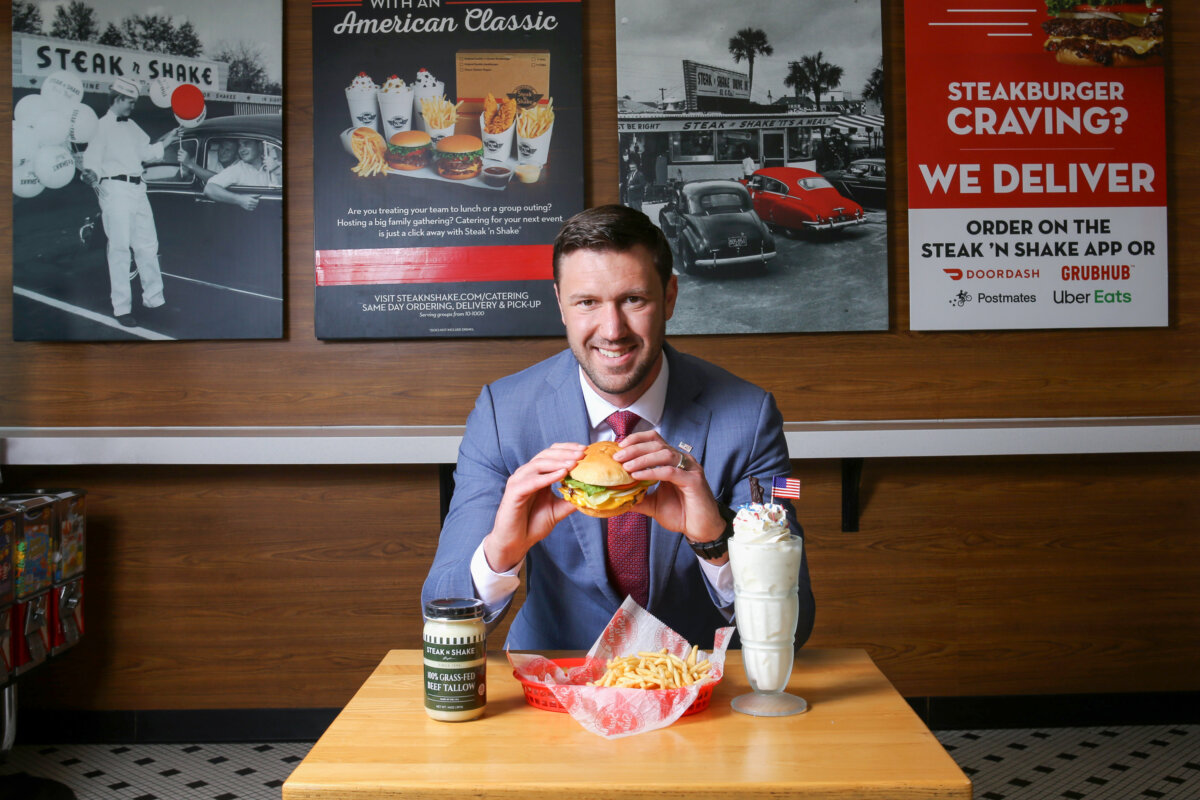

DALLAS—Lunch at Steak ‘n Shake is served for Michael Boes. The plate in front of him has a grass-fed burger and beef tallow fries. He washes it down with cane sugar Coca-Cola.
“Fast food doesn’t have to mean processed, complicated, or artificial. It used to mean real, simple, and delicious—and it can again,” Boes said.
Founded in Normal, Illinois, in 1934, Steak ‘n Shake was most known for its steakburgers and hand-dipped milkshakes for decades. Almost a century later, the chain is building its brand around the Make America Healthy Again (MAHA) movement.
The heart of Steak ‘n Shake’s transformation is a bold pledge: to eliminate industrial seed oils from its menu items and shift to cleaner ingredients.
Leading the transformation is Boes, one of the forces behind the 2025–2030 Dietary Guidelines for Americans. In April, he was named the restaurant chain’s first chief MAHA officer.
A former senior adviser within the Department of Health and Human Services (HHS) Office of the Assistant Secretary of Health, Boes holds a position described by the company as “a new executive role dedicated to advancing nutritional integrity, ingredient transparency, and the long-term health of Steak ‘n Shake customers.”
Sardar Biglari is chairman and CEO of Biglari Holdings, parent company of Steak ‘n Shake. When announcing the hiring of Boes, Biglari called the position “a sign of our continued commitment to make Steak ‘n Shake the great differentiator in fast food.”
“Michael is ideally suited for such a role, with his deep understanding of nutrition and his experience at the highest level of health policymaking,” Biglari said. “To put it simply, good-tasting food should also be good for you.”
The company announced in May that it would make the switch to “100 percent grass-fed and grass-finished” beef. In March 2025, the company announced the switch from seed oils to beef tallow. In February 2026, it said it would remove all microwaves from franchise locations by April, writing in an online post that “quality restaurants don’t need microwaves.”
Steak ‘n Shake prepares its shoestring fries, potato “tots,” onion rings, and chicken tenders in 100 percent beef tallow with “no additives, preservatives, or chemicals.”
On its website, the company explained that it has worked with its manufacturer of fries and tots to completely eliminate the vegetable oil formerly used to fry the product before freezing and shipping it to the restaurants. As a result, Steak ‘n Shake’s beef tallow fries and tots are not yet completely free of seed oils, according to the website.
“Transitioning away from seed oils is a journey, and we continue to work with our other suppliers to achieve our goal,” the company said on its website.
The chain uses 100 percent Grade A Wisconsin butter sourced from a family farm and it serves cane sugar Coke rather than drinks that have high fructose corn syrup. In December 2025, Steak ‘n Shake switched to A2 Milk, which is “100 percent real milk from cows that naturally produce only the A2 protein and no A1,” which may help with digestion, according to A2 Milk’s website.
Boes noted that Steak ‘n Shake is still early in its transformation.
“We took the bold step to say we’re going to drive the demand side in order to impact the supply side,” he said.
“The website is a prime example of the transparency and messaging, saying up front that we are making this transformation, but it’s not going to be complete overnight, so please stick with us.”
Boes, who grew up in the Dallas area, earned a bachelor’s degree from Texas Christian University followed by an MBA from Southern Methodist University.
He worked in healthcare technology with a focus on commercial growth for 15 years before joining HHS. He developed expertise in nutrition after addressing personal health challenges.
“I had gut and skin issues, I had trouble putting weight on, and I was on medication for ADD. I didn’t feel healthy,” Boes said.
Positive changes happened, he said, when he eliminated processed foods and started eating whole foods. In a matter of months, he gained “healthy weight,” added muscle, and felt more energetic.
From that point, he became immersed in reading articles and listening to podcasts about biohacking, which is a do-it-yourself form of personal improvement in which people focus on changing their biology to improve their overall health and well-being.
“The chronic disease epidemic and mental health crisis are tied to what we put into our bodies. I wanted to be a part of influencing positive change in those areas,” Boes said.
After attending President Donald Trump’s inauguration, he said, he was driven to work with the new administration.
Boes made cold calls and sent emails to figures such as Stefanie Spear, who served as the press secretary for Health Secretary Robert F. Kennedy Jr.’s presidential campaign and is now Kennedy’s chief of staff. HHS expressed interest, he said. After a phone call and two interviews, and learning that they sought private-sector professionals, Boes joined the agency and helped develop the new dietary guidelines.
Boes’s career path evolved once again after a chance meeting with Biglari at the wedding of political consultant Alex Bruesewitz, an adviser to Trump.
Biglari told Boes that he wanted to align Steak ‘n Shake with the growing movement of health-conscious consumers.
“I had my opportunity to impact the regulatory side. Now I have this opportunity to prove that not only is there a regulation component to this, but also MAHA can be the cornerstone of a brand,” Boes said.
“That is a powerful story that can impact people and shape the industry.”
He said that in his previous role with HHS, he talked to multiple restaurant companies and asked them if there was a way they could work collaboratively with the agency and reform the food environment.
Boes said he was repeatedly told that “customers aren’t demanding this.”
“I didn’t believe that to be true, and Steak ‘n Shake challenged the narrative,” he said.
Transforming to MAHA principles is not as simple as swapping one cooking oil for another, Boes said. It involves “top to bottom” supply chain reform that includes the oils used in frying and cooking, the buns that often rely on additives and seed oils, cheese and processed toppings that commonly include emulsifiers and seed oils, and other menu components.
Over the past year, Steak ‘n Shake has seen a roughly 15 percent growth in same-store sales, Boes told The Epoch Times.
“Americans are showing they want this, and Steak ‘n Shake is responding,” Boes said.
Over the past five decades, many large food corporations have replaced traditional ingredients with cheaper industrial substitutes—such as artificial additives, highly processed oils, and preservatives.
“Changes were not made to improve taste. They were done to reduce costs and maximize short-term profit margins,” Boes said. “Steak ‘n Shake believes that the customer demand is going in this direction and wants to be on the forefront of that. I share that vision and am excited to be part of this transformation.
“We are answering what the American people have been demanding, which is reform and change in the private sector around the food that they eat.”
Steak ‘n Shake is showing that a MAHA-aligned strategy can translate into revenue growth while improving food quality, Boes said.
He is spearheading a comprehensive review of the company’s ingredient sourcing, nutritional standards, and preparation practices. The company plans to share additional updates on ingredient improvements and nutritional initiatives throughout the year.
Competitors are watching, Boes said.
“I believe that Steak ‘n Shake will keep experiencing exponential growth. When other companies’ growth isn’t on the same trajectory, that could cause them to recognize they are missing something and need to make changes,” he said.
“Reform will happen in other organizations, and that will keep demonstrating the impact of MAHA and benefiting consumers, which is the ultimate purpose.”
 Friends Read Free
Copy
Facebook
Tweet
Friends Read Free
Copy
Facebook
Tweet