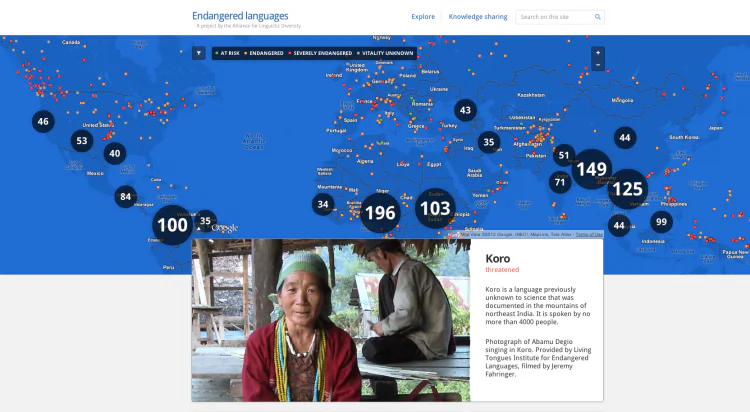
The First Peoples’ Cultural Council, a first nations-run Crown corporation based on Vancouver Island, has been chosen to oversee a project developed by Google that seeks to preserve endangered indigenous languages.
The Google Endangered Languages Project, launched June 21 to coincide with National Aboriginal Day, invites language experts from around the world to post videos, audio clips, books and other publications on its website to catalogue languages that are in danger of becoming extinct.
“A lot of the ideas have been driven by First Peoples’ commitment to ensuring that the communities themselves are the voice for their own languages,” says Lorna Williams, chair of the First Peoples’ Cultural Council (FPCC).
“There’s an opportunity for [communities] to present their language in a way that is true to them.”
The FPCC will chair the advisory committee and act as a key moderator of the new site, EndangeredLanguages.com, supporting and overseeing the project.
As part of the content development for the site, FPCC will share its 2010 Report on Languages as well as a number of key language revitalization tools it has devised.
According to the site, Canada has nearly 50 endangered languages. Many are “severely endangered” with less than 1,000 living speakers left, most of them seniors. About one-third of these severely endangered languages have 100 or fewer speakers left.
British Columbia is home to the majority (60 percent) of First Nations languages in Canada, and also has the highest number of endangered languages in the country.
Worldwide, experts estimate that 50 percent of the 6,000 languages spoken today will be extinct by the year 2100 unless something is done to preserve them.
‘Oppression and Injustice’
According to EndangeredLanguages.com, languages often fall into decline as a result of “oppression and injustice.”
First Nations languages in Canada began to deteriorate after European colonization. Subsequent government assimilation policies and residential schools caused a devastating interruption to intergenerational language transmission, according to FPCC’s report.
“First Nations people who had been raised at home in their First Nations languages as children, were trained, forced, and shamed into abandoning their languages at residential schools,” reads the report.
“Even when they were released from the schools, many could not go back to speaking their languages or pass the languages on to their children because of residual shame and trauma.”
The report also notes that the loss of language equals the loss of “whole cultures and knowledge systems,” which would include spirituality, philosophy, human values, oral and musical traditions, scientific and environmental expertise, medical knowledge, social and community relations, and cultural or artistic skills and traditions.
Preserving Cultural Heritage

Williams says the Google project is an opportunity for Canada’s indigenous peoples to present and preserve their cultural heritage now—on their own terms.
“Our languages and our boundaries have been determined by everyone else but us—by governments and government agents, anthropologists, linguists who gave us names but who really had no connection to us or to many of the languages,” she says.
“Now people in the language communities themselves can look at what has been posted, and they can say, ‘that isn’t accurate.'”
But language survival will ultimately depend on younger generations, many of whom have had limited access to their traditional tongue either at home or in school.
Williams says FPCC has been seeking to address this generation gap for years by embracing technology. Recently they unveiled an indigenous language app for Facebook Chat and Google Talk, which can be downloaded for free on iPhone, iPad, and iTouch systems.
The app, called FirstVoices Chat, contains custom keyboards for hundreds of Indigenous languages in Canada, Australia, New Zealand, and the USA, and allows users to text in their heritage language.
Williams says she sees many young people getting involved in First Nations culture and language preservation, and is optimistic about the future of language survival.
“When I see what’s happening, not just in [my] community but in other communities, a similar pattern is happening and it’s just so exciting.”
The Epoch Times publishes in 35 countries and in 19 languages. Subscribe to our e-newsletter.
 Friends Read Free
Copy
Facebook
Tweet
Friends Read Free
Copy
Facebook
Tweet