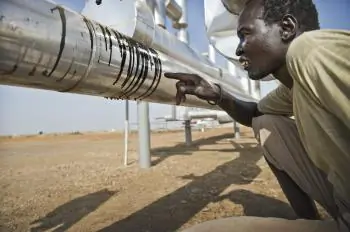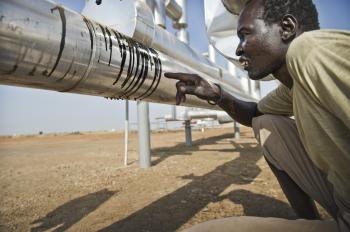
Sudan is Africa’s third largest oil producer, with a turnout of 490,000 barrels per day, according to the BP Statistical Review of World Energy for 2010. At the beginning of 2010, Sudan’s oil reserves were 6.7 billion barrels, 80 percent of which are in the south.
In 2005, Sudan’s 22-year bloody civil war, which left an estimated 2 million dead, ended with the signing of the Comprehensive Peace Agreement (CPA). The CPA created the Government of National Unity comprised of ministers from both the north and south. The south was granted semi-autonomous status and the right to hold an independence referendum after an interim period. Voting in that referendum concluded on Saturday. While official results won’t be announced until Feb. 14, early results announced on Sunday, indicate that as many as 95 percent of Southern Sudanese voted for independence.
Oil was a major part of the CPA and will continue to play a critical role when the two Sudans meet to negotiate the future in Khartoum on July 6.
Revenue Sharing Under the CPA
The above percentages refer to the state’s share of oil earnings, but in fact, the majority of drilling operations in Sudan are held in foreign hands.
According a report published last month by the European Coalition on Oil in Sudan (ECOS), the report, “Sudan’s Oil Industry on the Eve of the Referendum,” over 70 percent of Sudan’s petroleum producing blocks are owned by just two companies: China National Petroleum Corporation (CNPC), the national Malaysian oil company Petroliam Nasional Berhad (PETRONAS). Together with two other companies, Indian Oil and Natural Gas Corporation (ONGC Videsh) and the China Petroleum & Chemical Corporation, also known as Sinopec Corp., the top four companies control between 87 and 95 percent of Sudan’s oil. Only 5 to 7 percent is owned by the Sudanese national state oil company, Sudapet.
According to Egbert Wesselink, director of ECOS, 35 percent of the oil revenues go to the drilling companies, and 65 percent to Sudan, split as described earlier.
“These companies have made a lot of money thus far,” commented Wesselink.
So has Sudan. In 2010, the earnings split between the north and south were $4.5 billion, according to the Government of Southern Sudan (GoSS) Ministry of Finance and Economic Planning’s report for September 2010.
Both governments rely strongly on the oil revenues: 98 percent of the annual budget of the south comes from oil income; in the north, oil revenues accounted for 50 percent of domestic revenue and 93 percent of exports in 2009, reports Global Witness, a U.K.-based organization that monitors environmental exploitation and human rights abuses.
Post-Referendum Finances
When the South secedes, the previous even split between Khartoum and Juba will end, and each Sudan will keep the profits from the oil exploitation in their own territory.
This will naturally tip the financial scales in favor of Southern Sudan since it owns more than three -quarters of the oil.
Wesselink calculates that if there is no new agreement before July 9, when the independence of the south is expected to be declared, the north will end up with 32 percent of the oil revenues, and the South 68 percent.
“In the short term, the south will get a bigger share, but negotiations are far from being finalized.”
Wesselink says that with time, the difference between revenues in north and south will blur, mainly due to new oil explorations in the north.
“In the midterm, the differences in income between north and south will smooth out as production in the north is up and new fields along the Red Sea are about to be developed, while production in the South will be in steep decline after 2013."
The expert explains this is because the oil fields of two of the major oil drilling companies in Sudan–the Greater Nile Petroleum Operation Company and Petrodar–will start losing potential after next year and then start declining relatively rapidly. What is more, there are no known new finds or other concessions that are currently under exploration.
Next: lack of transparency in Sudan’s petroleum industry
 Friends Read Free
Copy
Facebook
Tweet
Friends Read Free
Copy
Facebook
Tweet