

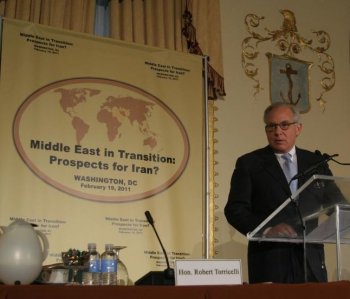
While much attention is currently centered upon Gaddafi and Libya, Iran and the Islamic regime, which has had significant degrees of instability in the last several years, does seem ripe for a regime change.
Over 70 percent of the population sits below the age of 30, and with ever rising unemployment rates and the inflation rates currently at 13.5 percent, the prospects for an overthrow have never appeared as probable.
During the post-presidential riots of 2009, opposition leaders took to the streets to protest the re-election of Mahmoud Ahmadinejad, a vote that was largely seen as fraudulent, in the largest set of riots since Islamic Revolution of 1979.
In Washington, where Iran has been a major focus of foreign policy for decades, the prospect of a major leadership shift offers a welcomed opportunity.
“Iran behind al-Qaeda was the second most discussed topic that we had during my time in government,” said the former director of the CIA and the National Security Agency (NSA), General Michael Hayden, on his discussions with former President George W. Bush.
Gen. Hayden, and Former Chairman of the Joint Chiefs General Peter Pace, Former Under Secretary if Defense for Policy, Walter Slocomb, and several other former military and government officials attended a forum over the weekend titled "Middle East in Transition: Prospects for Iran?" The forum highlighted Iran and the prospects for regime change and complexities associated with diplomatic relations between the U.S. and Iran.
Iran's leadership has consistently voiced strong language towards the United States and Israel, a major U.S. ally in the Middle East.
The regime’s nuclear program has consistently been scrutinized by the United Nations, and several series of sanctions aimed at shrinking the prospects of nuclear weapons capabilities have made the economic environment in Iran that much more severe for its leadership.
“I don’t know of any country that has caused us more heartburn, more anguish over a longer period of time than Iran,” said Lee Hamilton, former chairman of the House Foreign Affairs Committee, member of the president’s Foreign Intelligence Advisory Board and the president’s Homeland Security Advisory Council.
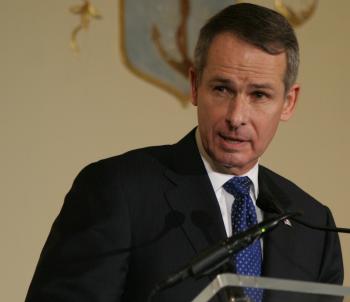
The United States has made it clear that the current Iranian regime is a threat with the potential development of nuclear weapons being the major concern.
“Militant Islamism threatens to destroy civilization as we know it,” said Michael Mukasey, former U.S. attorney general (2007¬–2009).
“This regime is incapable of abandoning its nuclear weapons ambitions voluntarily, something has to change inside Iran for their policies and their practices with respect to nuclear weapons to change,” said former Undersecretary of Defense for Policy Walter Slocombe.
Next: Maneuvering Regime Change
 Friends Read Free
Copy
Facebook
Tweet
Friends Read Free
Copy
Facebook
Tweet


























