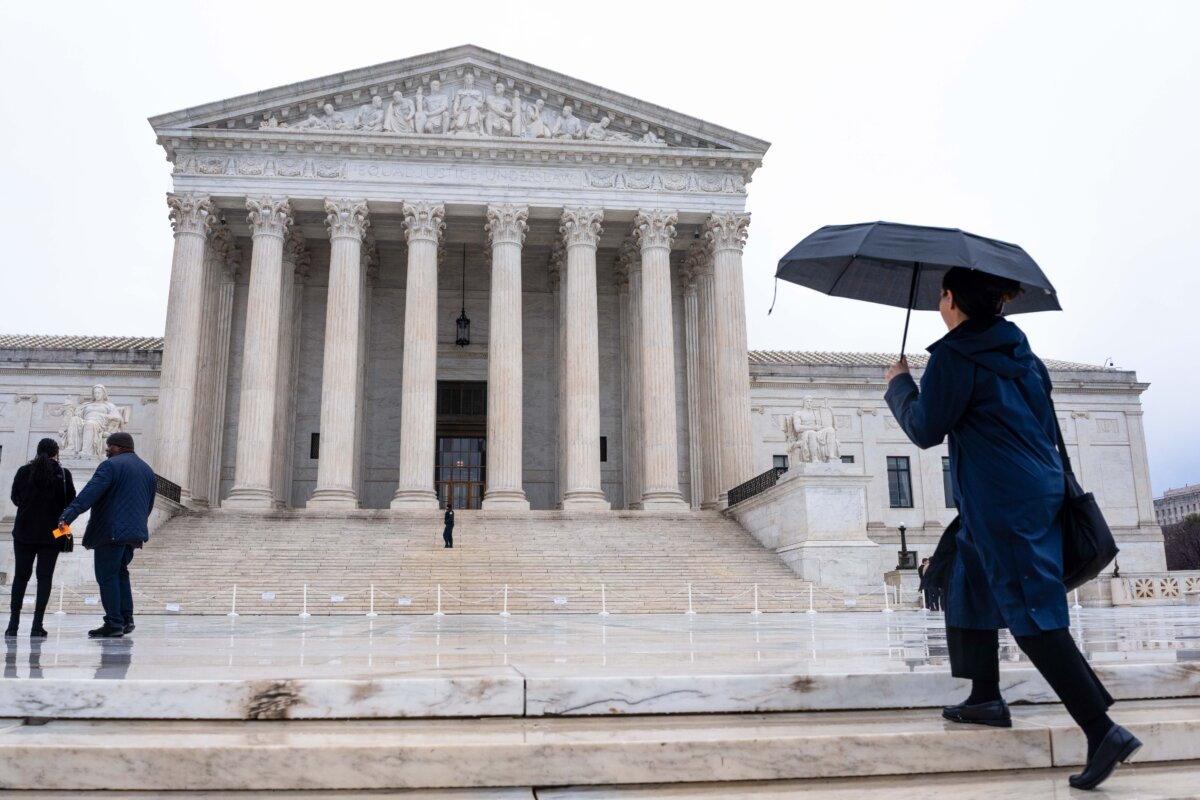

The Supreme Court yesterday sided with a therapist who challenged on free speech grounds a Colorado law that banned so-called conversion therapy for LGBT minors.
Colorado passed that law in 2019, and it forbade therapists from any practice or treatment “that attempts to change an individual’s sexual orientation or gender identity,” or “eliminate or reduce sexual or romantic attractions toward individuals of the same sex.”
Kaley Chiles, a licensed therapist, challenged the law in 2022, saying it violated her First Amendment free speech rights. After losing in lower courts, the Supreme Court sided with her in an 8–1 decision on Tuesday.
Colorado had argued its law was meant to regulate therapists’ conduct; any restrictions on their speech were just incidental.
The justices rejected that argument. Justice Neil Gorsuch, writing for the majority, said that reasoning would allow governments to craft laws designating any speech as conduct to “silence speech they disfavor.”
“The First Amendment is no word game, and ‘the exercise of constitutional rights’ cannot be circumscribed ‘by mere labels,’’’ he wrote.
The majority opinion also said Colorado’s law was meant to suppress a certain view regarding conversion therapy, while promoting other viewpoints.
Gorsuch noted that the law prevents therapists from helping youth change their orientation, but allows counselors to affirm teens in a new gender identity, or in their same-sex attraction.
“Colorado may regard its policy as essential to public health and safety,” he wrote.
“Certainly, censorious governments throughout history have believed the same. But the First Amendment stands as a shield against any effort to enforce orthodoxy in thought or speech in this country.”
Justice Elena Kagan, along with Justice Sonia Sotomayor, said it might be possible to craft laws regulating a therapist’s speech, but they would have to be viewpoint-neutral.
“Medical care typically involves speech, so the regulation of medical care (which is, of course, pervasive) may involve speech restrictions,” Kagan wrote.
“But laws of that kind may not pose the risk of censorship” or suppression of ideas “that appropriately triggers our most rigorous review.”
Kagan acknowledged that legal theory might present a “different and more difficult question.” But, she added, the Supreme Court can wait to tackle that question another day, since Colorado’s law is not viewpoint-neutral.
Justice Ketanji Brown Jackson, the sole dissenter, pushed back against the majority opinion. In her lengthy opinion, she said she didn’t dispute the Colorado law restricted Chiles’s speech, and not just her conduct.
But those restrictions are warranted, she said, because the state has the right to protect minors if it deems conversion therapy harmful.
“Because people’s identities are simply ‘a part of the normal spectrum of human diversity,’” she wrote, “the medical community has determined that efforts to change a patient’s sexual orientation or gender identity will necessarily be ineffective.”
“The United States and the majority just insist that a law that undertakes to regulate speech-based medical treatments is presumptively unconstitutional because the treatment is being administered solely through speech. But that reasoning is maddeningly circular, and it is based on happenstance, not logic.”
—Stacy Robinson
BIRTHRIGHT CITIZENSHIP HITS HIGH COURT
The Supreme Court will today consider a landmark case challenging President Donald Trump’s bid to limit birthright citizenship.
The case, known as Trump v. Barbara, centers on 14th Amendment rules guaranteeing citizenship to most individuals born in the United States. Trump will attend the oral argument, scheduled to start at 10 a.m. ET.
Upon entering office, Trump signed an order barring the children of illegal immigrants born in the United States from securing citizenship. It also applies to mothers on temporary U.S. visas who give birth here.
The order has been blocked by local courts pending the high court’s decision.
The justices are expected to wrestle with the meaning of the citizenship clause of the 14th Amendment. That part of the amendment reads, “All persons born or naturalized in the United States, and subject to the jurisdiction thereof, are citizens of the United States and of the state wherein they reside.”
Much of the debate has focused on five words from the amendment: “subject to the jurisdiction thereof.”
The wording of the 14th Amendment suggests that merely being born within U.S. borders is not enough for citizenship. That’s partially why the Supreme Court, in a 19th-century decision, said the children of foreign diplomats and those born in Native American territory do not receive citizenship.
The American Civil Liberties Union, representing affected children and their mothers, has argued that people are subject to U.S. jurisdiction if they are obligated to follow its laws. Diplomats and Native Americans are excluded because they belong to other sovereign nations.
The Justice Department has focused more on the concept of allegiance, namely that illegal immigrant parents lack allegiance to the United States and therefore aren’t fully subject to the country’s jurisdiction.
Last year, the Supreme Court issued a landmark decision lifting several blocks on Trump’s policy, but did so in a limited way. That decision, known as Trump v. CASA, only clarified how far judges could go in blocking the president.
The current case is inviting the justices to delve deeper into the 14th Amendment and one of its much older decisions from 1898. In United States v. Wong Kim Ark, the Supreme Court held that the 14th Amendment guaranteed birthright citizenship to a Chinese man whose parents were permanently domiciled in the United States.
Many federal judges have cited that decision to say that the Supreme Court already said the 14th Amendment granted citizenship to people born on U.S. soil—including those born to illegal immigrants.
When the U.S. Court of Appeals for the Ninth Circuit ruled on Trump’s policy, it pointed to a portion of the 1898 opinion that identified three exceptions: children of Native American tribes, those “born of aliens in hostile occupation,” and “children of diplomatic representatives of a foreign state.”
The Justice Department argued instead that the 19th-century decision applied only to children whose parents were domiciled, or residing with some kind of allegiance to the country.
It noted that the court repeatedly referred to domiciled status. For example, the majority opinion read, “Every citizen or subject of another country, while domiciled here, is within the allegiance and the protection, and consequently subject to the jurisdiction, of the United States.”
—Sam Dorman
BOOKMARKS
U.S. warplanes are increasingly hitting targets on the fly while over Iranian airspace, Secretary of War Pete Hegseth announced on March 31. The Epoch Times’ Ryan Morgan reported on Hegseth’s announcement, in which the Cabinet official said that U.S. forces had conducted 200 “dynamic strikes” overnight, referring to when a U.S. warplane already on a mission is retasked mid-flight to pursue additional targets.
Recent protests and clashes between residents and police have broken out across multiple regions in China, highlighting growing public frustration over environmental concerns, land disputes, and local governance, The Epoch Times’ Michael Zhuang reported. It comes as the Chinese regime has moved to tighten security controls, including sweeping new restrictions on civilian drone use.
Many U.S. airports reported significantly reduced security checkpoint wait times on March 30, with much of the worst pressure relieved after Transportation Safety Administration officers received their first paychecks in weeks. The Epoch Times’ Jacob Burg reported that some airports reported that previously four-hour lines are now experiencing wait times of 10 minutes or less.
A federal judge issued an order on March 31 halting, for the time being, the ongoing ballroom construction project at the White House that was ordered by Trump. The Epoch Times’ Matthew Vadum reported on the ruling, in which U.S. District Judge Richard Leon said the president “is the steward of the White House for future generations of First Families. He is not, however, the owner!”
A federal judge on March 31 ordered federal agencies not to implement an order from Trump to end funding for National Public Radio and the Public Broadcasting Service, concluding that Trump’s order was an unconstitutional violation of the First Amendment. The Epoch Times’ Zachary Stieber reported on the ruling, in which U.S. District Judge Randolph Moss said Trump’s order targeted the broadcasters, known as NPR and PBS, for their points of view.
 Friends Read Free
Copy
Facebook
Tweet
Friends Read Free
Copy
Facebook
Tweet