PHOENIX—The fire outside was not the deadliest threat. Two Phoenix firefighters lost to cancer, and Phoenix Deputy Fire Chief Jason Miller could not stop it.
The threat was invisible—poisons slipping through their gear, burrowing into skin and lungs, ticking like hidden explosives until they detonated.
Miller still chokes up at the memory. But from that loss came resolve—an idea that would protect hundreds of fire departments across Arizona and beyond.
Determined to save two more friends and countless other firefighters, he built a better solution: the Storm Stick.
“The cancer issue in the fire service is complex,” Miller told The Epoch Times. “There are a lot of things we have to get better at.”
Miller, 51, was already on the front lines of the fight against occupational cancer, first as a member and later as chairman of a regional cancer prevention and wellness team.
He has run the numbers, studied the research, and it all points to one harsh truth: Today’s fires are deadlier than ever.
According to the Firefighter Cancer Support Network, cancer is the most serious threat to firefighter health and safety.
From 2002 to 2019, it caused 66 percent of career firefighter line-of-duty deaths, based on data from the International Association of Fire Fighters.
In 2016 alone, that number rose to 70 percent.
By comparison, heart disease accounted for 18 percent of occupational deaths.
Nationwide, firefighters are 9 percent more likely to be diagnosed with cancer and 14 percent more likely to die from it, according to the Centers for Disease Control and Prevention and the National Institute for Occupational Safety and Health.
Miller said every blaze carries chemicals that can kill long after the flames are out.
Cancer lurks in everyday air, dust, and products, he said.
PAHs (polycyclic aromatic hydrocarbons) from smoke, pesticides, and PFAS (per- and polyfluoroalkyl substances) build up silently. Imported wood brings formaldehyde, while phthalates hide in toys, clothes, and floors.
Firefighters face danger head-on, and sleepless nights only make it worse—but fast, thorough decontamination can save lives, Miller said.
“This is a really big deal for the fire service—exposure to a lot of things, sleep deprivation, and the food we eat,” he said.
“We get bombarded with toxins at fire incidents. I was looking at what the first and most intense point of exposure is and what we are doing about it.”
One method was brutally simple: a bucket of soapy water, a scrubdown, and a blast of the hose.
Soap. Scrub. Hose. Repeat. Down the line, again and again.
“It takes about three minutes or so to do it that way,” Miller said. “Then you’ve got to dump the bucket out because it’s dirty, and fill it back up again.
“It worked great in the research environment. It just didn’t work in the field. What was happening was people were just kind of hosing people off with water, which is found to be about 20 percent effective.”
The Storm Stick system removes 85 percent of toxins before they can penetrate gear or skin, he said.
It is a portable system that washes toxic chemicals, soot, and carcinogens off firefighters’ gear immediately after a fire.
The Storm Stick mounts to the side of the engine and taps into the onboard water supply for fast, on-the-spot decontamination.
Firefighters simply step in front of the device, letting water streams strip away toxins and residue.
Think of it as a low-pressure, deep-cleaning power wash.
“I listed all the problems currently that we just are not [addressing] right or well and patched it up against the science … to come up with something that actually does what it’s supposed to do,” Miller said.
“I had this slight brainchild. How can we do better?”
That is where the Storm Stick began, Miller said—developed from concept to product with veteran colleagues Greg Gaiser and Evan Fuwa.
Armed with critical data, Miller and his team partnered with engineers, machinists, and industry experts to design and build the Storm Stick system—then put it to the test in some of Arizona’s busiest fire companies.
Work on the system began in 2017 and finished in about 2019.
Miller said the Storm Stick system has been adopted by dozens of fire departments across the United States and Canada.
From the outside, the system is straightforward: a patented, fabricated metal rod painted red and fitted with four nozzles, connected to a hose and a set of attachments.
A complete unit costs $2,299 and includes a grab-handle bucket, discharge assembly, a Storm Stick with an eight-foot hose, a detergent proportioning system, 15 detergent activators, and two BurstFiber brushes.
“It looks super simple, but there are a lot of complexities to the inner workings of it,” Miller said.
“It was a labor of love. It was, really, my passion project. It was my way of saying, ‘I want to do something.’”
Melissa Kowalski is CEO of the 100 Club of Arizona, which provides immediate financial support to Arizona first responders and their families after line-of-duty injuries or deaths.
The nonprofit is currently raising funds to provide every fire department and engine in Arizona—about 500—with the Storm Stick system.
To date, the organization has raised $82,000.
“We have been supporting Storm Stick for a couple years,” Kowalski told The Epoch Times. “We have already purchased about 100 throughout the state. And there are about 350 more that need to be purchased.
“There have been about 50 that have been purchased from other funding sources.”
She said today’s firefighters face greater challenges with toxic chemicals, demanding advanced training and more complex decontamination techniques.
“Now, we see a lot of plastics,” Kowalski said. “We see a lot of artificial materials, batteries. Just think of electric cars and all of these things that have never been in our environment before.”
“Exposure to those different chemicals is what is thought to be the reason for an increase in cancer in our firefighters,” she said.
The Glendale Fire Department is one of several Arizona fire companies in Maricopa County using the Storm Stick system.
On July 1, 2025, Fire Station 153 opened as a state-of-the-art facility, featuring three rapid-deployment bays, a fire engine, and a medical rescue vehicle.
Funded by a publicly approved $78 million bond, it replaced a 1973 substation after 50 years of service.
It is the department’s newest fire station, one of nine in Glendale, a city with more than 248,000 inhabitants and more than 240 fire department personnel.
Like Miller, Glendale Fire Capt. John Chester has lost colleagues to occupational cancer, each death leaving a lasting mark on the firefighting community.
Through a long-standing partnership with its union, the Glendale Fire Department has dedicated funding, personnel, and programs to enhance firefighter health and wellness, Chester said.
Decontamination zones, high-velocity washers, gear-separating bags, and showers help keep firefighters toxin-free—but true wellness goes far beyond that, he said.
Where crews once slept in bunk rooms, they now have individual sleeping quarters to maximize rest—given the link between sleep deprivation and cancer risk.
A special recovery room offers a cold immersion bath and sauna in which to decompress, and a fitness room lets firefighters stay active during downtime.
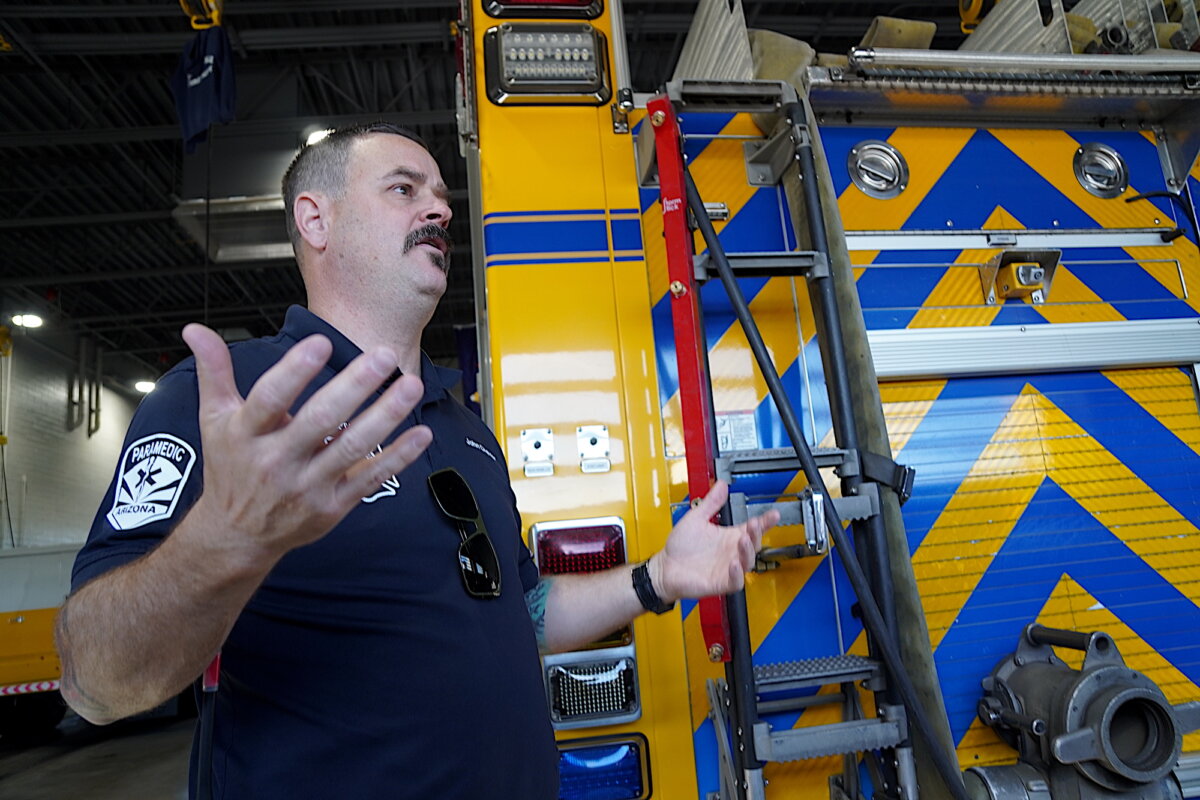
Engine 153 carries the Storm Stick system. It is a powerful tool to reduce carcinogen exposure and another weapon against cancer, but it is no “magic bullet,” Chester said.
“There’s only so much prevention that we can do,” he said. “Carcinogens still get in when you’re taking your mask off, right after you’ve washed off and decontaminated.
“You get your clothes off, and you can smell it. And if you can smell it, the risk is there.”
As a modern facility, Station 153 is spotless, odorless, and equipped with advanced decontamination procedures and air-quality control systems that disperse engine exhaust.
After battling a fire, firefighters are required to follow strict decontamination protocols in three separate zones.
“Basically, we roll into the station,” Chester said. “We put gloves on our hands, because [the skin on] our hands is very thin and can absorb carcinogenic material easily—especially soot.
“We take the firefighting turnout gear off the back of the truck, get it out of the bag, and separate it.”
Firefighter turnout gear has three layers: the inner liner for comfort and heat protection, a middle moisture barrier to block water and chemicals, and a tough outer shell that shields against flames and abrasion.
“We separate everything,” Chester said. “Our helmets—they come apart. Hoods. They come out. Our turnout jacket, bunk gear, and turnout pants all have layers. We strip them down and put our gear in the extractors until everything is cleaned.”
He said the Storm Stick system streamlines decontamination, making it faster, easier, and more efficient.
“It just attaches to the truck—super easy,” Chester said. “It plugs right in. When the firefighters come out, they open up a valve, and it’s ready. It is a part of a system of decontamination—an integral part.”
Miller said creating the Storm Stick—from first sketch to finished product—has been humbling, a way to channel grief into something meaningful and positive.
“I believe in what we’re doing,” Miller said. “The system works. But it was never about building a business. Ironically, the guys who joined me are the very ones I built it to protect.”
 Friends Read Free
Copy
Facebook
Tweet
Friends Read Free
Copy
Facebook
Tweet