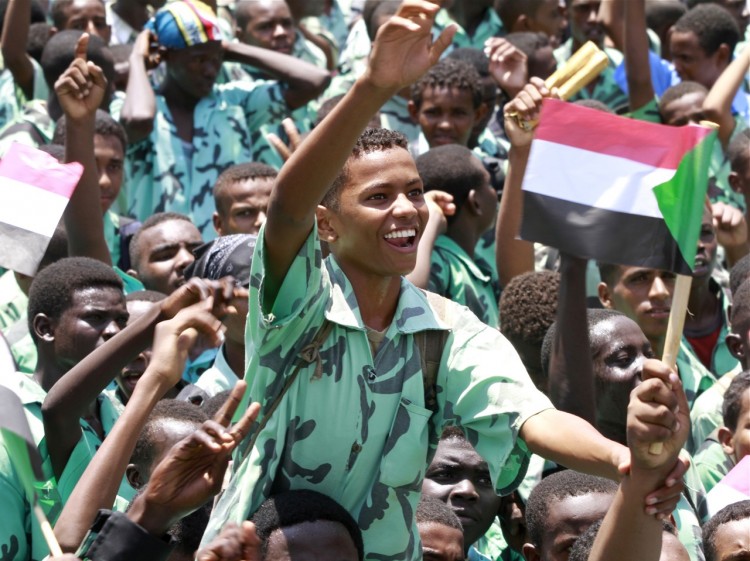
Apart from losing its national pride along with one-third of its territory, North Sudan is facing even bigger problems: harsh repression of civil protests, soaring inflation, and near-war status in the border areas of Southern Kordofan and Blue Nile state, as well as in Darfur.
But while many see the future of the Republic of Sudan as bleak, there are indications that the country is stabilizing and starting to open up to the world.
As a result of a referendum in January, the southern portion of Sudan, which has oil, is less developed, and populated mostly by Christians and Animists, decided to split from the north, which is richer, mostly Muslim, and has the pipelines to transport the oil. The act of secession that followed in July put a stop to more than two decades of Sudan’s north-south civil war and paved the way for South Sudan’s independence.
Still, while the separation saw new-found freedom for the south, it ushered in a hard period for the north. Even before the secession, many southerners who had previously lived in the north moved back to the south—either for fear of violence or out of a will to develop their homeland. This made many businesses in the north lose their consumers. In addition, the trade between the north and the south has become difficult since the separation, which has caused food and commodity prices to rise dramatically.
“It is remarkable how inflation flies,” Nico Plooijer, manager of the Horn of Africa Program at IKV Pax Christi, a peacekeeping organization based in the Netherlands, said in a telephone interview.
Plooijer, who visits Sudan regularly and has constant communication with both capitals—Khartoum in the north and Juba in the south—said meat prices have risen 30–50 percent recently. Veal, the favorite meat of the Sudanese, used to cost about 20 Sudanese pounds (US$7.47) per kilo, but now has jumped to more than 30 pounds (US$11.20). Beef, which was usually affordable to poor people, is now eaten by the rich and out of the reach of the poor. Tomatoes, an important part of poor peoples’ diet, used to cost around 2 pounds (US$0.74) per kilo but are now 10 pounds (US$3.74) per kilo.
According to a recent International Monetary Fund report, consumer prices in Sudan will increase by 20 percent in 2011 compared to 13 percent in 2010.
Plooijer pointed out that much of the food and diesel that used to come from the north is now provided by other countries like Uganda and Kenya, which makes things even more expensive.
“Of course, the global crisis also plays a role. The people in Sudan felt it very strongly,” he said.
Next … Wave of protests
 Friends Read Free
Copy
Facebook
Tweet
Friends Read Free
Copy
Facebook
Tweet