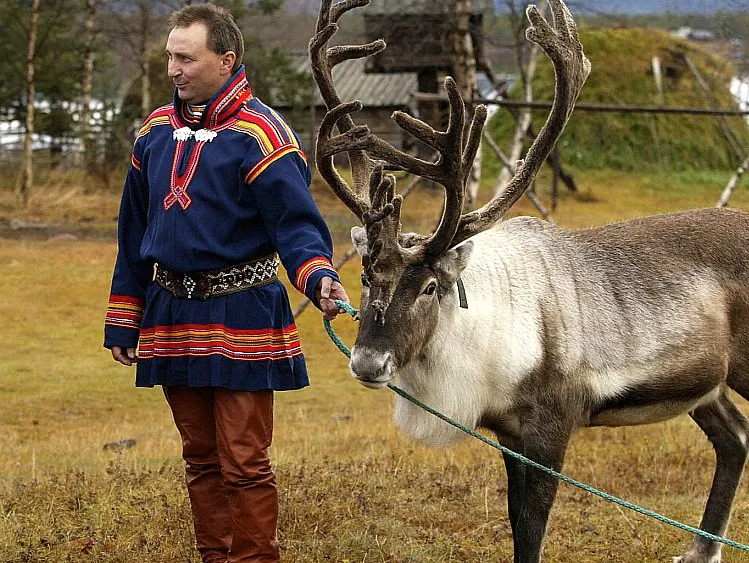

In the northernmost reaches of Sweden, a small but meaningful music festival was held in Bjorkvattsdalen, in the center of Sapmi, the homeland of the indigenous Sami people.
One of the main purposes of the Bjorkvattsfestivalen is to unite the Sami people, who face considerable challenges as Scandinavia’s only internationally recognized indigenous group. Sapmi includes parts of Norway, Sweden, Finland, and Russia.
Sweden is in the process of defining the rights of the Sami to land and water, and to hunting and fishing.
“We want to complete the parts of the legislation that has been left uncompleted—and [we want to] bring Sami people together in different ways,” said Torkel Stangberg, co-organizer of the festival.
Although under the International Labor Organization’s Convention 169 on the rights of indigenous peoples, the Sami are a recognized group, Sweden has not signed the convention.
Under Swedish law, as of January 2011, the Sami are a recognized people. But that doesn’t not apply to all Sami—also known as Lapps or Laplanders, which they consider derogatory terms.
In order to enjoy these rights, you must belong to a Sami village, or Siida. This in turn, according to Swedish law, is possible only if you participate in reindeer-herding activities. If you don’t, you have no indigenous rights, and this goes for about 90 percent of all Swedish Sami.
Stangberg calls this discrimination.
Stefan Mikaelsson, president of the Sami Parliament of Sweden is worried and unhappy about the situation. He believes it will lead to the Sami becoming ever more assimilated into the Swedish population.
“The space for using our traditional ways and express our culture is diminishing,” Mikaelsson says. “Our legitimate demands are not considered.”
He mentions mining as an example of an activity that threatens to marginalize the Sami even further.
International mining operations have been encroaching deeper into Sami territory for almost 100 years, due to its rich iron ore deposits.
One Sami group recently appealed a government decision to allow a mining company called Nickel Mountain to exploit two deposits near Tarnaby, close to where the festival took place.
This is a charged topic since the Sami say the reindeer will loose their pastures because of the planned mining operations.
According to Stangberg, only a small number of Sami families were allowed to participate in the early consultations, namely the minority directly involved in reindeer herding. The terms of the mining concession does not take the interests of all Sami into account.
To this day, the tradition of reindeer herding is still a central part of Sami culture.
“Traditional Sami food gives us strength. It’s locally produced and organic. The reindeer are not given any antibiotics, like cows and pigs. The people who slaughter the animals and handle the meat are all local people,” said Mikaelsson, adding that it’s rare to find Sami food in Swedish food stores.
While the Swedish state said that the mining operations would not interfere with the reindeer herding, the Supreme Administrative Court ordered the government to take the environment into consideration. Nonetheless, the mining company, which was awarded an exploration permit in 2005, is working as usual, since their permits still apply.
The idea behind the Bjorkvattsfestivalen is not to dwell on these troubles, but to “create something positive in everyday life” as Stangberg puts it.
Festival organizers had hoped to attract at least 300 visitors from Norway, Sweden, and possibly Finland. The event was sponsored by the Sami Parliament and the local municipality of Storuman.
Acts at the festival included local musician Lars-Johan Johansson and the NoiceMakers, who combined rock music with the traditional Sami vocal style of joik. The musicians reunited for this festival.
Before the festival Stangberg had this to say, “If we have a good year this year, maybe we will get some momentum. Maybe we will do it every second year. It takes a lot of volunteer work.”
The Epoch Times publishes in 35 countries and in 19 languages. Subscribe to our e-newsletter.
 Friends Read Free
Copy
Facebook
Tweet
Friends Read Free
Copy
Facebook
Tweet