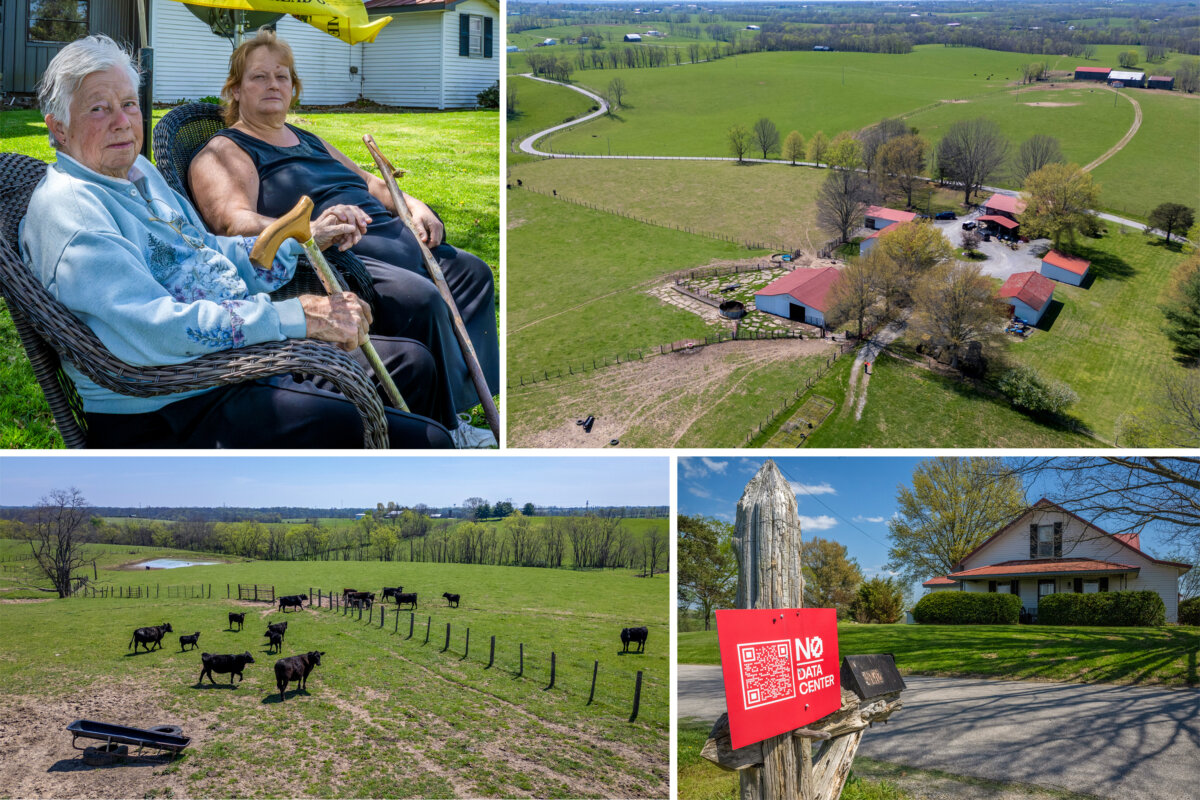

MAYSVILLE, Ky.—A man representing an undisclosed company stepped on 82-year-old Ida Huddleston’s farmhouse porch last year and made an offer he seemed confident she would not refuse.
Huddleston and her daughter, Delsia Bare, were offered $26 million for around 1,000 acres of the farmland that has been in the family since the 19th century, for the development of a hyperscale data center just outside of Maysville in northern Kentucky.
Everyone has a price, or so the man thought, Bare imagines.
“But not this family,” she said.
“This land is priceless. I want to pass down everything you see here to the next generation. God told me to keep this for as long as I’m here, and then pass it on to the next generation,” Huddleston told The Epoch Times from her front porch on a sunny day in early April.
The Huddleston family has farmed the land for more than 200 years.
Over generations, they’ve raised cattle, grown soybeans, and planted corn on their 1,200-acre property outside Maysville.
When jobs disappeared and families lined up for food during the Great Depression, the Huddlestons grew wheat.
Huddleston’s husband built the farmhouse in 1982 with timber cut from the property and stone hauled from a creek on land that has been in the family since 1848.
“Every day in this house, every time I’m on the land and sitting on this porch, I feel his presence. What you see here, it holds memories of the past, and hopefully, the future,” Huddleston said.
Along the Ohio River in Kentucky’s Mason County, cattle graze on pastures, hay fields sweep down toward small creeks, and hills are dotted with farmhouses, barns, and grain silos, looking much like they did two centuries ago.
Families here trace their land ownership back to Revolutionary War grants. Now, their way of life is threatened by a company intent on building a data center.
Residents in the Dark
The company that made the offer is unknown. Local officials describe it as a Fortune 100 technology firm that owns and operates large-scale campuses around the world.
The Mason County Industrial Development Authority has proposed to rezone 28 properties to allow construction of a 2,080-acre data center campus that would support artificial intelligence and cloud computing operations.
A county planning commission unanimously approved the development plans, with conditions, on April 22.
Huddleston called the offer she received a “scam.” She talked about “harassment” and “bullying” with repeated offers, all of which the family turned down.
“Those people can’t be trusted. We’re not going anywhere. We’re going to stand and do what we’ve always done,” she said.
Mason County is a microcosm of what’s happening across the country, said Max Moran, cofounder of We Are Mason County, a grassroots organization of farmers, residents, and business owners spanning Republicans, Democrats, and independents that advocates for responsible development.
Tech companies approach cash-strapped rural counties, dangle the promise of economic development, and require local officials to sign nondisclosure agreements, Moran explained.
The NDAs are legal, but they show a lack of transparency because parties are making deals with local governments without residents knowing what is going on, he added.
“They call us old, stupid farmers, you know, but we’re not,” Bare said.
“A good psychiatrist would tell you that whenever somebody wants to enter into a relationship, and they do not want to reveal who they are or anything about themselves, you are headed for trouble.”
Permanent Changes
Residents nationwide are seeing their countryside changed by massive data centers that demand an equally massive amount of resources while creating few long-term jobs, Moran said.
“They require a significant amount of land, water, and electricity while forever changing the landscape of rural communities,” Moran said.
Kentucky has courted data centers with 50-year sales-tax exemptions on equipment. Like they have across the country, proposals have sparked fierce pushback from farmers and residents concerned about escalating utility rates, shrinking farmlands, noise pollution, air quality impacts, and water consumption and contamination.
In 2025 alone, 2.5 million acres of farmland and 15,000 farms were lost, according to the USDA.
Huddleston and Bare measure wealth in how well they can feed America with the food raised on their sprawling property, and in memories that no amount of money could replace.
Multiple families have refused to sell. Dr. Tim Grosser, who raises cattle on 250 acres of farmland with his son Andy not far from the Huddlestons, rejected offers as high as $35,000 per acre, he said.
He was eventually told to name any price. He declined.
Moran is a 23-year-old space systems engineer who helps his family manage 400 acres of farmland that dates back to the 18th century.
He was “born and raised” in the area, first living on the farm itself, then in Germantown, a community of around 150 that straddles the Mason–Bracken county line.
His family farms cattle and grows hay and soybeans on more than 760 acres. A weathered log cabin on the property may pre-date the American Revolution, said Moran, who is a Germantown councilman.
“We’re worried all of this landscape will change. It won’t be what it’s been for centuries and generations, and keeping that from happening is worth the fight,” Moran said.
Janet Garrison helped Moran form We Are Mason County. She and her husband operate a 130-acre cattle farm not far from the Huddlestons. She is a retired community college instructor who taught computer and information technology for 34 years.
Garrison said that few residents knew what was coming when county officials began talking about the data center project.
As contracts started circulating and officials began knocking on farmhouse doors with enormous offers, word spread. That prompted Garrison to take notice.
Moran was first alarmed in early 2024 when he was invited to join a Facebook group formed in Oldham County, Kentucky, where residents were already fighting against a proposed data center.
He found information about the project’s water usage, power demand, pollution risk, and land impacts, and he recognized the same issue could arise in Mason County.
His hunch proved correct.
Moran said he talked to county officials about other potential locations for the data center proposed in Mason County, but he was told that these industrial-zoned sites were deemed unsuitable because they sat on a floodplain.
“A billion‑dollar, trillion‑dollar company can’t have flood mitigation?” he asked.
Courting Local Officials
We Are Mason County has filed a lawsuit challenging the process that produced the ordinance. The group is seeking a moratorium on further data center approvals until transparent rules and community protections are in place, Moran said.
Garrison and Moran question the use of NDAs by the county judge-executive and commissioners, who have said they signed NDAs related to the data center while also sitting on the steering committee that updated the county’s comprehensive plan without adding data centers as a recognized land use.
They also allowed an appointed industrial authority, rather than the company itself, to be the formal applicant and land buyer, obscuring who is really behind the project, Moran said.
“It’s almost a dereliction of duty to know something this big is coming and never bring it up while you’re rewriting the county’s road map,” Moran said.
Maysville and Mason County officials did not respond to requests for comment.
Maysville City Manager Matt Wallingford told a local television station that the company behind the data center is confidential, but the impact is “a big deal” for the community.
He said that the project would create more than 1,000 construction jobs over eight to 10 years and more than 100 full-time positions with average salaries of $100,000 a year. A state tariff would require the company to pay for a second power plant at no cost to taxpayers or ratepayers, he added.
Even now, with the acreage under contract and rezoned, the company behind the project remains unknown.
“If this had been community‑driven, we could have named our price,” Garrison said.
“We could have decided where we, as a community, were willing to sacrifice land—in an industrial park or a brownfield—instead of having it pushed down our throats on prime farmland and next to people’s homes.”
Moran said that a single data center complex may permanently transform thousands of acres of pastures and crops into concrete pads, steel, and substations and create between 50 to 400 permanent jobs.
Facilities such as Toyota’s plant in Georgetown, Kentucky—which also was built on farmland—employ more than 10,000 people, Moran said.
“It might be a lot more acreage than what they now have. Unofficially, we believe it’s going to be 10,000 acres tied up altogether,” Moran said. “It will forever change the landscape of this area, and it will cause many people to leave.”
Garrison and Moran are among the farmers, residents, and business owners who have spent months trying to understand a single question: Why Mason County?
The area sits beside a massive coal‑fired power plant owned by East Kentucky Power Cooperative that feeds into the regional transmission grid and has high‑capacity power lines radiating away from it. There is also abundant water from the Ohio River and from a regional aquifer that supplies drinking water.
For companies hungry for gigawatts of electricity and industrial‑scale cooling, Mason County looks like a “sweet spot,” Garrison said.
Garrison and Moran point out that there are already decommissioned coal plants and brownfield sites along the river in nearby Ohio. That land cannot safely be farmed because of coal ash and industrial contamination, but it still has substations and transmission infrastructure in place.
“That is where data centers should go, not on prime farmland on properties where so many families live,” Garrison said.
Based on conversations with officials and industry patterns, Garrison concludes that data center developers prefer rural counties with weak or nonexistent zoning, where a few elected leaders—enticed by promises of tax revenue—can smooth the way.
Strain on Resources
In Mason County, the proposed plans call for 2.2 gigawatts of power, which is around one-third of New York City’s electricity demand, and millions of gallons of water.
The local coal plant’s capacity is about 1.3 gigawatts, which Garrison pointed out is mostly already committed to current customers.
That shortfall will trigger an expensive and intrusive build-out of new substations, high-voltage transmission lines, and the possibility of small modular nuclear units or regional nuclear plants to feed electricity to the data center hubs, Garrison said.
Initial plans centered around pumping millions of gallons of Ohio River water each day for evaporative cooling, Garrison said.
Engineers shifted to municipal-drawn water from the local aquifer, which also supplies homes and farms across the area.
Residents were told the company could use 500,000 gallons of water per day during construction alone to control dust, Garrison said.
Moran pointed to communities in Morrow County, Oregon, where residents report cancer clusters and cases of miscarriages and kidney failure among residents after years of large-scale data center operation and chemical runoff.
Communities near existing facilities have reported a constant low‑frequency hum from transformers, cooling systems, and high‑voltage equipment, Moran said.
We Are Mason County pushed for a strict 45‑decibel limit at property lines but were told “the laws of physics” made that impossible. The county settled on 50 decibels.
Garrison also said that the proposed project includes banks of diesel generators that developers insist will rarely be used.
“We have ice storms and grid failures here. What will happen when those generators are used? We worry about emissions that cover creeks, homes, and pastures,” she said.
Highland Heights is a subdivision situated across from part of the proposed development. Initially, residents there were told that the project would be three-quarters of a mile away. Later, Moran said, application documents showed industrial uses across the road.
Residents are receiving buyouts that might not be enough to buy equivalent housing elsewhere, especially in Mason County, Moran noted.
At Meadowland Village Mobile Home Park, residents were originally offered $20,000 to move their trailers off land under contract for the proposed data center.
After widespread regional media coverage, the offer increased to $50,000. Many units are old enough that they can’t legally be moved, Moran said.
“These are more people who will likely have to leave our county,” he said.
We Are Mason County also backs candidates who will commit to strict limits on data centers on prime farmland and transparent planning. Garrison, a Democrat, is running for Mason County commissioner. Moran, a Republican, is in the race for Mason County judge executive, which is similar to a county administrator’s role.
Legislative Moves
Ahead of the 2026 session, Kentucky lawmakers said they would pass legislation to address the influx of data centers and implement guardrails to make sure consumers are protected from increased utility rates.
That did not happen.
As the 2026 session reached its close on April 15, a provision to place regulations on new data centers was stripped from a measure before it cleared the House and the Senate.
Last month, House Bill 593 was passed by a 90–8 vote in that chamber. The measure stalled in the Senate, but provisions were almost revived when language was added to Senate Bill 197 as it cleared a House committee and was sent to the floor.
On April 15, SB 197 was sent back to the House budget committee, where Republican Rep. Josh Bray’s data center language was removed before it passed through the committee and then cleared the chamber. The Senate agreed with the amended SB 197, and it passed in the legislature without the data center proposals.
Under Bray’s proposed bill, large data centers could only gain electric service from a public utility if they signed a contract agreeing to cover any transmission or infrastructure costs attributable to serving that data center.
For now, Kentucky has no new statutory guardrails ensuring data centers pay their full costs, leaving utilities, the Public Service Commission, and local governments to navigate data center developments.
Regardless of what happens moving forward, Huddleston and Bare said, they will not sell, even if the proposed data center development arises in the distance.
“As long as I’m on this land, as long as it’s feeding me, and as long as it’s taking care of me, there’s nothing that can destroy me,” Bare said. “We’ve helped feed the nation for generations. We’re not gonna stop now.”
 Friends Read Free
Copy
Facebook
Tweet
Friends Read Free
Copy
Facebook
Tweet