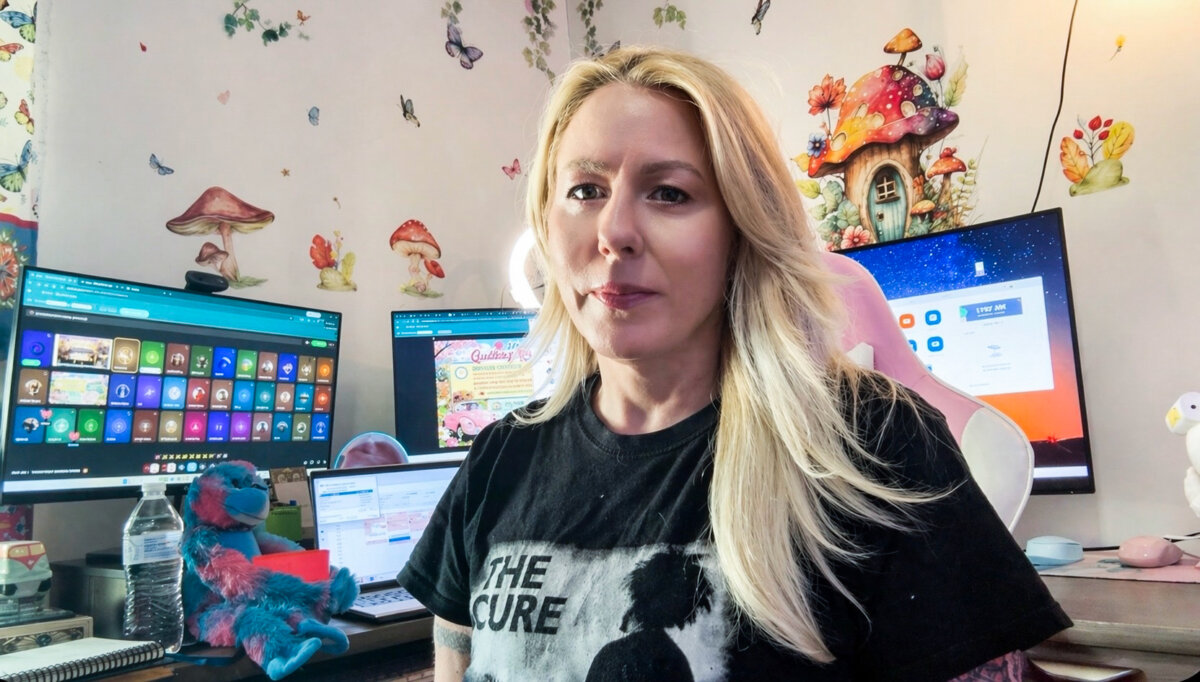

After Decima Davis started taking kratom, a tropical plant often billed as a healthy pick-me-up, she could not stop.
Whenever she tried to pry herself loose from kratom’s grip, her torment only intensified.
“Every morning, I’d wake up drenched in sweat, already in agony, knowing relief was just two minutes away at the local gas station [that sold kratom],” Davis, 51, of Mississippi, told The Epoch Times.
“I spent my mornings throwing up, desperately redosing just to be functional enough for work. That desperation is what led to three overdoses and grand mal seizures.
“I reached a point where I couldn’t even look in the mirror; I didn’t recognize the person looking back. I felt completely gone, just a hollow shell of myself living a daily nightmare.
“It was a relentless, soul-crushing cycle.”
After many failed efforts, something finally clicked for Davis after she and two fellow kratom addicts formed the online community Quitting Kratom Support—There Is A Way Out. Since its inception in 2017, the peer-guided group has drawn upward of 15,000 unique online visitors, said Davis, its president.
“The group replaced my isolation with accountability,” she said. “In the past, I was surrounded by negative messages and self-loathing, but this community drowned that out.
“We use a ‘collective tools’ approach—people bring what they’ve learned from various programs and share it. Peer support is backed by the ‘helper therapy principle,’ which suggests that when we help others, we heal ourselves.”
Now, at least three times per day, dozens of people quietly tap into a reservoir of hope at KratomQuitters.com. In the past two months, online attendance has grown by 17 percent, Davis said.
Many group members, including Davis, credit the online community with saving their lives.
“We want people to know: Hope is out there; there’s help,” Davis said, noting that she and a handful of other volunteers—all unpaid—keep the group running. They often absorb website costs and other expenses themselves, defrayed by some contributions.
Davis said being around others “who actually understand the specific pull of kratom” is key.
“Being surrounded by people who truly want to see me win changed my internal narrative from ‘I’m a failure’ to ‘I am part of a family that cares about my well-being and loves me,’” she said.
“This community is the family I chose. It didn’t just help me manage the withdrawals; it gave me my soul back.”
Increased interest in groups such as Davis’s parallels the rise of kratom use in the United States, along with higher numbers of reported adverse effects among users—and additional legal restrictions.
Last year, a Journal of Psychoactive Drugs survey found that about 9 percent of Americans were using kratom. That is a ninefold increase over the 1 percent that an American Journal of Preventive Medicine survey estimated in 2019.
Although several foreign countries banned kratom years ago, officials across the United States are grappling with how to regulate the opioid-like substance. Some praise kratom as helpful, but others denounce it as addictive and harmful.
So far, at least eight U.S. states and the District of Columbia have banned kratom. Ohio and Florida banned concentrated versions called 7-OH last year and more than a dozen states enacted other restrictions, according to End Kratom Addiction, a nonprofit organization.
However, kratom remains unregulated at the federal level. In 2016, the Drug Enforcement Administration withdrew a proposed ban following backlash. Advocates asserted that kratom should remain legal to help manage pain, anxiety, or opioid withdrawal.
As regulators continue investigating, the Food and Drug Administration held a May 18 “listening session” with Davis’s peer support leaders and the group’s board members, according to an email provided to The Epoch Times.
The group’s treasurer and another cofounder, Natalie Melvin, 37, of Kentucky, told The Epoch Times that the FDA gleaned knowledge the group has collected.
“We have been on the ground … hearing people’s stories and their experiences every single day … all day, every day,” she said. “I don’t think there’s a lot of places out there that have the knowledge and the data that we have, just from personal experience.”
Besides anecdotal information, the group also shared the results of an April survey of 148 of its members. Among respondents, 55 percent who became addicted said they believed that they were taking a “safe” substance that was not addictive, and nearly 36 percent reported experiencing seizures or heart palpitations that they attributed to kratom.
“I think the most important thing is just that kratom addicts’ voices are finally being heard,” Melvin said, noting that they have often been drowned out by kratom advocates.
The support group’s meetings “grow bigger and bigger because more people are finding [it], and more people are needing help,” she said.
“We’re just people who have been through it, helping the next person the same way we were helped when we first came in,” Melvin said. “There’s something different about that—it’s real, it’s relatable, and people feel it.”
Now a paramedic, Melvin formerly used the substance to help her “get through the day” in a job that was physically demanding.
But the bad effects soon overshadowed the seemingly good ones.
“I would wake up every day just with this dark cloud over me. … It was affecting everything,” she said. “It was like I had no life left in me.”
Now, she and Davis have each been kratom-free for about three years.
Melvin’s message to others: “There’s help out there for you, and life can be beautiful—sober.”
—Janice Hisle
BOOKMARKS
The race to succeed term-limited California Gov. Gavin Newsom is looking like it might be a bipartisan affair, with Democrat Xavier Becerra and Republican Steve Hilton leading as votes are tallied after the state’s June 2 primary election, The Epoch Times’ Travis Gillmore and Beige Luciano-Adams reported. Hilton leads with nearly 28 percent of the vote, while Becerra sits around 26 percent.
Hundreds of people protested outside a police station in Southampton, England, on June 2 about the death of Henry Nowak, who last year was fatally stabbed by Vickrum Digwa and then handcuffed by police as he lay dying. The Epoch Times’ Chris Summers reported that the incident drew renewed attention after the killer was sentenced to life with a minimum of 21 years in prison on June 1, and following the release of a video showing police dismissing Nowak when he said that he had been stabbed.
President Donald Trump confirmed in a new interview that he sharply castigated Israeli Prime Minister Benjamin Netanyahu for Israel’s military campaign in Lebanon, The Epoch Times’ Ryan Morgan reported. Axios had first reported, citing unnamed sources, that Trump had berated Netanyahu in a June 1 phone call, claimed he’d helped keep the Israeli leader out of jail, and shouted expletives as he called for Israeli forces to restrain their campaign against Lebanon-based designated terrorist group Hezbollah.
The Trump administration has proposed imposing tariffs of up to 12.5 percent on imports from dozens of trading partners over concerns that they failed to enforce import bans on goods made with forced labor, The Epoch Times’ Melanie Sun reported. “The failure of our most important trading partners to address the importation of goods made with forced labor is unacceptable,” trade czar Jamieson Greer said.
 Friends Read Free
Copy
Facebook
Tweet
Friends Read Free
Copy
Facebook
Tweet