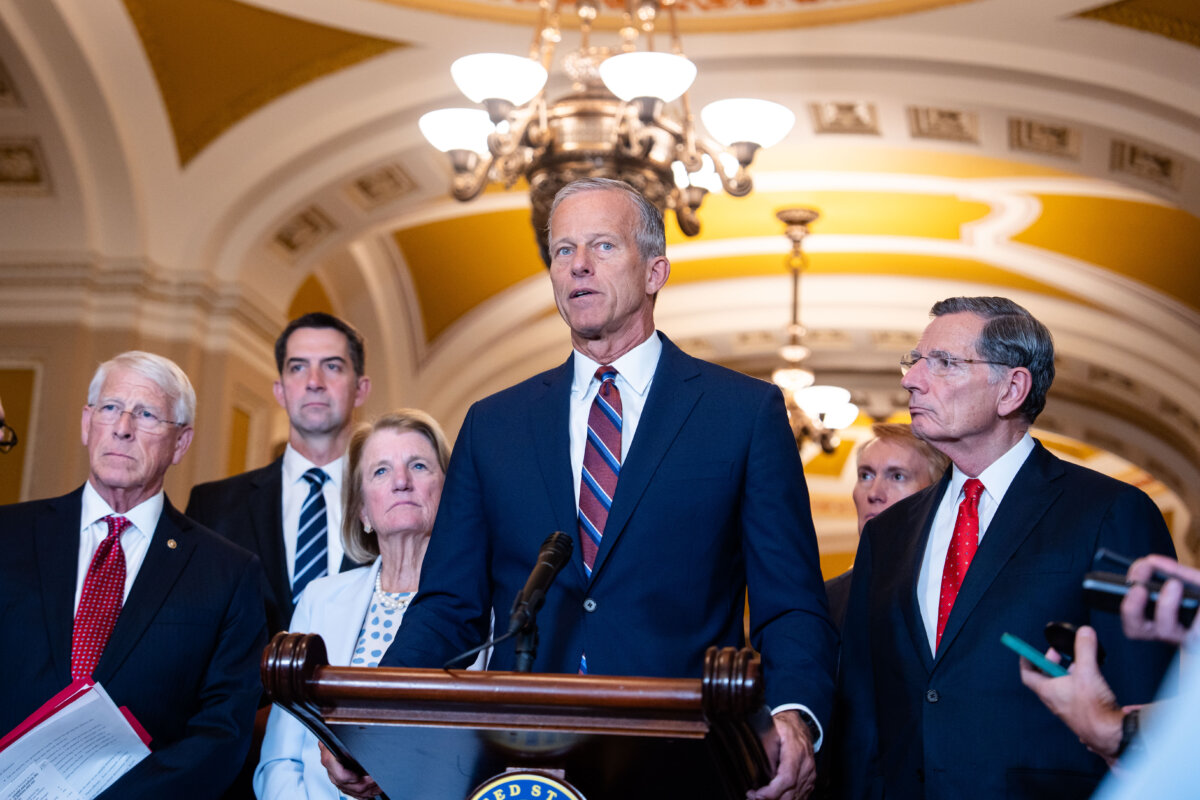

Senate Majority Leader John Thune (R-S.D.) on Monday announced that Republicans may “nuke” the Senate rules to allow for faster confirmation of President Donald Trump’s nominees.
Thune previewed the changes in an op-ed published on Breitbart on Sept. 8. He announced that “A Nominations Rules Change is Coming.” In the piece, he criticized Democrats for their efforts to slow the process, calling it “delay for delay’s sake.”
“Democrats have made [Trump] the first president on record to not have a single nominee confirmed via voice vote or unanimous consent, and they are forcing time-consuming votes on noncontroversial nominees who go on to be confirmed by large bipartisan margins,” Thune wrote.
Though they’re out of power in Washington, Democrats have in recent months taken advantage of their powers in the Senate to slow the confirmation of Trump’s executive appointees.
This has included taking their full allotted time to speak for each individual nominee—a divergence from norms in Washington, where lawmakers have historically confirmed dozens or hundreds of lesser nominees through unanimous consent voice votes.
Thune said the rule change would be adapted from one developed in 2023 by two senators, Amy Klobuchar (D-Minn.) and Angus King (I-Maine), who caucuses with the Democrats. At the time, Senate Republicans were erecting their own roadblocks to then-President Joe Biden’s nominees.
Klobuchar and King introduced a resolution at the time to increase the number of nominees that the full Senate can consider en bloc—that is, simultaneously in a block.
The resolution carved out exceptions for Supreme Court judges and other top posts. It ultimately fizzled out after being referred to the Committee on Rules and Administration without advancing further.
In his article for Breitbart, Thune said the GOP proposal would further increase that number.
He warned that many key slots in the executive branch will remain empty if the Senate doesn’t speed things up.
“No party should be able to weaponize the confirmation process the way that Senate Democrats are doing now,” the South Dakotan wrote.
He is widely expected to use the “nuclear option,” enabling Republicans to alter a standing rule through a simple majority. Republicans have 53 seats in the Senate, along with a possible tiebreaking vote from Vice President JD Vance.
Senate Democrats have withheld unanimous consent and required voice votes on Trump’s nominees, dragging out the process.
Secretary of State Marco Rubio, a former senator, remains the only civilian nominee who has not faced a filibuster in that chamber.
Thune and his GOP colleagues had suggested for well over a month, including in the days ahead of the August recess, that a rules change could be coming.
“Either Democrats are going to play ball or we’re going to figure out a way to change it,” Thune said on July 31.
Before the recess, Senate Minority Leader Chuck Schumer (D-N.Y.) said that he and Republicans were “exchanging paper and conversations to try and come up with a bipartisan agreement” on nominations.
Yet, no deal emerged during the subsequent weeks.
In an Aug. 6 post on Truth Social, Trump urged Republicans to pursue legislation that would expedite the confirmation of nominees in the face of Democratic opposition.
Schumer has consistently defended the slow pace of confirmations.
“Historically bad nominees deserve a historic level of scrutiny by Senate Democrats,” he wrote on X in response to an op-ed from Senate Majority Whip John Barrasso (R-Wyo.), who objected to Senate Democrats’ maneuvers.
Thune and Schumer were unable to reach an agreement to move forward with the issue before the August recess. Trump briefly floated the idea of canceling the coveted month-long recess, the longest of the year.
According to Trump, Democrats at the time were demanding the release of about $1 billion and sought promises from the administration not to rescind additional federal funds, in exchange for allowing the quick consideration of the president’s nominees.
The rules of the Senate can be changed by a simple majority vote—meaning that a majority party at any time has the power to change or amend the rules as long as enough of their members are on board with the plan.
However, members have historically been hesitant to exercise the power. It’s unclear how members will respond to the proposal, though some have already publicly backed such a move.
In an appearance on Fox News, Sen. Markwayne Mullin (R-Okla.) suggested that this option should be on the table, saying, “We can do this the easy way or the hard way.”
—Nathan Worcester, Joseph Lord
BOOKMARKS
The Department of Homeland Security (DHS) launched a new immigration enforcement operation in Chicago on Monday, The Epoch Times’ Jackson Richman reported. ICE agents have been stationed at Naval Station Great Lakes, a military base outside Chicago, as Trump continues to threaten a deployment of the National Guard to the city to crack down on crime.
Officials last week released video footage showing the moments leading up to the killing of Iryna Zarutska, a Ukrainian war refugee, on a light rail train in Charlotte, North Carolina, The Epoch Times’ Jack Phillips reported. Decarlos Brown Jr., 34, is accused of killing Zarutska, and faces first-degree murder charges.
French Prime Minister François Bayrou lost a confidence vote on Sept. 8, deepening a political and economic impasse in the Eurozone’s second-largest economy after opposition leaders from across the political spectrum pledged to oust him, The Epoch Times’ Owen Evans reported. It leaves President Emmanuel Macron scrambling again for a path through France’s economic turmoil.
Rep. John Moolenaar (R-Mich.) announced on Monday that malicious cyberactors had impersonated him in online correspondence with trusted connections in recent weeks and that he suspects Chinese state-backed cyberactors were involved, The Epoch Times’ Catherine Yang reported. He said he suspects the hackers were targeting sensitive information, as the timing overlaps with U.S.–China trade talks.
The U.S. Supreme Court on Monday temporarily blocked a lower court order restricting immigration stops in Southern California, The Epoch Times’ Matthew Vadum reported. The high court stepped in after a judge in the U.S. District Court for the Central District of California blocked federal authorities from stopping or arresting individuals based on the language they speak or where they work.
 Friends Read Free
Copy
Facebook
Tweet
Friends Read Free
Copy
Facebook
Tweet